Remember when farming felt like playing darts blindfolded? Those days are gone. Modern agriculture has evolved into something closer to mission control than Old MacDonald’s farm.
I’ve watched this revolution unfold. We’ve moved from guesswork to data-driven mastery. GPS guidance, IoT sensors, and GIS mapping now optimize every decision.
The results speak for themselves. Farmers achieve 20-30% higher yields while cutting costs by a quarter. They’re saving up to 30% on water and fertilizer too.
This isn’t just about working smarter. It’s about farming like we actually want to keep this planet habitable. Welcome to the future of precision ag – where every resource counts and every decision matters.
Overview of Key Technologies
Modern farming technology has changed a lot. It’s like comparing a spaceship to a bicycle. The agricultural sector is now very advanced.
Let’s look at the smart farming devices changing agriculture. These are big changes, not just small updates. They’re exciting enough to catch the eye of Silicon Valley investors.
Precision agriculture uses GPS that’s super accurate. It guides equipment within centimeters. It’s like Google Maps for crops, but better.
AI and machine learning analyze field data like a chess grandmaster. They predict yields, find pests, and plan planting better than humans.
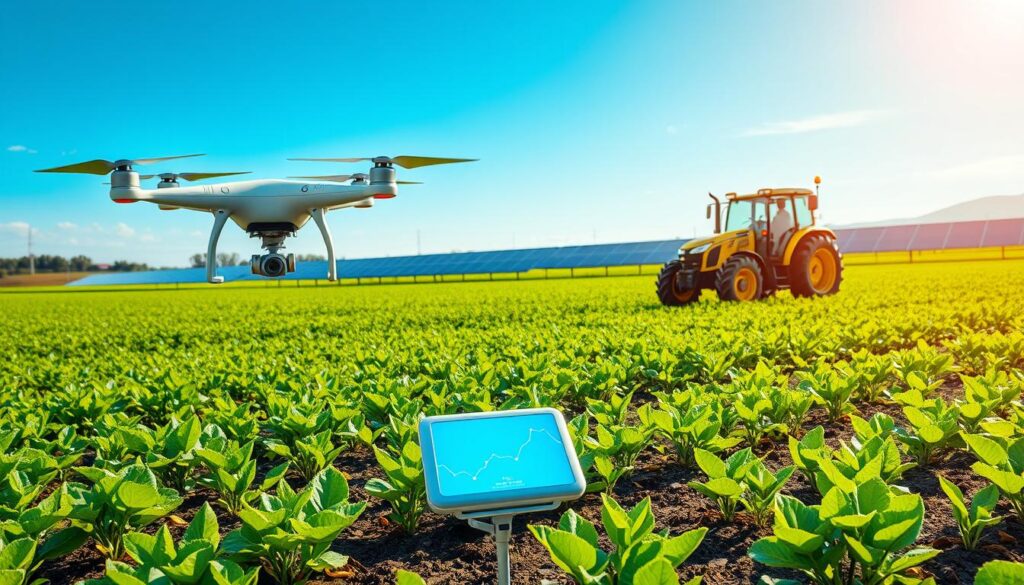
Drones are like the eyes in the sky for farmers. They capture detailed images of crops. It’s like having X-ray vision for your farm.
Autonomous machinery works all day, every day. It’s like having self-driving tractors and harvesters. They work without breaks or complaints.
Biotechnology has created crops that grow easily. They resist drought, pests, and grow more than before. It’s amazing.
Blockchain technology tracks food from seed to store. It’s very transparent. It’s like having a notary public for your lettuce.
Vertical farming grows produce indoors in layers. It uses 95% less water than traditional farming. It’s like farming in a skyscraper.
Yield monitors collect harvest data with excitement. They measure moisture content and yield variations. It’s like having an overachieving intern.
Advanced cameras and sensors watch plant health closely. They detect stress, disease, and nutrient deficiencies early. It’s like having a helicopter parent for plants.
GIS software turns data into useful insights. It’s like having a crystal ball that works. It doesn’t need psychic abilities.
The beauty of these smart farming devices is their results. They increase yields, reduce waste, and manage resources better.
Farmers using these technologies save money and help the environment. It’s a win-win situation. Profitability and sustainability go hand in hand.
This change in agriculture is huge. It’s the biggest since the invention of the plow. Farmers using smart farming devices are shaping the future of food production.
Sensors & Drones in the Field
Drone technology has advanced beyond just Amazon deliveries and neighborhood annoyances. Today, we see sophisticated aerial systems that rival James Bond’s gadgets.
Modern agricultural drones are not toys. They have multispectral cameras that detect plant stress before we can see it. It’s like having X-ray vision for crops, spotting nutrient deficiencies with precision.
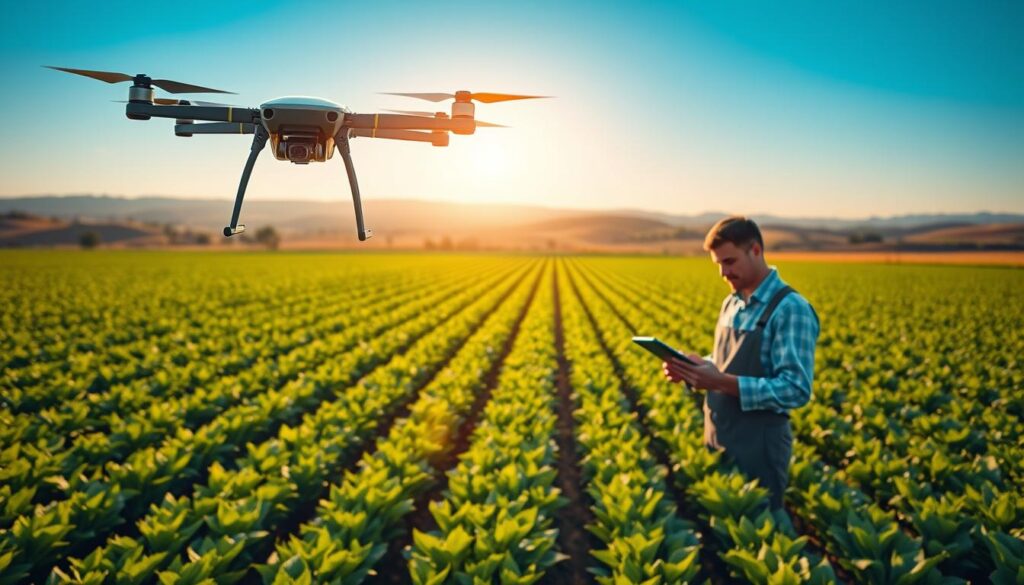
Drones with thermal imaging can find irrigation issues before plants show stress. Multispectral cameras show chlorophyll levels and plant health that’s invisible to us. It’s like agricultural espionage.
Drone precision spraying targets specific trouble spots, not the whole field. This method is not just efficient but revolutionary. Farmers see pesticide reductions up to 20% and yield increases of 10-20%.
But drones are just the beginning. Ground-based sensors on machinery collect data with amazing accuracy. They measure soil moisture and temperature variations.
This isn’t a future dream. It’s happening now in American farmlands. Drones and ground sensors work together 24/7, without breaks or health insurance demands.
The monitoring doesn’t stop at drones. We have an entire ecosystem of technologies:
| Technology | Resolution | Cost Efficiency | Best For | Real-time Capability |
|---|---|---|---|---|
| Agricultural Drones | Very High (cm level) | High | Small to medium fields | Excellent |
| Manned Aircraft | High (meter level) | Medium | Large acreage | Good (scheduled) |
| Satellites | Medium to Low | Low (subscription) | Regional monitoring | Limited (orbital) |
| Ground Sensors | Ultra High (mm level) | Variable | Micro-climate data | Continuous |
This multi-layered approach is at the forefront of agtech trends. Drones offer an aerial view, while ground sensors provide detailed data. It’s like having satellite imagery and street view for crops.
The economic impact is huge. Early disease detection solves problems before they become big issues. Precision application means chemicals are used where needed. Yield optimization means more food from the same land.
These agtech trends are turning farming into a science. The data shows that farmers who use these technologies get great returns. It’s like they’re beating Wall Street.
It’s not just about growing more food. It’s about smarter farming. Using less chemicals is better for the environment. Precise application saves money. Comprehensive monitoring leads to better decisions.
The future of farming is here, flying overhead and digging into the soil. These technologies are the most exciting agtech trends of our time, and they’re just beginning.
Data Platforms
Ever tried drinking from a firehose? That’s what modern farming data feels like without the right platform. Sensors, drones, and satellites send out a lot of information. Without proper data platforms, you’re just collecting digital clutter.
Enter Farmonaut – the Marie Kondo of agricultural data. This platform doesn’t just collect information; it sparks joy by turning chaos into clarity. Their satellite monitoring system tracks crop health with precision that would make Google Maps jealous. The AI-driven advisory service, Jeevn AI, serves up recommendations more personalized than your Spotify playlist.
The real game-changer? Blockchain traceability that lets you track a carrot from seed to supermarket. Suddenly, “farm to table” isn’t just a restaurant slogan – it’s verifiable reality. Fleet management tools coordinate equipment like a symphony conductor, while carbon footprinting helps farmers become environmental heroes.
These platforms create what experts call management zones – digital maps that tell you exactly where to plant, water, and harvest. It’s like having GPS for your farming decisions. Prescription applications become surgical strikes instead of blanket bombing.
API integration is the secret sauce that makes everything work together. Your tractor talks to your weather app, which chats with your soil sensors, creating a seamless flow of information. It’s the agricultural equivalent of the Avengers assembling – each piece powerful alone, but unstoppable together.
| Platform Feature | Traditional Farming | Precision Ag Platform |
|---|---|---|
| Data Collection | Manual notes, guesswork | Automated real-time monitoring |
| Decision Making | Seasonal intuition | AI-powered recommendations |
| Traceability | Paper records | Blockchain verification |
| Resource Management | Uniform application | Prescription zoning |
The beauty of modern precision ag platforms isn’t just in the fancy features. It’s in how they transform overwhelming data into actionable insights. Farmers stop worrying about information overload and start making decisions backed by concrete evidence.
These systems create digital twins of entire operations. You can simulate drought conditions, test fertilizer strategies, or practice pest control – all without risking a single crop. It’s like having a farm simulator that uses real-world data instead of guesswork.
The bottom line? Data platforms are the brains behind the precision ag revolution. They turn farmers from data collectors into strategic decision-makers. In an industry where margins are thinner than newspaper, that intelligence isn’t just convenient – it’s essential for survival.
ROI Case Studies
Let’s talk about the only metric that truly matters in agriculture: the return on investment. All these smart farming devices could win design awards. But if they don’t pay for themselves, they’re just expensive lawn ornaments.
The numbers tell a story more compelling than a late-night infomercial. We’re seeing yield increases that would make tech stocks jealous. And cost savings that actually justify the initial investment.
Michigan State researchers uncovered something fascinating: 24% of the state’s farmland consistently underperforms. That’s not just poor soil – that’s money being literally buried through wasted inputs. Farmers using precision technology to identify these zones are seeing returns that would make Warren Buffett nod approvingly.
It’s the difference between spraying fertilizer like you’re seasoning popcorn and applying it with the precision of a Michelin-star chef. The ROI isn’t just in immediate savings – it’s in long-term sustainability and reduced environmental impact.
| Technology | Yield Increase | Cost Savings |
|---|---|---|
| Precision Agriculture | 20-30% | 15-25% |
| AI Systems | 15-25% | 10-20% |
| Drone Technology | 10-20% | 8-15% |
| Autonomous Machinery | 15-30% | 15-35% |
These numbers aren’t theoretical. Real farmers using smart farming devices are reporting transformational results. One Midwest operation cut fertilizer costs by 22% while increasing yields by 28% – that’s not just efficiency, that’s agricultural alchemy.
The beauty of these systems? They pay for themselves faster than most equipment upgrades. While your grandfather’s tractor might last decades, today’s smart farming devices generate enough savings to cover their cost within 2-3 growing seasons.
It’s not just about doing things better – it’s about not going broke trying to farm the same way your great-grandfather did. The data doesn’t lie: smart technology is the difference between struggling and thriving in modern agriculture.
Next-Gen Equipment
Forget about self-driving cars. The real excitement is in farming, where driverless tractors and robotic harvesters are changing the game. These machines cut labor costs and reduce emissions by 10-20%. They offer savings that make old methods seem outdated.
By 2025, over 60% of large farms will use these advanced tools. DigiFarm VBN’s RTK correction services make precision farming a reality. Hexagon’s digital reality solutions create systems that are incredibly smart.
This move from manual to automated farming is thrilling. It combines farming with sci-fi, bringing real benefits to farmers. The future of farming is already here, and it’s all about being autonomous.