The U.S. Department of Agriculture is putting $180 million behind a new Seed Sovereignty Initiative that could change how American researchers find, characterize and use genetic traits hidden inside the country’s vast plant collections.
Agriculture Secretary Brooke Rollins announced the initiative on October 6, 2026, in Prairie City, Iowa, describing the investment as an effort to strengthen U.S. agricultural security while creating new opportunities for crop innovation. The program will provide funding to USDA’s Agricultural Research Service (ARS) National Plant Germplasm System, which holds more than 600,000 accessions representing over 16,000 plant species.
Over the next two years, USDA plans to characterize and sequence numerous collections of major crops and apply advanced technologies, including artificial intelligence, to identify valuable traits. The goal is to move genetic resources from long-term preservation into more active use by researchers and plant breeders.
That shift could matter across U.S. agriculture because the genetic material stored in the national collection contains traits associated with drought tolerance, disease resistance, pest resistance, yield stability and nutritional characteristics.
USDA Is Turning A Seed Collection Into A Breeding Resource
The National Plant Germplasm System is much larger than a conventional seed bank.
USDA describes it as a national network preserving genetic resources in the form of seeds, clones, budwood, pollen and other plant material. The system operates across numerous locations and provides material to researchers, educators and plant breeders. USDA ARS research indicates that the NPGS conserves more than 620,000 accessions representing more than 16,700 species, with more than 200,000 samples distributed annually for research, breeding and education.
The October announcement places new emphasis on the information contained within those collections.
A seed sitting inside a freezer has limited immediate value if researchers do not know which genetic traits it contains. Sequencing changes that equation by giving scientists a detailed genetic map that can be connected to observable characteristics.
That creates the possibility of finding useful genetic material without having to test every accession through years of conventional field breeding.
USDA has already demonstrated the potential of this approach. ARS researchers in Fort Collins, Colorado, developed artificial-intelligence tools capable of using genetic sequences to identify plants likely to contain specific agronomic traits. The technology was developed partly to solve the problem of searching enormous genetic collections for relatively rare traits.
The new funding gives that concept a much larger national platform.
Sequencing Could Shorten The Search For Valuable Traits
Traditional plant breeding can require years of crossing, field evaluation and selection.
Researchers first need to identify plants containing useful genetic variation. They then need to determine whether the trait is heritable, whether it affects yield or quality and whether it can be transferred into commercially useful varieties without introducing undesirable characteristics.
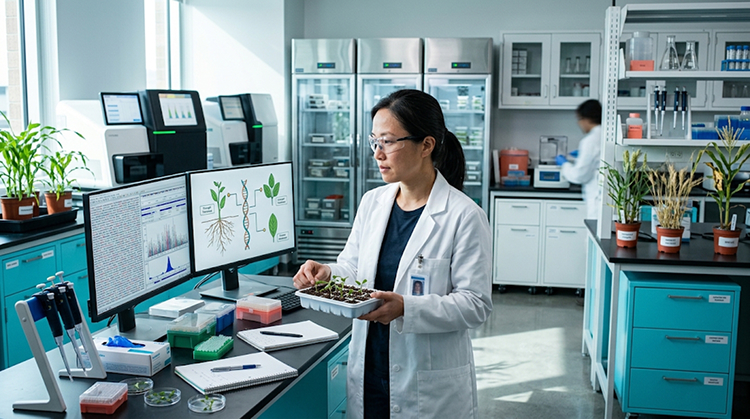
Genomic sequencing can move some of that work earlier in the process.
Instead of relying exclusively on visible plant characteristics, breeders can use DNA information to identify genetic differences before committing extensive field resources to individual plants.
That becomes particularly valuable when the desired trait is difficult to observe.
A plant may carry genetic variation associated with drought tolerance or disease resistance without showing a dramatic difference under normal growing conditions. Genetic information can help researchers identify those candidates before environmental stress reveals the difference.
USDA’s existing research portfolio already includes projects using advanced sequencing, computational biology and AI to identify genetic variation. ARS researchers have also developed tools for analyzing large genetic datasets and identifying candidate plants for breeding programs.
The $180 million initiative could expand that approach across more of the national collection.
Iowa Is Already A Major Center For U.S. Germplasm Research
The announcement in Iowa was strategically significant because the state already plays an important role in the National Plant Germplasm System.
The North Central Regional Plant Introduction Station in Ames is a joint operation involving USDA-ARS, Iowa State University and agricultural experiment stations from 12 North Central states.
The facility was established in 1948 and sits on approximately 120 acres of Iowa State University agricultural research land. It maintains seed-storage facilities, laboratories, greenhouses and equipment used for seed regeneration and research.
The Ames operation also provides researchers with access to genetic material through the USDA’s Germplasm Resources Information Network.
That infrastructure matters because sequencing is only useful if genetic resources remain viable, properly identified and accessible.
USDA research at Ames shows that maintaining these collections requires continuous regeneration of seed lots, viability testing, inventory management and accurate genetic information. When seed inventories fall below viability or quantity thresholds, accessions can become unavailable until they are regenerated.
The new investment therefore addresses more than DNA sequencing.
It strengthens the information infrastructure surrounding the genetic material.
The Genetic Collection Could Become More Valuable As Climate Risks Increase
The timing of the investment also reflects a growing need for crop varieties capable of performing under difficult environmental conditions.
Drought, heat, disease and pest pressure can all reduce yields, but breeding programs need genetic variation to respond to those challenges.
A narrow genetic base limits the number of options available to breeders.
The NPGS exists partly to preserve that diversity. Its collections include cultivated crops and wild relatives that can contain traits lost from modern commercial varieties.
USDA’s strategic germplasm plan specifically calls for maintaining disease-free and backed-up germplasm, improving knowledge of valuable traits and acquiring or developing genetic resources with useful characteristics.
The practical value can emerge years after a collection is acquired.
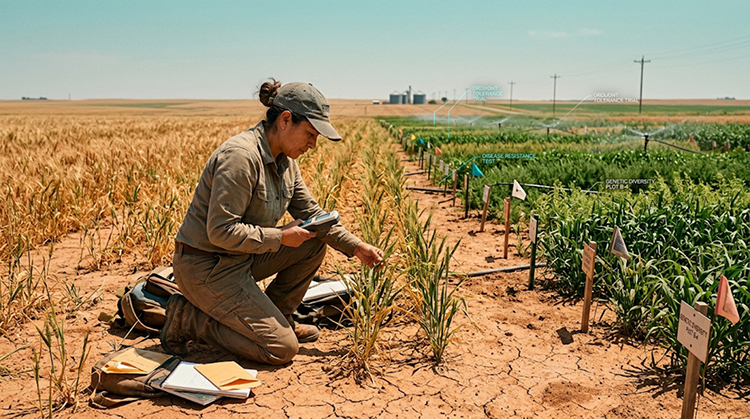
A plant collected decades ago may contain a resistance gene that becomes highly valuable after a new pathogen appears. A wild relative may contain drought tolerance that becomes useful as production conditions change.
Sequencing makes it easier to find those resources before the agricultural problem becomes severe.
AI Could Become The Bridge Between Genetic Data And Breeding
The biggest technological opportunity may come from combining sequencing with artificial intelligence.
The volume of genetic information generated by modern sequencing can become too large for conventional manual analysis. AI systems can examine relationships among genetic sequences, physical traits, environmental conditions and breeding outcomes.
USDA ARS has already been using AI in this area.
One ARS project describes the use of AI to analyze complete genetic sequences and identify plants with genetic differences associated with important agronomic characteristics. The objective is to reduce the time and cost involved in searching large genetic collections.
Another USDA research effort is applying advanced computational methods to genome assemblies, variation analysis, functional genomics and germplasm characterization to create resources that can support crop improvement.
The Seed Sovereignty Initiative could therefore accelerate an existing transition in crop science.
The gene bank is becoming a data bank.
Seed Prices Add Another Economic Dimension
The initiative arrives while farmers are also dealing with higher seed costs and a concentrated seed market.
USDA’s Economic Research Service found that average prices paid by farmers for crop seed increased 270% between 1990 and 2020, while the crop commodity price index increased 56% over the same period.
For crops predominantly planted with genetically modified seed, including corn, soybeans and cotton, seed prices increased 463% over that period.
Those price increases reflect more than market concentration. USDA researchers have also documented significant productivity gains from improved seed technologies, including traits that can reduce insecticide applications, mechanical weed control and other production costs.
The economic question is therefore more complicated than simply asking whether seed prices are high.
Farmers are paying for genetics that can deliver measurable agronomic benefits, but higher prices also affect production budgets and the economics of adopting new varieties.
The new federal investment could influence that equation if publicly supported genetic resources create additional opportunities for independent breeding programs and seed companies.
Two Companies Have Dominated Major U.S. Seed Markets
USDA research shows how concentrated some major crop-seed markets have become.
Between 2018 and 2020, Bayer and Corteva accounted for 72% of planted U.S. corn acres and 66% of planted soybean acres, according to USDA ERS estimates.
USDA also found that the two companies accounted for more than half of U.S. retail seed sales for corn, soybeans and cotton during that period.
That concentration developed alongside major investments in biotechnology, intellectual-property protection and crop research. Higher potential returns encouraged companies to spend heavily on research and development, helping produce new varieties and traits while also increasing market power.
The Seed Sovereignty Initiative does not eliminate that private-sector structure.
Instead, it could strengthen the public genetic resource base available to breeders.
That distinction is important. USDA Chief Scientist Dr. Scott Hutchins said the public sector intends to make genetic information available to U.S. companies on a licensing basis that is not exclusive, potentially giving multiple breeders access to the same underlying public resources.
USDA And DOJ Are Also Targeting Seed-Market Competition
The $180 million announcement came alongside a separate move involving seed-market competition.
On October 6, the USDA and U.S. Department of Justice announced an expanded Memorandum of Understanding covering competition in agricultural inputs, including seed, fertilizer, fuel, equipment, pesticides and feed.
Attorney General Todd Blanche and Secretary Rollins signed the amended agreement on October 5. The agencies said the partnership will expand cooperation on identifying and addressing potentially anticompetitive conduct affecting agricultural inputs.
Seeds receive particular attention under the agreement.
The move means USDA’s seed strategy has two parallel components: increasing the supply of public genetic information while examining competitive conditions in the commercial seed marketplace.
That combination could become more significant for independent breeders.
A breeder needs access to useful genetics, but also needs a market in which new varieties can reach farmers. Public germplasm can address part of the first problem. Competition policy addresses part of the second.
Public Genetics Could Give Smaller Breeders More Options
The potential effect on smaller seed companies may be one of the most important long-term outcomes.
Large companies have substantial research budgets and established distribution networks. Smaller breeders can face greater difficulty obtaining useful genetic material, conducting extensive trials and bringing varieties to market.
A stronger public germplasm system can reduce one barrier.
USDA already distributes germplasm to qualified researchers and breeding programs. The Ames facility, for example, provides access to genetic material through the NPGS and its associated information systems.
If sequencing identifies valuable traits more efficiently, breeders could spend less time searching for useful material and more time developing varieties suited to specific markets.
That could be particularly important for crops and regions that receive less private-sector breeding investment.
Public breeding programs can focus on traits that may be valuable to farmers but do not offer the same commercial returns as traits serving the largest acreage markets.
The Initiative Could Improve Disease And Pest Response
Disease resistance represents another major potential benefit.
Plant pathogens can evolve faster than commercial varieties can be replaced. Once a disease becomes established, breeders need resistance genes that can be incorporated into new varieties.
The NPGS contains genetic material from crop relatives and older varieties that may carry resistance traits no longer common in modern commercial lines.
USDA says the new initiative will use sequencing and AI to identify valuable traits that can help researchers respond more quickly to emerging pests and diseases.
That does not mean a resistant variety will appear immediately after a disease is discovered.
Breeding still requires crossing, selection, testing and regulatory or commercial development where applicable.
But a better map of genetic resources can improve the starting point.
For farmers, that could eventually mean varieties with better resistance that reduce crop losses and the need for chemical controls.
The Initiative Also Has A National-Security Dimension
USDA is framing the program as agricultural security as well as crop science.
The department argues that genetic resources are strategic assets because countries and private companies around the world are investing in the collection and sequencing of plant genetics.
The concern is that the United States could possess enormous genetic resources but fail to fully understand their value.
That creates a different kind of vulnerability.
A physical seed collection can protect genetic diversity, but genetic information determines how quickly researchers can locate and use that diversity.
USDA Deputy Secretary Stephen Vaden described the genetic resources as a strategic national asset and said the agency needs to identify vulnerabilities in domestic agricultural resources.
The policy therefore connects crop breeding with supply-chain security.
Seeds are one of the first inputs farmers need each planting season. If access to important genetics becomes constrained, the effects could eventually reach crop yields, input costs and food production.
Farmers Will Not See The $180 Million As Immediate Seed Savings
There is an important limitation to the initiative.
The $180 million investment is primarily aimed at genetic-resource preservation, characterization and research. It is not a direct payment program that will reduce a farmer’s seed bill for the 2027 planting season.
The economic benefits will take time.
Researchers need to sequence collections, identify useful traits, validate those traits and make the information available to breeding programs. Breeders then need to incorporate the genetics into commercially useful varieties and test those varieties across different environments.
That process can take multiple growing seasons.
The near-term impact is therefore likely to be concentrated in research institutions, USDA facilities, universities and breeding programs rather than on farm balance sheets.
The longer-term potential is much larger.
Precision Agriculture Could Benefit From Better Genetics
Genetics and precision agriculture are increasingly connected.
Precision farming can measure where crops perform well or poorly across a field, while improved genetics can determine how plants respond to soil, weather, disease and management conditions.
A variety with better drought tolerance may perform differently across soil zones. A disease-resistant variety may provide greater value in fields with a history of specific pathogens.
Better genetic information could eventually help breeders create varieties targeted toward these conditions.
That makes crop genetic research an important complement to precision-agriculture systems. Field-level data can identify where performance problems occur, while genetic research can help explain why plants respond differently.
The combination could lead to varieties developed for more specific production environments rather than broad national averages.
The U.S. Seed Industry Is Entering A New Research Phase
The $180 million initiative represents a shift in how USDA approaches genetic resources.
For decades, the National Plant Germplasm System has primarily served as a preservation and distribution network. Its collections have protected genetic diversity that breeders could request when needed.
The new initiative places greater emphasis on knowing what is inside those collections before the next agricultural challenge arrives.
That means sequencing, AI, computational biology and genetic characterization become part of the value of the collection itself.
The result could be a faster pipeline from genetic resource to useful trait to breeding program to commercial variety.
That pipeline will not replace private seed companies or conventional breeding. Instead, it could give researchers and breeders a much larger and better-characterized pool of genetic material from which to work.
For American farmers, the eventual value could appear in varieties that withstand drought better, resist emerging diseases, maintain yields under stress or require fewer costly inputs.
$180 Million Could Create A Long-Term Advantage For U.S. Agriculture
USDA’s Seed Sovereignty Initiative is much larger than a seed-storage project.
The $180 million investment announced October 6 is intended to turn more than 600,000 plant accessions into a better-understood source of genetic information. Over two years, USDA plans to sequence major crop collections, identify valuable traits and use AI and other technologies to accelerate discovery.
At the same time, the USDA-DOJ partnership is placing greater attention on competition in the seed market.
Those two efforts address different parts of the same agricultural system.
One focuses on the genetic resources available for future crop improvement. The other focuses on the commercial market through which farmers obtain seed and other inputs.
The payoff will not arrive with a single harvest.
It will come if researchers can turn previously underused genetic diversity into varieties that perform better under drought, disease, pests and changing production conditions—and if those varieties can reach farmers through a competitive seed market.
For U.S. agriculture, the most important outcome of the new initiative may therefore be measured years from now, when a seed preserved decades ago becomes the genetic starting point for a crop designed for the next generation of American farms.