The U.S. Department of Agriculture (USDA) announced an $8 billion Harvest Fuel Relief Program on October 19, 2026, offering one-time payments intended to help American farmers manage elevated fuel expenses, higher production costs, and difficult agricultural market conditions. President Donald Trump and Agriculture Secretary Brooke L. Rollins announced the initiative as producers across the country work through the 2026 harvest season.
The program arrives at a financially sensitive point for U.S. agriculture. Farmers must pay for diesel, fertilizer, seed, equipment, grain transportation, and seasonal labor while managing crop prices and debt obligations. Higher operating expenses can reduce the revenue left after harvest, particularly for producers who purchased inputs before knowing their final yields or market prices.
According to the USDA’s official Harvest Fuel Relief announcement, the initiative will provide proportional assistance based on modeled losses during the 2026 crop year. The Farm Service Agency (FSA) will administer payments using a formula incorporating reported planted acreage, production-cost estimates, and USDA yield and price data.
The $8 billion allocation could provide meaningful short-term liquidity for eligible operations. However, its practical value will depend on the final payment rates, producer eligibility requirements, application procedures, and the extent to which individual farms’ expenses exceed their available revenue.
Why USDA Introduced the $8 Billion Harvest Fuel Relief Program
The October announcement reflects mounting pressure on farm operating budgets. Diesel powers tractors, combines, grain dryers, irrigation equipment, and trucks that transport harvested crops. A sustained increase in fuel prices can affect several stages of production, creating costs that extend beyond the fuel purchased directly for fieldwork.
Farmers also face expenses that interact with energy prices. Fertilizer manufacturing and transportation require substantial energy, while grain hauling and drying can add costs after crops leave the field. Even operations that produce strong yields may experience weaker margins if input expenses rise faster than commodity revenue.
Reuters reported on October 20 that the Trump administration intends to use the new program to offset part of the financial pressure associated with higher diesel costs during harvest. The announcement followed an executive order earlier in October that expanded access to tax-exempt dyed diesel for certain uses.
The Reuters report on the program also places the initiative within a broader federal response to agricultural financial pressures. The new funding is intended to provide one-time payments rather than establish a permanent subsidy for fuel purchases.
That distinction matters for farm planning. A temporary payment can help cover outstanding operating expenses, replenish cash reserves, or reduce short-term borrowing. It does not guarantee that fuel prices will fall or that farm profitability will improve over several growing seasons.
How USDA Plans to Calculate Farmer Payments
The USDA says the Harvest Fuel Relief Program will use a uniform formula to distribute proportional support based on a portion of modeled losses during the 2026 crop year. The calculation will draw on three principal information sources.
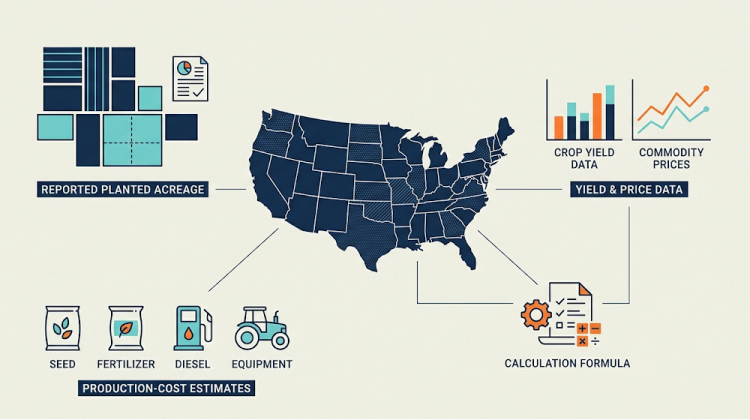
First, the FSA’s reported planted-acreage data will help establish the production base used in the formula. Acreage is relevant because larger crop operations often have greater total exposure to fuel, fertilizer, machinery, and transportation expenses. However, acreage alone does not establish a producer’s actual profit or loss.
Second, the USDA’s Economic Research Service (ERS) supplies cost-of-production estimates. These estimates help represent the expenses associated with producing different agricultural commodities. They are useful for national and commodity-level analysis, although an individual farm’s costs can differ considerably because of geography, soil conditions, equipment, labor arrangements, and input purchasing decisions.
Third, USDA’s World Agricultural Supply and Demand Estimates (WASDE) provide yield and price information. These figures help establish a consistent framework for estimating agricultural revenue and production conditions.
The agency has not yet published the final commodity-specific payment rates. According to the USDA announcement, rates for Title I commodities are expected in November 2026. Payment methodology for other eligible commodities will be announced later.
This means farmers should avoid treating the $8 billion headline as a fixed payment pool divided equally among producers. Actual assistance will depend on the eventual formula and the eligible production categories.
Which Crops and Agricultural Businesses Could Benefit?
The program is expected to cover Title I commodities, including major field crops such as corn, soybeans, wheat, sorghum, barley, oats, and other oilseeds. These crops occupy substantial acreage across the United States and have different production-cost structures, making commodity-specific rates an important part of the forthcoming guidance.
Corn producers may face significant fuel exposure during planting, spraying, harvesting, grain drying, and transportation. Soybean growers also rely on diesel-powered machinery throughout the production cycle, while wheat producers may experience different cost patterns depending on regional climate, harvest timing, and transportation distances.
The effects will vary across agricultural regions. Producers in the Midwest may have different expenses from growers in the Great Plains, where field sizes and hauling distances can influence fuel consumption. Irrigated farms may have additional energy requirements, while specialty-crop operations can have different labor, refrigeration, packaging, and distribution costs.
The USDA has also invited producers of non-Title I commodities, including specialty-crop growers and fishermen, to submit information about increased fuel expenses for consideration when payment rates are determined. The agency listed HarvestFuel@usda.gov as the contact for those submissions.
That invitation does not establish a guaranteed payment amount or confirm that every specialty crop or fishing operation will qualify. Producers should wait for the relevant eligibility and payment-methodology guidance before including anticipated assistance in their budgets.
What the Program Could Mean for Farm Cash Flow
Cash flow is often more urgent than annual profitability for agricultural businesses. Farms may own productive land and equipment yet still experience periods when bills fall due before crop revenue arrives. Harvest Fuel Relief payments could help eligible producers manage this timing gap.
A farm might use an eventual payment to cover diesel invoices, settle part of a fertilizer account, pay a machinery repair bill, or reduce a line-of-credit balance. Lower outstanding borrowing can also reduce future interest expenses, depending on the loan terms and the amount repaid.
Consider a hypothetical farm that receives a $20,000 payment. If the producer uses $12,000 to settle outstanding operating expenses and applies $8,000 toward a revolving credit balance, the payment could reduce immediate liabilities and preserve some future borrowing capacity. This is an illustration, not a forecast of actual program payments.
The potential benefit will be different for each operation. A farm with substantial unpaid input bills may use the assistance immediately, while a producer with stronger cash reserves could retain part of the payment for winter maintenance, seed purchases, or next season’s fertilizer.
Farmers should incorporate confirmed payments into their financial records only after the amount and timing are established. Until then, farm operating decisions should account for the possibility that federal assistance may arrive later than anticipated or cover a smaller portion of expenses than expected.

How Harvest Fuel Relief Compares With Earlier Federal Assistance
The new program follows another major round of agricultural support earlier in 2026. USDA reported that its Farmer Bridge Assistance program delivered $12 billion in one-time payments to more than 560,000 farmers across the country.
The department also announced approximately $13.8 billion in gross payments through the Agriculture Risk Coverage (ARC) and Price Loss Coverage (PLC) programs for the 2025 crop year. Those payments address different aspects of agricultural risk and should not be confused with Harvest Fuel Relief.
| Federal program | Announced or reported amount | Primary purpose |
|---|---|---|
| Harvest Fuel Relief | $8 billion | One-time support for a portion of modeled 2026 crop-year losses |
| Farmer Bridge Assistance | $12 billion | One-time assistance for eligible producers |
| ARC and PLC payments | Approximately $13.8 billion gross | Revenue and price safety-net support for the 2025 crop year |
Sources: USDA Harvest Fuel Relief announcement and USDA Farm Service Agency news.
These amounts describe separate programs and payment purposes. They should not be added together and interpreted as the amount any particular farmer can receive. Eligibility rules, covered crop years, payment calculations, and other program requirements differ.
For agricultural lenders and farm accountants, the distinction is especially important. Federal support may improve a producer’s liquidity, but lenders still need to evaluate operating costs, debt service, crop revenue, collateral, and the timing of incoming funds.
What Farmers Should Do Before Applications Open
USDA has encouraged eligible producers to create a Login.gov account in advance of the application-period announcement. Producers who link that account to USDA will be able to access pre-filled applications online, according to the department.
Preparing early can reduce administrative delays when applications become available. Farmers should review their FSA records, confirm that planted-acreage information is accurate, and check that their contact details and account access remain current.
Producers should also maintain organized records of fuel purchases, production expenses, crop sales, and financing obligations. Although the program’s announced formula relies on USDA and FSA data, accurate farm records remain useful for financial management and for resolving potential discrepancies.
A practical preparation checklist includes:
- Confirm access to Login.gov and the relevant USDA online services.
- Review FSA acreage and producer records for accuracy.
- Organize operating-cost, crop-production, and sales documentation.
- Monitor official USDA announcements for payment rates, eligibility details, and application dates.
- Avoid committing anticipated assistance to new expenses before payment amounts and timing are confirmed.
Farmers should rely on official USDA and FSA communications for final program requirements. The announcement does not yet establish a universal payment amount, and the precise application window remains a key outstanding detail.
Why the November Payment Rates Matter
The release of commodity-specific rates in November should provide the next important information for producers. Those figures will help farmers assess how much of their expected financial pressure the program may offset and whether the assistance is large enough to change near-term borrowing or purchasing decisions.
The distribution formula will also influence how support varies across crop types. A producer’s acreage, the modeled costs associated with the relevant commodity, and USDA yield and price estimates will all matter to the calculation described by the agency. The final guidance will be necessary before individual operations can estimate a payment with confidence.
The $8 billion program offers a potential source of short-term relief during a costly harvest, but it cannot resolve every financial challenge facing American agriculture. Commodity-price weakness, elevated input expenses, interest costs, and unpredictable weather can continue to affect farm margins after a one-time payment is received.
For now, the most useful approach is to prepare records, verify USDA account access, and build conservative budgets that do not depend on unconfirmed assistance. Once the November rates and application details are available, producers will be better positioned to determine how Harvest Fuel Relief fits into their remaining 2026 obligations and plans for the 2027 growing season.