U.S. ammonia prices have climbed sharply in recent months as declining supplies from Trinidad and Tobago collide with a tight global fertilizer market, creating another cost challenge for American farmers preparing for the 2027 growing season.
Midwest ammonia prices rose from approximately $600 per short ton in late June to about $800 by early October, before reaching roughly $875 per short ton by November 2, according to fertilizer analyst Justin Ratcliff of CRU. That represents an increase of more than 45% in just over four months.
The increase is particularly significant because ammonia is the primary building block for nitrogen fertilizers used throughout American agriculture. Corn producers are especially exposed because nitrogen is one of the most important nutrient inputs for achieving strong yields.
The supply problem is closely connected to Trinidad and Tobago, the second-largest source of ammonia imported by the United States after Canada. U.S. ammonia imports from Trinidad have fallen approximately 34% in 2026, according to Veronica Nigh, chief economist at The Fertilizer Institute.
At the same time, Nutrien announced in October that it would indefinitely shut down its nitrogen operations at the Point Lisas facility in Trinidad because of continuing natural-gas constraints and uncertainty. The combination has left American buyers with fewer international tons available just as seasonal fertilizer demand increases.
Why Ammonia Prices Have Climbed So Quickly
Ammonia pricing is closely connected to the cost and availability of natural gas because natural gas is a major feedstock used to manufacture nitrogen fertilizer.
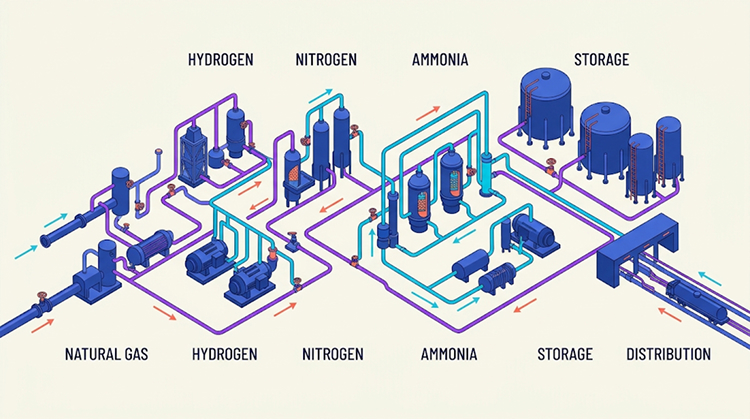
That relationship makes the Trinidadian supply problem especially important. Trinidad and Tobago has historically been a major fertilizer producer because of its natural-gas resources, but declining gas production has reduced the country’s ability to maintain previous output levels.
Reuters reported that Trinidad’s gas production has been affected by aging fields and limited new discoveries. Access to Venezuelan gas has also been complicated by U.S. sanctions and geopolitical developments. Those constraints have reduced the amount of natural gas available to fertilizer manufacturers.
The result is a supply chain in which disruption at the production stage can eventually affect farmers thousands of miles away.
Much of the anhydrous ammonia imported from Trinidad enters the United States through the Gulf of Mexico before moving by barge along the U.S. river system. Josh Linville, vice president of fertilizers at StoneX, told Reuters that the loss of supply from one major source can ripple through the broader fertilizer market when global availability is already tight.
That logistics network is particularly important for growers in the Midwest. Fertilizer does not simply move directly from an overseas production plant to a farm. It must pass through ports, terminals, pipelines, rail networks, barges, storage facilities, and agricultural retailers before reaching fields.
When one source loses production, replacing those tons requires both additional supply and sufficient transportation capacity.
Nutrien’s Trinidad Shutdown Adds Another Supply Constraint
The Trinidad situation became more serious in October when Nutrien announced an indefinite shutdown of its nitrogen operations at the Point Lisas facility.
Nutrien announced the decision on October 5, 2026, saying continuing natural-gas constraints and uncertainty made the shutdown the best option following an extensive review. The company had previously carried out a controlled shutdown of the facility on October 23, 2025, after facing port-access restrictions and unreliable and uneconomic natural-gas supplies.
Nutrien also said the shutdown would have no impact on its 2026 nitrogen sales-volume guidance because its projections had already assumed no production from the Trinidad operation.
That distinction is important. The company has North American production assets capable of supplying customers, but the loss of Trinidad production still removes potential supply from an already tight international market.
For the U.S. market, the timing is difficult.
Farmers are applying or purchasing fertilizer for fall fieldwork in major corn-producing states. At the same time, growers are beginning to calculate their input budgets for the next planting season.
If replacement supplies are unavailable or significantly more expensive, the higher cost can move through the entire agricultural chain.
U.S. Farmers Are Already Paying More for Nitrogen
The increase in wholesale and regional ammonia prices is reflected in retail fertilizer markets.
DTN’s fertilizer surveys showed an average U.S. retail price of approximately $987 per ton for anhydrous ammonia during the second week of October. That was about 18% higher than a year earlier. Urea averaged approximately $674 per ton, up 13% from the same period in 2025.
Other major fertilizers have also become more expensive.
| Fertilizer | Approx. October 2026 Price | Year-Over-Year Change |
|---|---|---|
| Anhydrous ammonia | $987/ton | +18% |
| Urea | $674/ton | +13% |
| UAN28 | $441/ton | +7% |
| MAP | $981/ton | +5% |
| 10-34-0 | $702/ton | +5% |
| UAN32 | $486/ton | +4% |
| Potash | $503/ton | +3% |
| DAP | $937/ton | +2% |
The numbers show that ammonia is part of a broader fertilizer-cost increase rather than an isolated price movement.
For farmers, the distinction between an ammonia price at the wholesale level and the final retail price matters. Transportation, storage, handling, application, local supply, and timing can all influence what a producer ultimately pays.
Still, the direction of the market is clear: nitrogen inputs are substantially more expensive than they were a year ago.
Corn Producers Face Particular Exposure
Corn is one of the crops most closely associated with nitrogen fertilizer demand.
Nitrogen supports plant growth and is essential for developing the crop’s leaf area and yield potential. Corn producers therefore cannot simply eliminate nitrogen applications without potentially affecting productivity.
That makes rising ammonia prices a direct concern for the U.S. Corn Belt.
Iowa, Illinois, Indiana, Ohio, Minnesota, Nebraska, and other major corn-producing states depend heavily on nitrogen fertilizer. Farmers in these states must balance expected crop prices against fertilizer, diesel, machinery, labor, land, and financing expenses.
The economics become more difficult when commodity prices do not rise alongside input costs.
A farmer may be able to absorb a temporary increase in fertilizer prices if corn prices are strong. But when fertilizer, diesel, and other operating costs rise simultaneously, the margin between revenue and production expenses becomes narrower.
Recent farmer comments demonstrate that concern.
On October 27, leaders from the Iowa Corn Growers Association, Ohio Corn & Wheat Growers Association, and Texas Corn Producers Association sent a letter to President Donald Trump asking the administration to advance a federal investigation into possible anticompetitive behavior in fertilizer markets.
The organizations said Iowa farmers had received ammonia price quotes approximately $150 per ton higher than in mid-September.
Steve Kuiper, president of the Iowa Corn Growers Association, argued that farmers need a fertilizer market that is transparent and competitive.
The concern goes beyond the current price of ammonia. Producers are questioning whether relief programs can provide meaningful assistance if fertilizer prices continue increasing at the same time.
Federal Farm Aid Is Being Tested by Higher Input Costs
The fertilizer surge comes just weeks after the Trump administration announced an $8 billion Harvest Fuel Relief program for farmers facing elevated diesel costs.
USDA has said details of the program will be provided in November, with the $8 billion payments expected in January. The administration has presented the program as a response to unusually high fuel costs affecting agricultural producers.
However, higher fertilizer costs are reducing some of the financial benefit farmers might otherwise receive from fuel assistance.
Farm groups in Iowa, Ohio, and Texas specifically warned that fertilizer prices were eroding the impact of the administration’s relief efforts. Their argument is straightforward: a farmer receiving additional financial assistance for fuel still faces a larger production bill if nitrogen fertilizer becomes substantially more expensive.
The broader cost environment is already difficult.
USDA forecasts U.S. government payments to farmers at a record $47.4 billion in 2026, according to DTN reporting. That figure includes $12 billion in Farmer Bridge Assistance and approximately $13.8 billion in Agricultural Risk Coverage and Price Loss Coverage payments.
The federal assistance can improve short-term liquidity, but it does not eliminate the underlying cost of producing a bushel of corn, soybeans, wheat, or other crops.
Why the United States Cannot Immediately Replace Trinidadian Supply
The United States has become less dependent on imported ammonia over the past decade because domestic production has expanded.
That provides an important buffer.
But domestic production is not an unlimited substitute. Newer U.S. plants have experienced operational problems, limiting the industry’s ability to replace every missing ton from Trinidad. CRU’s Justin Ratcliff told Reuters that these issues have reduced the industry’s ability to compensate for the decline in imports.
The geography of fertilizer production also matters.
USDA’s Agricultural Marketing Service expanded its Fertilizer Transportation Dashboard in August 2026 to include anhydrous ammonia pipeline rates. The new dataset covers five origins, including facilities in Louisiana, Arkansas, and Iowa, and 25 destinations, most of them in the Corn Belt.
The data highlight how important transportation is to fertilizer economics.
Large quantities of ammonia can move through pipelines, barges, railroads, and terminals, but every transportation method has capacity limitations. A supply shortage in one region can therefore create price differences elsewhere depending on how easily additional product can be delivered.
For farmers, local availability can sometimes matter as much as the national market price.
Global Fertilizer Markets Are Adding More Pressure
Trinidad is only one part of the current fertilizer supply problem.
Reuters reported that broader global fertilizer markets are also being affected by supply shocks in the Middle East. That means U.S. buyers are competing for replacement supplies in an international market where other countries are facing their own production and transportation constraints.

This creates a difficult environment for fertilizer importers.
When a major producer reduces output, buyers may turn to another supplier. But if several producing regions are constrained simultaneously, replacement becomes much more expensive.
The situation is also different from a localized shortage. Fertilizer is a globally traded commodity, so geopolitical developments, natural-gas availability, shipping routes, sanctions, tariffs, and production outages can influence prices in American farm communities.
That is why a disruption in Trinidad can eventually affect a corn producer in Iowa or Illinois.
What Higher Ammonia Prices Could Mean for 2027 Planting
The most important question for farmers is whether the current price spike will persist into the 2027 planting season.
The answer remains uncertain.
Ammonia prices could decline if additional domestic production becomes available, global supply improves, or demand weakens. Conversely, prices could remain elevated if Trinidad’s production remains constrained, international supply stays tight, or U.S. fertilizer demand remains strong.
Farmers therefore face a timing decision.
Some producers purchase fertilizer well ahead of application to lock in prices and guarantee supply. Others wait in the hope that prices will decline. Both approaches carry risk in a volatile market.
Buying early can protect against another price increase, but it also exposes farmers to the possibility of paying more than necessary if the market falls.
Waiting can produce savings if supply improves, but it can also leave growers exposed to shortages or even higher prices.
This is where farm-level planning becomes particularly important. Producers must consider expected corn and soybean prices, available storage, cash flow, fertilizer application requirements, and local supplier availability rather than relying solely on national fertilizer averages.
Competition and Domestic Production Will Remain Central
The recent fertilizer dispute has also revived questions about competition within the U.S. fertilizer industry.
The Iowa, Ohio, and Texas corn organizations are asking federal regulators to examine whether market concentration or anticompetitive practices are contributing to high prices. Their request follows a December 2025 executive order directing the Department of Justice and Federal Trade Commission to investigate potential price fixing and anticompetitive conduct in the food supply chain, including fertilizer markets.
The existence of a federal investigation or policy review would not automatically mean fertilizer companies have violated competition laws. Supply shortages, energy costs, transportation constraints, and international disruptions can also push prices higher.
That distinction will matter as regulators evaluate the market.
The long-term solution may ultimately involve several elements: additional domestic production, reliable natural-gas supplies, better transportation infrastructure, greater competition, and diversified import sources.
For farmers, diversification matters because reliance on a small number of international suppliers can leave the U.S. market vulnerable when one producer experiences an extended disruption.
The Fertilizer Market Is Becoming a Bigger Farm-Economics Story
The rise in ammonia prices demonstrates how quickly conditions outside an American farm can influence production costs in the United States.
Trinidad’s natural-gas constraints, Nutrien’s Point Lisas shutdown, global fertilizer disruptions, transportation capacity, domestic production reliability, and U.S. farm demand are all connected through the same market.
At approximately $875 per short ton, Midwest ammonia is far above the roughly $600 level recorded in late June. Retail anhydrous ammonia prices were already averaging approximately $987 per ton in DTN’s October survey, with all eight major fertilizer products tracked by the organization costing more than a year earlier.
For American farmers, the issue is therefore larger than one fertilizer product.
Higher nitrogen costs can affect planting budgets, crop profitability, cash-flow decisions, fertilizer application strategies, and eventually the economics of food and feed production.
The next several months will show whether additional U.S. production can replace declining Trinidadian supply and whether global fertilizer markets loosen enough to bring prices down. Until then, farmers entering the 2027 planning cycle have another major input cost to account for.
For producers already dealing with expensive diesel, uncertain export demand, and elevated equipment costs, the ammonia market is becoming another test of how much financial pressure their operations can absorb.