Remember when farming was all about guesswork and almanacs? Those days are quickly fading away. Now, we’re seeing a digital revolution in agriculture, with drones and advanced tech leading the charge.
The numbers are impressive. Today, precision farming is worth $11.67 billion globally. But get ready, it’s expected to soar to $24.09 billion by 2030. That’s a growth rate of 13.1%, making it a hot topic in the business world.
In North America, the trend is even stronger. Here, 43% of the market share is held. American farmers have always been quick to embrace new tech, from John Deere’s steel plow to today’s AI tractors.
The real excitement comes from combining IoT with advanced analytics. Sensors track soil moisture, drones map fields, and algorithms predict yields with amazing accuracy. It’s like Farmville, but with real results and better graphics.
This isn’t just about bigger harvests. It’s about making farming smarter and more sustainable. It’s about making agriculture fit for the 21st century.
Top Growth Areas
If agriculture had a red carpet event, hardware would be walking it with 66% of the market spotlight shining directly on it. The precision farming trends we’re seeing aren’t subtle whispers but rather headline-grabbing transformations that would make even Silicon Valley take notice.
Hardware Dominance and Technological Evolution
Hardware is the rock star of this agricultural revolution. While everyone talks about data and AI, the physical gadgets are quietly (or not so quietly) collecting 66% of all revenue. That’s not just leading the pack; that’s basically lapping everyone else.
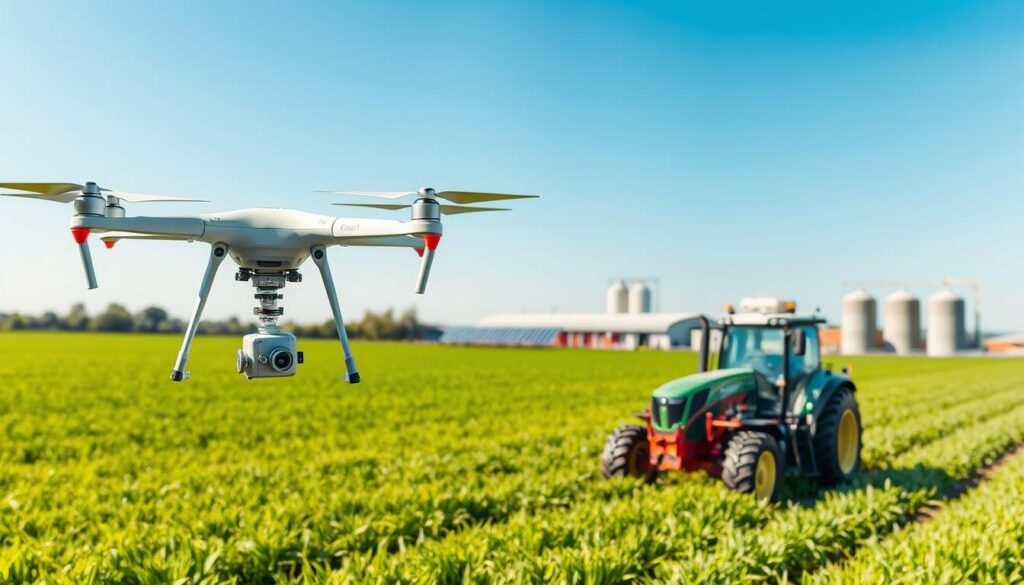
We’re talking about drones that could give Amazon’s delivery fleet performance anxiety. Sensors so advanced they probably know when a plant is thirsty before it does. And monitoring systems that make your smart home look like child’s play.
The services sector is growing at a respectable 15.7% CAGR, which basically means farmers are learning the oldest tech lesson: buying the gadget is only half the battle. Maintaining it? That’s where the real relationship begins.
Automation & Control Systems Leading the Charge
Automation systems aren’t just participating in precision farming – they’re basically the Beyoncé of the operation. Always flawless, constantly evolving, and somehow getting better with each iteration.
These systems handle everything from irrigation scheduling to fertilizer application with the precision of a neurosurgeon. They’re the reason farmers can now manage thousands of acres with the same effort it used to take to manage hundreds.
Yield monitoring applications alone command 42% of the market share. Because apparently knowing what you’re harvesting is somewhat important to the whole farming thing. It’s like having a financial dashboard for your fields – except instead of stock prices, you’re tracking bushels per acre.
| Technology Segment | Market Share 2024 | Growth Rate | Primary Applications |
|---|---|---|---|
| Automation & Control Systems | Leading segment | Highest growth | Irrigation, fertilization, planting |
| Drones/UAVs | 15% | 22% CAGR | Field mapping, crop monitoring |
| Sensing Devices | 18% | 19% CAGR | Soil analysis, moisture detection |
| Yield Monitoring | 42% | Steady growth | Harvest measurement, quality control |
| Services Segment | 34% | 15.7% CAGR | Maintenance, data analysis, support |
The current precision farming trends show hardware isn’t just winning – it’s redefining what modern agriculture looks like. From drones that map fields with photographic memory to sensors that speak plant language better than most botanists, the growth areas are both impressive and slightly intimidating.
Farmers aren’t just adopting technology; they’re building entire operations around these systems. And with hardware leading the charge, the agricultural landscape is changing faster than a Midwest weather forecast.
Investment Trends
Farmers are worried about their crops, but Wall Street and Silicon Valley are betting big on food production’s future. The money going into agtech is growing fast, like a supercrop.
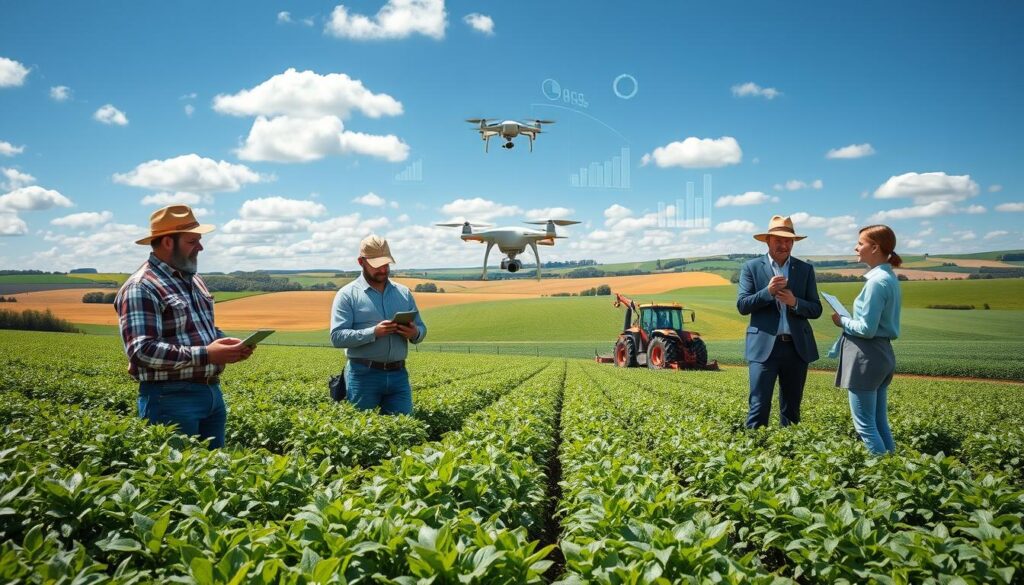
Where Smart Money Meets Smarter Farming
Forget old-school farming investments. Today’s ag news is all about tech startups. Venture capital firms are now into AI soil sensors and drone crop monitoring.
Billions are going into tech that makes farming better. It’s not just about more food. It’s about farming smarter.
Venture Capital and Corporate Acquisitions Reshaping the Landscape
Big companies are diving into precision farming. Deere & Company bought Smart Apply Inc. They know profits come from data, not just land.
AGCO and Trimble teamed up for PTx Trimble. Topcon and Bonsai Robotics are teaming up too. Tractors need AI now.
These deals are more than just business. They’re strategic moves to control how we eat. The agribusiness investment trends show tech will solve big farming problems.
VC is backing startups on water and yield. Investors see food production as key, not just another app.
The future farm will be funded by VC and built through acquisitions. It will be powered by tech that would amaze our ancestors.
Adoption Barriers
The agtech market offers exciting changes, but the journey is tough. It’s like trying to drive a combine harvester through a narrow alley. The obstacles make you wonder if the end is worth the trouble.
The High Cost of Getting Smart
Money is a big issue in agtech. Precision farming systems cost over $100,000. For small farms, this is more than they make in a year.
It’s not just a matter of upgrading. It’s like asking a family to buy a private jet when they can barely afford a commercial flight. Only big farms can afford the latest tech, leaving small ones with outdated tools.
Things get even harder. Many rural areas can’t support the tech needed for precision farming. Without fast internet, farmers can’t even access the data they need.
This creates a strange situation. Farms use advanced tech, but they can’t get online fast enough. It’s like trying to watch 4K Netflix on dial-up—it’s just not practical.
There’s also a big skills gap. Finding people who know both farming and tech is hard. Farmers worry about who gets to keep their data, too.
The agtech market is stuck in a cycle. Without better infrastructure, adoption is slow. Without more adoption, there’s less investment in infrastructure. We need a new approach to digital investment in rural areas.
Farmer Adoption Rates
If you think technology adoption follows a straight line, you’ve clearly never watched farmers try to decide which tractor to buy. The journey from early adopters to mainstream movement in agriculture looks less like a smooth curve and more like a country road after a heavy rain – full of potholes, unexpected turns, and the occasional stubborn cow refusing to move.
From Early Adopters to Mainstream Movement
Remember when only tech bros had smartphones? Precision farming is having its iPhone moment. The cool kids with the newest gadgets are now large-scale farmers who treat data like their grandfathers treated soil samples – with religious devotion.
What started as niche experimentation has become economic necessity. Farmers aren’t just adopting technology because it’s shiny. They’re doing it because it pays. Yield maps don’t lie, and neither do profit margins.
Regional Variations and Size-Based Adoption Patterns
The global adoption story reads like a high school yearbook with clear cliques and social hierarchies:
- North America sits at the popular table with the best infrastructure and government support
- Europe follows closely, driven by EU sustainability mandates that make green tech non-negotiable
- Asia-Pacific represents the fastest-growing group with 15.5% CAGR – that’s not just growth, that’s a revolution
Farm size creates another divide. Large commercial operations adopt technology like college students adopt caffeine – quickly and extensively. Smallholders watch from the sidelines, wanting to join but struggling with entry costs.
The generational gap might be the most fascinating aspect. Younger farmers who grew up with technology trust algorithms as much as their instincts. Older generations still prefer feeling the soil over reading sensor data. This tension creates a fascinating laboratory for how innovation diffuses through one of humanity’s oldest professions.
These precision farming trends show us that technology adoption isn’t just about having the tools. It’s about having the right conditions, the economic incentives, and the cultural willingness to change centuries-old practices.
What’s Next for Modern Farms
The farm of tomorrow is already taking shape. It’s not like Old MacDonald’s farm anymore. Instead, it’s more like something from a sci-fi movie. We’re moving towards farms where the most important worker might be a computer program.
The AI-Powered, Data-Driven Agricultural Future
Artificial intelligence is becoming the brain of modern farming. Machine learning systems can predict pest outbreaks and the best times to harvest. This change is huge, marking a new way of growing food.
Now, digital twin technology is creating virtual farm models. These digital farms let farmers test and improve without risking real crops. It’s like having a virtual practice field.
Autonomous Operations and Predictive Analytics Revolution
Self-driving tractors and equipment are becoming real. They work all the time, needing only updates. This could change farming’s economics a lot.
Predictive analytics are turning yield optimization into a science. With climate change making farming harder, tech is helping farmers adapt. Sustainability is now key for farming’s survival.
New markets are the next big thing in farming tech. The same tech used in Iowa is helping other areas with food security. The farming revolution is speeding up, moving towards a future where brains, not brawn, are key.