Imagine the American farm. You might see rows of corn or golden wheat. These are the main crops that make money.
But what happens after harvest? The farm looks empty, with bare soil. This soil is left open and weak.
Then, there are the cover crops. They’re not the main stars. Instead, they’re fast-growing plants like rye and clover. They work hard when no one is watching.
Think of them as the soil’s winter clothes. They act like a green blanket. They keep the soil from washing away or getting too hard.
They’ve been seen as small parts of farming. But they’re really the start of a new chapter in farming. They help the soil stay healthy.
This idea, called cover cropping, is more than just covering the soil. It’s about bringing life to the soil when it’s not busy with main crops. It’s a secret way to keep the soil healthy.
Soil Health Science
The soil beneath your feet is more than just dirt. It’s a complex system, like Wall Street or Silicon Valley. Microbes and earthworms work together, making it a biological supercomputer.
Enter the best cover crops. They’re not just plants. They’re ecosystem engineers, trading nutrients and building soil structure. The USDA’s soil health principles are a guide for building a strong underground system.
Let’s look at the ten core functions of cover crops. They feed soil organisms with carbon sugars. This is a 24/7 feast for bacteria and fungi, trading nutrients for food.
Earthworms thrive with cover crops. They’re like the subway system of your soil, making tunnels for roots and water. More worms mean better soil infrastructure.
Building soil carbon is key. As cover crops decompose, they create organic matter. This is like building a strong foundation for fertile soil.
| Soil Function | Problem Without Cover Crops | Solution With Cover Crops | Analogy |
|---|---|---|---|
| Nutrient Management | Fertilizer runoff, pollution | Living roots capture excess nutrients | Sponge in a leaky bucket |
| Erosion Prevention | Topsoil loss during storms | Root systems anchor soil particles | Natural Velcro® |
| Compaction Reduction | Hardpan, poor root growth | Taproots break up dense layers | Biological subsoiler |
| Water Infiltration | Runoff, drought vulnerability | Creates pore spaces for water storage | Underground reservoir |
| Biodiversity Support | Monoculture collapse risk | Multiple species create stability | Investment portfolio diversification |
Managing nutrients is precise work. Cover crops act as biological sponges, soaking up excess fertilizer. They prevent pollution and save your farm’s genetic memory.
Improving biodiversity is crucial. Different cover crop species support various microbial communities. It’s like having backup systems for your data center.
Water infiltration improves with cover crops. They create channels for water to penetrate deeply. This helps during droughts or floods.
Reducing compaction is natural. Some best cover crops have taproots that break up hardpan. They’re nature’s demolition crew, working for free. Livestock grazing completes the nutrient cycle, making it a circular economy.
Halting soil loss is essential. It’s not just about keeping dirt in place. It’s about maintaining a complex network of organisms that make soil alive.
The science is clear: building soil health means managing an ecosystem. You’re not a farmer—you’re a mayor governing a microscopic metropolis. The best cover crops are your most effective department heads.
This isn’t agriculture as usual. It’s regenerative systems thinking with roots in the ground and data in the cloud. The soil health revolution is already here, growing quietly beneath our feet.
Types of Cover Crops
If you think all cover crops are the same, you’re missing the point. Cover cropping is all about choosing the right tool for the job. Each type has its own strengths, like a team working together to achieve a goal.
You wouldn’t send a diplomat to break through concrete, and you wouldn’t send a drill sergeant to negotiate a peace treaty. The same goes for cover crops. Each one has its own role to play.
The Grasses: Cereal Rye, Oats, Annual Ryegrass
These cover crops are like the infantry. They grow fast, cover the ground well, and have strong roots. Their main job is to clean up leftover nitrogen in the soil.
They help prevent soil erosion and improve soil health. They may not be the most exciting, but they do important work.
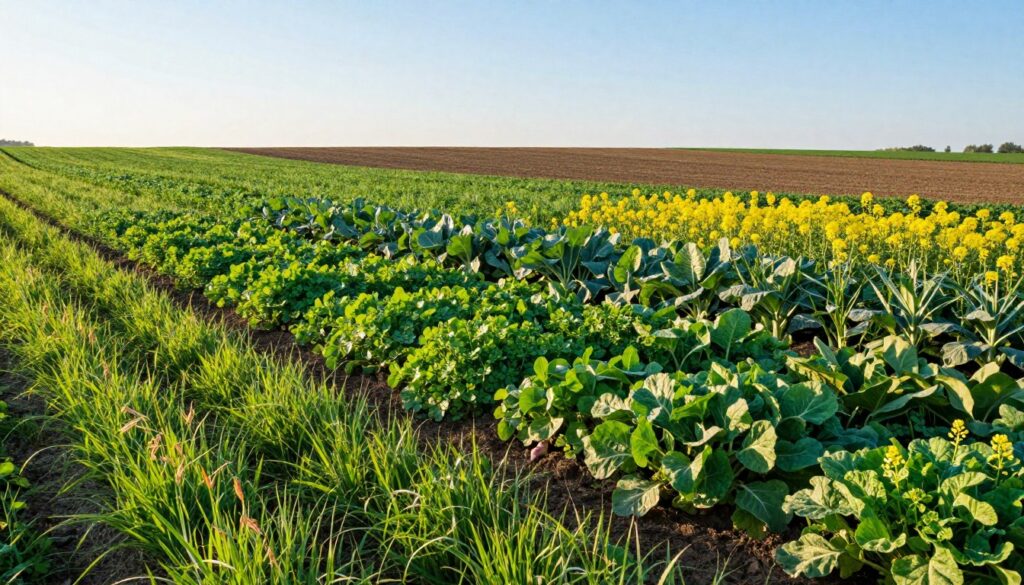
Legumes are like diplomats. They have special bacteria in their roots that turn air into nitrogen. This is like magic for your soil.
Legumes are great for adding nitrogen to the soil. They’re like a special investment for your future crops. It’s like turning air into gold.
The Brassicas: Tillage Radish, Rapeseed, Mustards
Brassicas are like bio-drillers. They have deep roots that can break through hard soil. They help improve drainage and soil structure.
When they die, they leave behind tunnels that help the soil. They’re like shock troops for your soil.
Using different types of cover crops together is the best strategy. For example, a mix of grasses and legumes can control erosion and improve soil health. It’s like having a team that works together.
This approach is like a natural ecosystem. It suppresses weeds and supports beneficial insects. It’s not just about planting one type of crop; it’s about creating a diverse environment.
Choosing the right cover crop is like solving a puzzle. You need to consider your soil, climate, and future crops. Are you fighting compaction? Use brassicas. Need more nitrogen? Legumes are the answer. Want quick cover and organic matter? Grasses are your best bet.
Smart cover cropping is about understanding your field and choosing the right solution. It’s not just about planting; it’s about strategy and planning for your soil’s future.
Rotation Strategies
The Midwest’s corn-soybean rotation is like playing checkers, but your soil needs chess. You’re not just planting season to season. You’re planning a multi-year sequence where every choice matters.
That corn-soybean pattern is just a simple step. Adding cover crops makes it a complex dance. Choosing the best cover crops for each spot turns simple alternation into a sophisticated dance.
Here’s a key move. After soybeans, plant cold-tolerant cereal rye. It grows in fall, sleeps in winter, and wakes in spring. This green blanket protects your soil until corn time.
Before corn, your strategy changes. You might plant crimson clover to fix nitrogen or tillage radishes to break up soil layers. Finding the best cover crops for this spot is tactical farming.
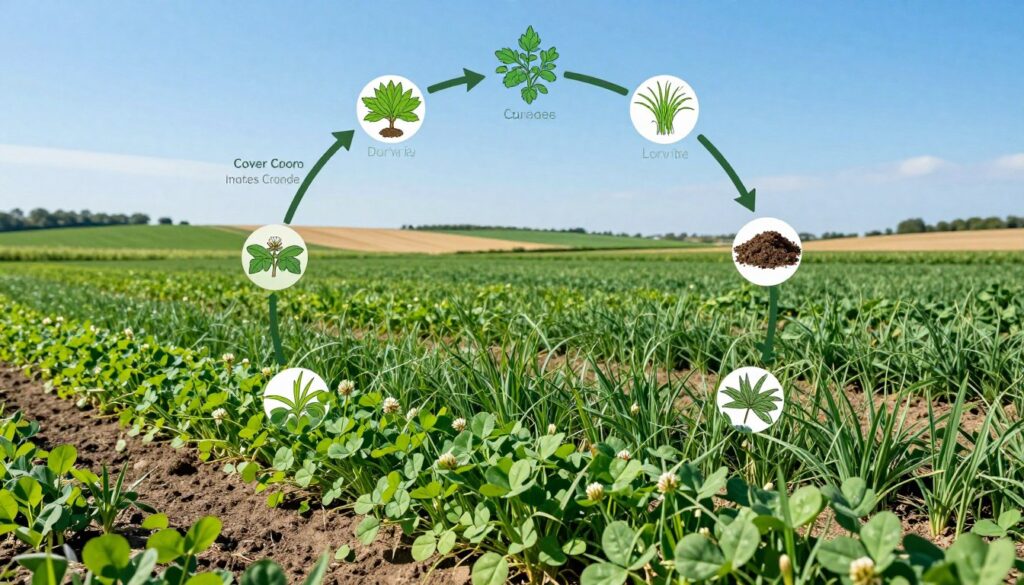
But why stop at two dimensions? Adding a third crop, like winter wheat, changes everything. Wheat harvests early, giving you time for more covers.
Imagine sunn hemp, buckwheat, and cowpeas working together. This isn’t just cover crops. It’s a soil-building festival. The soil microbiome gets the ultimate signal: the party never ends.
This approach creates a continuous ecosystem. Your soil becomes vibrant and never abandoned. The heart of regenerative agriculture beats in these sequences.
| Rotation Type | Cash Crops | Best Cover Crops | Strategic Benefit |
|---|---|---|---|
| Basic Two-Crop | Corn, Soybeans | Cereal Rye, Oats | Erosion control, simple nutrient cycling |
| Enhanced Two-Crop | Corn, Soybeans | Cereal Rye, Crimson Clover, Radishes | Nitrogen fixation, compaction relief, diversity |
| Three-Crop System | Corn, Soybeans, Winter Wheat | Diverse mixes (Buckwheat, Sunn Hemp, Cowpeas) | Extended living cover, maximum biodiversity |
| Advanced Multi-Species | Multiple cash crops + specialty crops | Custom blends for specific soil goals | Ecosystem mimicry, regenerative acceleration |
Farmers in the Corn Belt are playing this advanced game. They’re not just following the calendar. They’re reading their soil’s needs and responding with green interventions.
The final move? Selecting the best cover crops isn’t about a universal recipe. It’s about diagnosing your field’s specific needs and prescribing the right green medicine. Your rotation strategy becomes your farm’s signature.
Equipment & Timing
Moving from the elegant theory of soil science to the muddy reality of the field requires a shift in mindset—from agronomist to field general. This is where cover cropping transitions from a beautiful concept to a logistical ballet. It can sometimes feel like a slapstick comedy. The theory is pristine. The execution? That’s where the seed meets the soil, often against a ticking clock.
Timing is the fiendish puzzle at the heart of this practice. You must plant after your cash crop harvest, but early enough for the cover to establish before winter slams the door. This narrow window forces creative solutions. Farmers might drill seeds directly into standing corn or soybeans, a technique called interseeding. Others use aerial seeding, flying the seed onto the field. Each method is a race against the calendar.
The equipment question looms just as large. Do you invest in a dedicated no-till drill? Modify your existing planter? Or avoid the capital outlay entirely?
- Buying equipment offers control but demands significant investment.
- Modifying existing tools is a middle-ground, requiring technical know-how.
- Borrowing from a local Conservation District is the ultimate low-risk entry point.
My advice? Don’t try to be a hero on day one. Start with a test strip on a few acres. Treat it like a pilot episode for your soil. See what works in your specific conditions. This “start small” philosophy lets you adjust species, planting method, and timing without betting the farm. It’s the smart, analytical approach.
The spring brings another high-stakes game: termination timing. Get this wrong, and your noble experiment becomes a weedy mess. Kill a vigorous cereal rye cover too late, and it becomes a thirsty competitor, robbing your young corn of moisture and nutrients. Kill it too early, and you lose its precious soil-protecting benefits during spring rains. It’s a management decision with direct yield implications.
This is the gritty, unglamorous reality of integrating covers into a working farm. It demands management intensity and a willingness to “fail forward,” learning from each season. For those seeking guidance, speaking with your local Conservation District or exploring resources from the USDA Climate Hubs on how cover cropping can improve climate is a brilliant first move.
Getting this dance of equipment and timing right is what separates a successful, resilient system from a frustrating setback. It’s not just about having the right tools; it’s about having the right plan.
Economic Impact
Farming isn’t free. Cover crops seem expensive at first. You spend on seed and fuel, but see no immediate gain. This is where short-term thinking fails.
The real value of cover crops is like a slow-burning thriller. They’re not just a cost. They’re an investment in saving money. For example, rye after corn cuts nitrogen loss by over a third. Clover before soybeans boosts yield by 15%. That’s free nitrogen you didn’t buy.
Think of cover crops as a smart risk move. Precision agriculture data shows a 4% yield boost. Full integration can increase that to 10%. Your input costs go down. Fertilizer use drops 14%. Chemical use falls by a quarter. You save 30% on water and 6% on diesel.
Choosing the right cover crops changes your economics. It moves you from a short-term focus to a long-term view. The profit isn’t just in this year’s yield. It’s in the soil ready for your grandkids. That’s an ROI no spreadsheet can fully capture.