Let’s cut through the greenwashed marketing speak, shall we? This isn’t just another hashtag for your farmer’s market haul. It’s a full-throated rebellion against the industrial system that turned fertile topsoil into a chemical-dependent wasteland.
Think less about rules, more about philosophy. The farm as a living ecosystem, not a production factory. Pioneers like Rodale championed this radical idea: don’t just sustain the damage—actively repair it.
While boardrooms debate definitions, initiatives like “4 per 1000” get to the heart of the matter. They recognize soil’s incredible power as a carbon sink. This goes well beyond organic farming’s limitations.
We’re talking about reversing decades of ecosystem degradation. The current model gives us nutrient-starved food and monoculture deserts. Regenerative ag offers pragmatic hope instead of dystopian decline.
It begins with one simple shift in perspective. What if we worked with nature rather than fighting against it? The results might just save more than our dinner plates.
Key Principles
Forget everything you think you know about farming. This isn’t about just adding inputs and watching outputs. It’s about rebuilding an entire system. The core of regenerative ag is written in the language of life, starting with the ground.
Soil isn’t dirt. Dirt is what you sweep off the floor. Soil is a living, complex world. It’s a place where worms trade, fungi travel, and microbes store data. The first rule is that soil health is key to everything. We’re not just managing land; we’re taking care of the planet’s core.
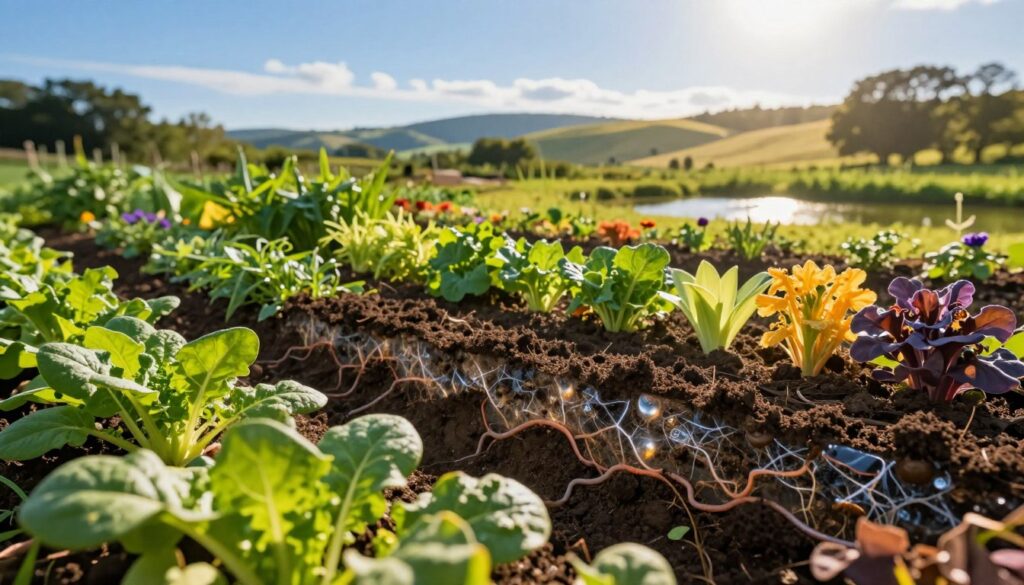
This changes everything. We’re not just growing crops. We’re building up the soil’s wealth—its organic matter. Think of organic matter as the soil’s savings account. The more you have, the more it pays out in ecosystem services.
More organic matter means more carbon sequestration, better water retention, and more biodiversity. It turns a barren area into a thriving ecosystem. This isn’t farming; it’s engineering the environment.
The second rule is a big shift: from taking to giving back. Conventional farming is a “take-make-waste” cycle. Regenerative systems are circular, leaving the system better than they found it.
How? By using life to support more life. Roots feed microbes, which cycle nutrients, which feed plants, which feed animals, whose manure feeds the soil. It’s a closed-loop system, like a backyard economy. This is why sustainability matters—it’s the foundation. Regeneration is the next step.
This leads to the third key: biodiversity as the system’s defense. A monoculture is vulnerable to pests and disease. A diverse system is strong and adaptable. Biodiversity is the backbone of stability.
Lastly, regenerative ag is all about results. We’re not just doing things for the sake of doing them. Success is measured in tons of carbon stored, rainfall absorbed, and nutrient-rich food produced.
That carrot on your plate is more than just a food item. In a regenerative system, it’s a sign of the planet’s healing. This is the ultimate goal. It requires precision, vision, and patience. We aim to not just sustain but to regenerate what we’ve lost.
Crop Rotation & Cover Crops
Think of your soil’s nutrients like a playlist. Monocropping is like playing the same song over and over. It’s efficient at first but soon gets boring and depletes nutrients.
A dynamic rotation is the answer. It’s not just swapping crops. Modern sustainable farming involves layering different plants. Each plant plays a role to keep the soil thriving.
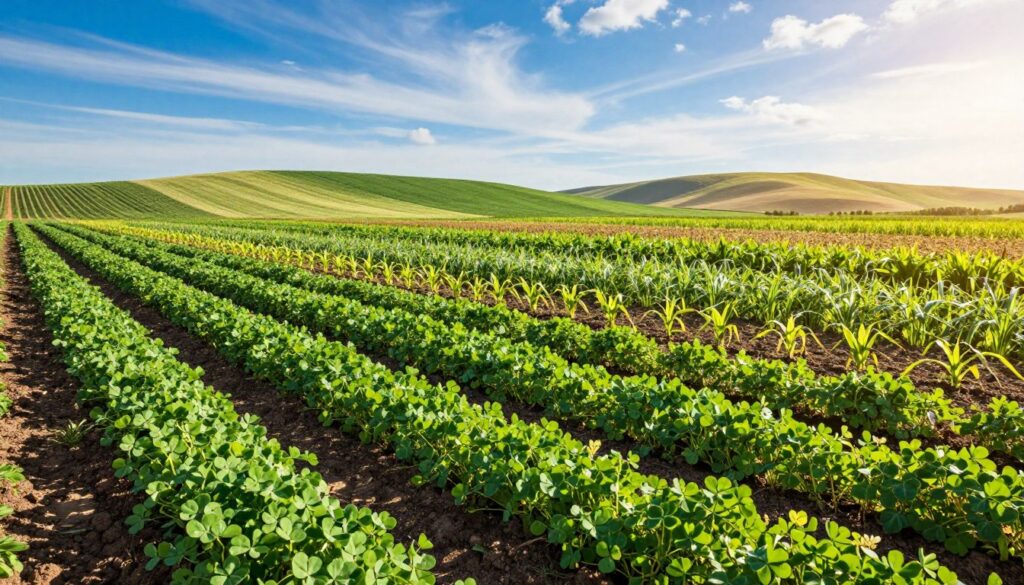
Cover crops are the heroes of the field. They’re planted between seasons or with main crops. They act as a living mulch, protecting the soil.
They reduce evaporation, suppress weeds, and prevent topsoil loss. Cover crops have roots that break up compacted soil. This improves soil structure.
As these plants grow and die, they add biomass to the soil. This is key for soil health. It increases Soil Organic Matter (SOM).
For every 1% increase in SOM, an acre of soil can hold an extra 20,000 gallons of water. This is crucial in times of drought.
Healthier soil supports a robust soil food web. This includes fungi, bacteria, and earthworms. They make nutrients available to your crops, boosting their yield.
For farmers who love data, this isn’t just old wisdom. Technology platforms like ReGrow use data to plan rotations. They help choose the right cover crop for the best results.
The old way and the new way are very different. Here’s a table showing the main differences:
| Practice | Impact on Soil Structure | Water Management | Biodiversity & Pest Pressure |
|---|---|---|---|
| Monocropping | Leads to compaction and loss of pore space. | Poor infiltration, high runoff, and erosion. | Low biodiversity; creates a target-rich environment for specific pests. |
| Crop Rotation | Varied root structures aerate and bind soil differently. | Improves infiltration over time by breaking up hardpans. | Disrupts pest and disease cycles; supports a wider range of soil life. |
| Cover Cropping | Roots create biopores; biomass adds organic matter to improve tilth. | Dramatically increases water retention via SOM; protects surface from evaporation. | Provides habitat for beneficial insects; can suppress weeds through competition. |
| Combined Regenerative Approach | Synergistic effect creates resilient, crumbly soil ideal for plant growth. | Transforms soil into a water-holding reservoir, mitigating drought and flood impacts. | Builds a complex, self-regulating ecosystem that minimizes external inputs. |
Starting can seem hard, but it’s simple. Choose two or three cover crops that fit your climate and goals. Common choices include:
- Legumes (like clover or vetch): These fix nitrogen, fertilizing the soil for free.
- Grasses (like rye or oats): They add organic matter and prevent erosion.
- Brassicas (like radish): Their deep roots break up compacted soil.
This is just the start of regenerative agriculture. By moving away from monoculture, you’re not just farming. You’re creating an entire ecosystem. You’re building soil health that saves water, cuts costs, and makes your farm more resilient. It’s time to change the song.
Livestock Integration
Forget what you’ve heard about cows being bad for the climate. When managed right, they can actually help the planet. This idea changes how we see livestock, turning them into helpers for soil health.
The secret is movement. Think of bison herds roaming freely, never staying in one place too long. Today, we use a similar method called rotational grazing. Animals are moved often between different areas.
This method stops overgrazing and lets pastures recover fully. The result is stronger roots, better water retention, and more carbon stored in the soil. It’s a cycle of renewal.
Stationary grazing can harm the soil, making it compact and barren. But rotational grazing does the opposite. It encourages plant growth and builds up the soil. Each move gives the land a chance to rest.
La Julia Farm in Argentina is a great example. Their use of high-density rotational grazing turned bad land into a lush pasture. The change is amazing, showing how animals can fix what they eat.
Technology makes this old practice even better. Virtual fencing systems like Vence use GPS collars to create invisible boundaries. It’s like smart home tech for pastures.
Farmers can manage grazing from their phones. No need for physical fences. It lets them make precise, climate-friendly decisions. The data helps them make every move count.
The Savory Institute certifies farms that use holistic planning. They integrate livestock with landscape monitoring. It’s a science-based approach to regeneration. Animal integration is no longer a guess.
Here’s how conventional and regenerative methods compare:
| Aspect | Conventional Livestock Management | Regenerative Livestock Integration |
|---|---|---|
| Management Approach | Continuous, stationary grazing | Rotational, planned movement |
| Impact on Soil Health | Compaction, erosion, degradation | Improved structure, organic matter, life |
| Technology Used | Basic fencing, manual checks | Virtual fencing, GPS tracking, data analytics |
| Carbon Outcome | Net emissions source | Carbon sequestration potential |
| Economic Model | Volume-based, input intensive | Ecosystem service-based, lower inputs |
This is a complete shift in how we view farming. Regenerative integration sees the farm as an ecosystem. Animals work with the land, not against it.
This approach makes livestock key to sustainable farming. They act as mobile fertilizers. Their manure and hooves help the soil.
Water cycles improve as soil becomes more absorbent. Biodiversity grows with varied plant recovery times. The farm becomes more resilient against droughts and floods.
Ultimately, livestock integration changes the conversation. It’s not about reducing harm but creating benefit. Animals help in ecological restoration.
This shows that sometimes, the answer was grazing all along. We just needed to manage the herd, not remove it.
Real-World Case Studies
Farmers in Kenya to Argentina are leading the way in regenerative agriculture. They’re not in labs but on real land, facing real challenges. Their stories are about survival and success.
The idea of regenerative agriculture sounds good in meetings. But it’s the real-world results that prove its worth. Let’s explore these global efforts.
In Kenya’s dry highlands, Simion Ole Kiok and Dismus Pere are taking matters into their own hands. They use minimum tillage, agroforestry, and cover crops to manage water.
The chisel plow helps them plant without harming the soil. This keeps moisture and life in the soil. Cover crops protect the earth from the sun.
Thanks to these methods, their soil now holds water like a sponge. This is more than sustainable farming; it’s smart water management.
India: The Quiet Rebellion in Gujarat
Harshadbhai’s farm in Gujarat is a quiet stand against the status quo. The area is known for water-hungry cotton farming, but Harshadbhai is changing that. He uses organic inputs and manages residues carefully.
His approach is not just about the crops. He feeds the soil life, not just the plants. This way, the soil holds more water.
When drought hits, his farm still produces. The soil’s health acts as a buffer against climate changes, something chemicals can’t offer.
Argentina: Cows as Landscape Architects
The Bianchi family in Argentina sees their cows as landscape designers. Their grazing system improves the land for water and wildlife.
By moving the cows often, they prevent overgrazing. The grass grows back, creating channels for water. This brings back seasonal lagoons and wildlife habitats.
This approach is similar to successful regenerative grazing in Virginia. It benefits the ranch and the environment.
Mexico: Scaling Resilience Across 139 Ranches
The Boomitra project in Mexico is a large-scale experiment. One hundred thirty-nine ranchers are working together. They use rotational grazing and solar pumps.
Their goal is to survive droughts and restore the land. By grazing wisely and using solar pumps, they save water and money.
The results are impressive. Even in dry times, their soil is healthier, and wildlife is returning. This shows how regenerative ag can transform entire areas.
These stories show a common theme. They’re not just sustaining land; they’re healing it. From Kenya to Mexico, the message is clear. The future of sustainable farming is about doing more good, one acre at a time.
Getting Started Steps
So the case studies have you convinced. You’re ready to leave the industrial twilight zone behind. The path ahead is both exciting and quiet.
First, face the messy truth. Regenerative ag doesn’t follow one rulebook. It’s a mix of Savory and Organic-plus. This mix fights dogma but also risks greenwashing. Your best defense is knowledge. Learn about your land’s past before planning its future.
Begin with small steps, not big risks. Try planting a cover crop or designing a rotational paddock. The real first step is getting your hands dirty in sustainable farming.
You’re not going it alone. A new financial world is forming. Phil Taylor’s Perennial Fund helps share farmer risks. Sites like Steward let you fund a change. Look into carbon markets with Soil Heroes. Money is starting to match nature’s pace.
For those who eat, not farm, there’s an easy step. Look for local food with clear origins. A visit to a farm can teach a lot. Use tools like the Washington Food and Farm Finder. Your choice of food is a vote for a better system, as explained in the beginner’s guide to regenerative agriculture.
This journey is long. It starts by seeing your land as a partner, not just a resource. The soil remembers. It’s time we do too.