Beneath every Prairie field lies a complex community of bacteria and fungi. This living system acts as a biological engine, not just a place for roots. It controls how well plants get vital nutrients and handle seasonal stress.
Understanding the importance of soil health for crops is key to a sustainable farming system. Tiny microbes play a big role in seedling growth. This biological network boosts long-term crop productivity and resilience.
Modern growers must see the earth as a dynamic ecosystem, not just a static medium. Nurturing this underground life leads to consistent yields and environmental quality. High biodiversity creates a strong food web, supporting superior harvest outcomes on every acre.
Key Takeaways:
- Living systems drive plant resilience against external stressors.
- Microbial diversity significantly boosts natural nutrient access.
- True sustainability starts with protecting underground vitality.
- Healthy biological networks ensure stable long-term yields.
Organic Matter and Microbial Life
Soil health is tied to its microbial diversity and organic content. Soil microbiology includes beneficial bacteria, fungi, and other tiny life forms. These organisms help cycle nutrients and break down organic matter.
They work together in the root zone. This supports root growth and improves soil function.
The Role of Microorganisms in Soil Health
Microorganisms are key to soil health. They decompose organic matter, fix nitrogen, and fight plant diseases. The variety of microbial life shows soil health.
Beneficial Bacteria and Fungi
Beneficial bacteria and fungi are vital for nutrient cycling and soil structure. They form relationships with plant roots. This improves soil fertility.
- Nitrogen Fixation: Certain bacteria convert atmospheric nitrogen into a form that plants can use.
- Decomposition: Microorganisms break down organic matter, releasing nutrients back into the soil.
- Pathogen Suppression: Beneficial microbes can outcompete or inhibit the growth of pathogens, reducing the risk of plant diseases.
To understand the importance of soil testing in assessing microbial activity and overall soil health, visit soil testing resources.
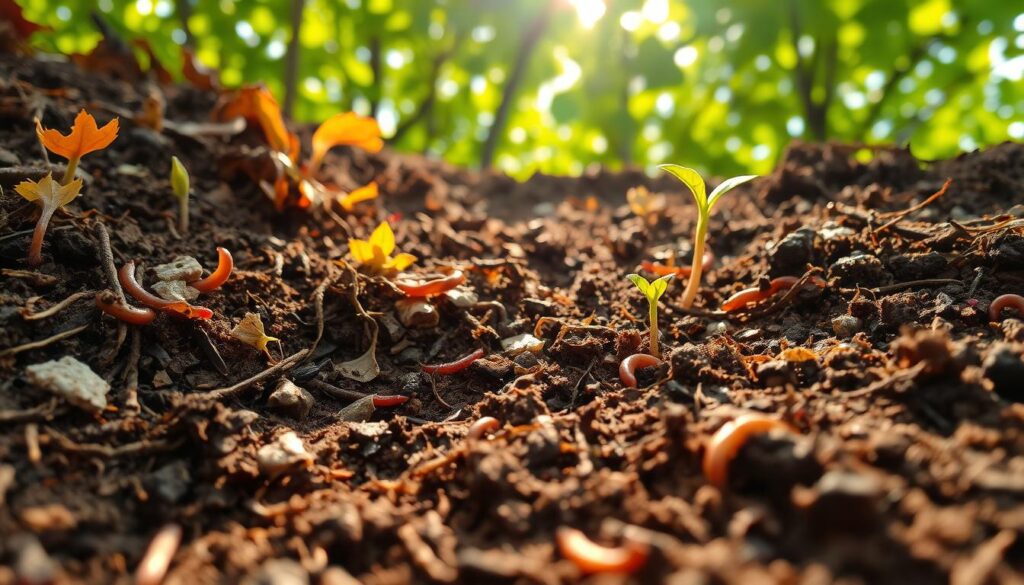
Healthy soils with diverse microbial communities are more resilient. They need fewer external inputs. By managing organic matter and microbial life, farmers and gardeners can improve soil fertility and structure. This leads to more sustainable agricultural practices.
Soil Structure and Water Movement
Soil structure and water movement are key to soil health for crops. The way soil particles are arranged affects water infiltration, aeration, and root growth.
A well-structured soil is great for water movement. This is vital for keeping crops healthy. Microbes help keep the soil stable, improving its ability to hold water and air.
Impact on Soil Aeration and Water Infiltration
Microorganisms greatly affect soil aeration and water infiltration. They break down organic matter, making the soil more porous. This porosity is essential for air and water to reach the roots, aiding in growth and nutrient uptake.
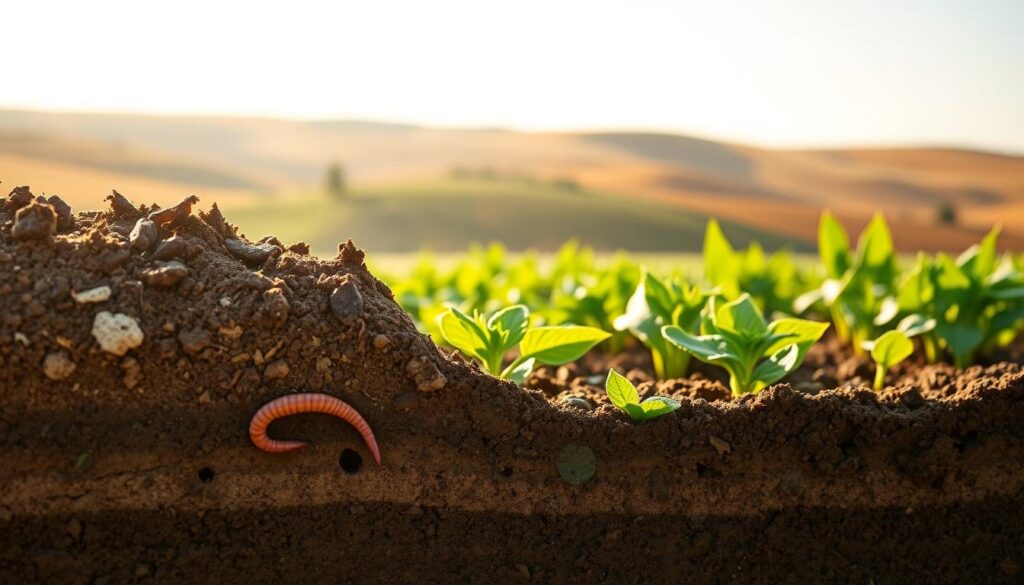
As microbes improve soil stability, they help prevent erosion and compaction. This stability is key for maintaining optimal soil aeration and water infiltration. Both are critical for crop productivity.
Better aeration and water infiltration also improve nutrient cycling. This leads to healthier plants and more sustainable farming.
- Enhanced soil structure supports root growth.
- Microbial activity improves soil aeration.
- Optimal water infiltration reduces erosion.
Soil Testing and Interpretation
To really understand soil health, we need to test it thoroughly. Soil testing is more than just checking nutrient levels. It’s about knowing the soil’s chemical, biological, and physical state.
Soil health is complex, and nutrient availability is a big part of it.
Understanding Soil Nutrient Availability
Soil nutrient availability is key to soil fertility and crop productivity. Several things affect how available nutrients are, like pH levels, organic matter, and microbes.
Microbial activity is a big part of soil health.
Measuring Microbial Activity
Microbes are essential for soil health. They break down organic matter, fix nitrogen, and fight diseases. We can measure their activity with tests like respiration and microbial biomass.
The table below shows important soil tests for nutrients and microbes:
| Test Type | Purpose | Indicators |
|---|---|---|
| Nutrient Testing | Determine nutrient levels | N, P, K levels |
| Microbial Activity Tests | Assess microbial health | Respiration rates, microbial biomass |
| pH Testing | Measure soil acidity/basicity | pH levels |
Soil testing is very important. It helps us make smart choices about how to manage our soil.
By knowing about nutrient and microbial activity, we can improve soil fertility and crop productivity.
Long-term Field Benefits of Healthy Soil
Keeping soil healthy is key for growing crops sustainably. By boosting soil biology, structure, and organic matter, farmers gain many benefits. These include better nutrient cycling, improved water use, and less erosion.
These changes help roots grow stronger and crops grow better. Studies show that using biochar coatings can greatly improve soil health. This makes farming more resilient and productive, needing less inputs and being kinder to the environment.
By focusing on soil health, farmers can make their farms more sustainable and productive. This leads to better crop yields and water use. As farming evolves, prioritizing soil health will be vital for feeding the world while protecting the environment.