The U.S. Department of Agriculture has designated 11 New Jersey counties as natural disaster areas following ongoing drought conditions that began June 9, 2026, opening a new path to federal emergency credit for affected agricultural producers. The USDA Farm Service Agency announced the designation on September 3, adding Hunterdon, Morris, Somerset and Union counties as primary disaster areas and extending contiguous-county eligibility to Essex, Hudson, Mercer, Middlesex, Passaic, Sussex and Warren.
The designation arrives as New Jersey continues to manage persistent water-supply concerns after two years of below-average precipitation. Although summer rainfall has provided some improvement, the New Jersey Department of Environmental Protection said on August 26 that deficits in streamflow and unconfined groundwater had not been fully overcome statewide. The state remained under a Drought Warning at that time. (New Jersey drought conditions)
For farmers, the USDA action is significant because drought can affect an operation long after a dry period becomes visible in a field. Reduced soil moisture can influence crop development, forage availability, irrigation requirements and livestock feed costs, while producers may face additional expenses simply to maintain normal production.
The September designation therefore adds a financial response to an environmental problem that has already been affecting water resources across the state.
Four Counties Receive Primary Disaster Status
The USDA’s September 3 designation identifies Hunterdon, Morris, Somerset and Union counties as the primary New Jersey counties eligible for assistance. Seven additional New Jersey counties—Essex, Hudson, Mercer, Middlesex, Passaic, Sussex and Warren—qualify as contiguous counties. Richmond County in New York and Bucks County in Pennsylvania also receive contiguous eligibility under the designation.
The triggering disaster is listed as drought beginning June 9, 2026, and continuing. Producers affected by the drought have until April 26, 2027, to apply for the emergency loans associated with the designation.
| Eligibility Area | Counties |
|---|---|
| Primary New Jersey counties | Hunterdon, Morris, Somerset, Union |
| Contiguous New Jersey counties | Essex, Hudson, Mercer, Middlesex, Passaic, Sussex, Warren |
| Contiguous counties outside New Jersey | Richmond County, NY; Bucks County, PA |
| Drought period | June 9, 2026 – ongoing |
| Application deadline | April 26, 2027 |
The distinction between primary and contiguous counties matters because USDA disaster designations are structured around the location of documented impacts and neighboring jurisdictions that may experience related agricultural losses.
For producers in the affected areas, eligibility does not automatically mean that every operation will receive funding. The FSA evaluates emergency loan applications based on factors including the extent of losses, available security and the applicant’s repayment ability.
What USDA Emergency Loans Can Cover
The new designation is primarily a financing mechanism rather than a direct payment program.
USDA’s Farm Service Agency says emergency loans can be used for several recovery purposes, including replacing essential equipment or livestock, reorganizing a farming operation and refinancing certain debts. That flexibility is important because drought-related losses do not always appear as a single failed harvest.
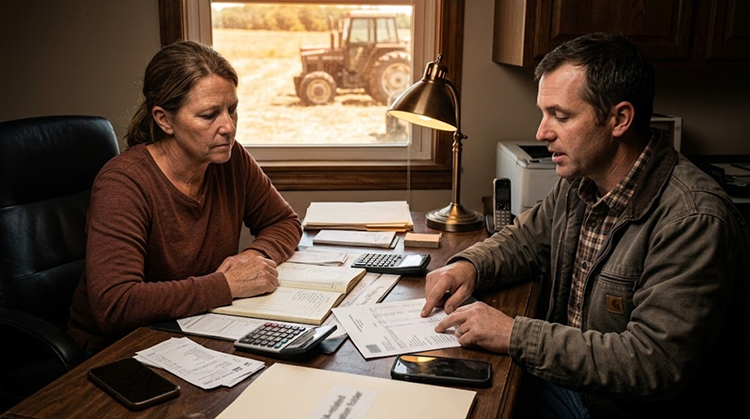
A livestock producer, for example, may face higher feed expenses or reduced forage availability. A crop farmer may need to replace damaged equipment, repair irrigation infrastructure or restructure existing obligations after a poor production season.
The financial pressure can also extend into the following planting cycle.
A farm that generates less revenue because of drought may still need seed, fertilizer, fuel, labor and machinery expenses before the next crop produces income. Emergency credit can therefore provide working capital at a point where the timing of cash flow becomes as important as the size of the eventual crop loss.
USDA directs affected producers to its Disaster Assistance Discovery Tool and local FSA Service Centers to determine which programs may apply to their operations.
The September 3 announcement also makes clear that producers should maintain documentation of losses and communicate with their local USDA offices rather than assume that the county designation itself completes the assistance process.
New Jersey’s Drought Is Larger Than One Growing Season
The immediate USDA designation is tied to drought beginning June 9, but New Jersey’s water situation has a longer history.
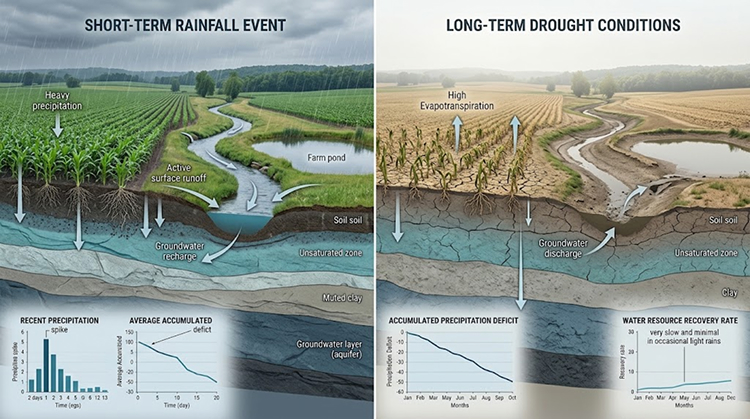
The New Jersey Department of Environmental Protection reported in late August that water-supply indicators were improving after steady summer rains. However, the department also said that the deficits accumulated during the previous two years of below-average precipitation had not been overcome, particularly in streamflow and unconfined groundwater. (NJDEP drought monitoring)
That distinction is critical for agriculture.
Rainfall during a single week can improve surface conditions without completely restoring deeper groundwater or streamflow levels. Agricultural producers therefore have to evaluate water availability across a much longer period than the weather forecast.
New Jersey’s water situation also demonstrates why agricultural drought and water-supply drought should not be treated as identical measurements. NJDEP specifically distinguishes different types of drought, noting that its monitoring program focuses on water-supply conditions while agricultural drought can affect sectors differently.
For farms, the practical question is whether enough water is available at the right time and at an economically manageable cost.
That can become especially important for specialty crops, where the value of an acre can be considerably higher than the value associated with commodity grain production.
Specialty Crops Add Another Layer Of Risk
New Jersey’s agricultural economy is highly diverse. The state produces field crops, vegetables, fruit, nursery products and livestock, meaning drought does not affect every operation in the same way.
USDA data show approximately 9,900 farm operations in New Jersey and about 690,000 acres operated based on the latest state agricultural overview available through September 2, 2026. The same USDA data report 2025 production of approximately 48.5 million pounds of cultivated blueberries, 10.6 million bushels of corn for grain and 3.86 million bushels of soybeans. (USDA New Jersey agriculture overview)
These figures show why water availability matters across multiple agricultural systems rather than only for major row crops.
New Jersey also has substantial hay production. USDA’s state overview lists 101,000 harvested hay acres in 2025, producing approximately 212,000 tons. Hay availability directly affects livestock producers because reduced forage production can increase the need to purchase feed from outside the operation.
That creates a chain reaction.
Lower forage production can increase feed purchases. Higher feed purchases can raise operating costs. Reduced water availability can increase irrigation requirements. Additional irrigation can increase energy and infrastructure costs. At the same time, weaker crop production can reduce farm revenue.
Drought risk is therefore an economic issue as much as an environmental one.
2026 Crop Acreage Shows The State’s Agricultural Scale
New Jersey entered the 2026 growing season with substantial acreage dedicated to soybeans, corn and hay.
According to New Jersey’s Department of Agriculture, based on USDA-NASS estimates, farmers planned to plant 110,000 acres of soybeans, 73,000 acres of corn and harvest hay from 98,000 acres in 2026. The estimates compared with 100,000 soybean acres, 75,000 corn acres and 101,000 hay acres harvested in 2025.
A later July release reported that New Jersey field corn planted for all purposes was estimated at 72,000 acres, with 62,000 acres expected to be harvested for grain. Expected hay harvested acreage reached 106,000 acres, the highest level since 2018, while soybean harvested acreage was estimated at 98,000 acres.
Those numbers make the drought designation more consequential because the affected counties sit within a state agricultural system that includes both commodity crops and higher-value specialty production.
The effect of drought is also unlikely to be uniform. A producer with access to dependable irrigation may have a different risk profile from a farm dependent primarily on rainfall. Soil type, crop selection, water rights, infrastructure and proximity to reliable water sources can all change the financial impact of the same weather event.
A Growing Pattern Of USDA Disaster Designations
The September 3 announcement is also part of a broader sequence of USDA disaster actions involving New Jersey during 2026.
On August 20, USDA designated Mercer and Monmouth counties as primary natural disaster areas because of drought beginning May 12, with Burlington, Hunterdon, Middlesex, Ocean and Somerset counties eligible as contiguous areas. The application deadline under that earlier designation is April 13, 2027.
USDA also issued multiple New Jersey disaster designations in late August connected to 2025 excessive rain, excessive heat and drought. One August 28 designation covered Morris, Sussex and Warren counties for drought from July 2 through August 30, 2025, while Hunterdon and Somerset were identified as primary counties for another drought period beginning July 31, 2025.
The sequence demonstrates that New Jersey’s agricultural disaster exposure is not limited to a single weather event.
Earlier in 2026, the state also dealt with significant freeze damage. Governor Mikie Sherrill declared a state of emergency in May after an April freeze damaged fruit crops, with early estimates putting statewide agricultural losses at at least $300 million.
For producers, the combination of freeze, drought, excessive rain and other weather disruptions creates a difficult planning environment.
Water Management Becomes A Farm Investment Issue
The latest USDA designation also reinforces the importance of water-management investments on New Jersey farms.
NJDEP’s August guidance encouraged water conservation measures including reduced outdoor watering and the use of drip irrigation and microsprays, which can reduce water consumption by 30% to 50% compared with less efficient approaches under the state’s guidance. (New Jersey water conservation guidance)
For agriculture, the same principle can translate into investments in irrigation efficiency, soil-moisture monitoring, scheduling systems and drought-tolerant production practices.
Technology does not eliminate drought risk, but it can change how efficiently a farm responds to limited water.
Precision irrigation systems can apply water according to field conditions rather than treating an entire acreage block identically. Soil sensors can provide information about moisture levels at different depths. Weather-based scheduling can help producers avoid unnecessary irrigation during periods when rainfall is expected.
These practices become more valuable as water availability becomes less predictable.
For Agheiro’s focus on sustainable and data-driven agriculture, New Jersey provides a useful example of how climate pressure can accelerate practical changes in farm management rather than simply creating short-term production losses.
The Financial Question Extends Into 2027
The April 26, 2027, application deadline gives affected producers several months to assess losses and determine whether USDA emergency financing is appropriate.
But the financial consequences of the drought may extend beyond the deadline.
Farmers make production decisions months before crops are harvested. If drought reduces soil moisture or forage availability during one season, producers may enter the following planting cycle with reduced cash reserves, higher debt or additional infrastructure requirements.
That is why emergency lending can be important even after weather conditions improve.
The immediate goal is to help a viable agricultural operation recover from a disaster. The longer-term goal is to prevent one difficult season from disrupting the farm’s ability to produce during the next one.
New Jersey’s current situation also shows why agricultural resilience increasingly depends on both financial planning and water management. The state’s farmers are operating across a diversified production system, but each segment remains exposed to weather conditions that can change quickly.
USDA’s September 3 designation gives producers in Hunterdon, Morris, Somerset, Union and neighboring eligible counties another financial tool as they respond to the continuing drought.
The broader issue is whether future seasons will require increasingly frequent emergency interventions or whether investments in irrigation efficiency, soil management, drought planning and agricultural data can reduce the financial impact before the next disaster designation becomes necessary.