Kansas wheat farmers are facing one of the most difficult market situations in years: wheat prices are rising at the same time that drought and weather damage have sharply reduced the amount of wheat available to sell.
The contradiction is becoming increasingly visible in September 2026. Global wheat prices have climbed to their highest level in roughly three years as disruptions in the Black Sea region affect shipments from Russia and Ukraine. Yet Kansas, the leading U.S. winter wheat-producing state, has just recorded a winter wheat forecast of 191.4 million bushels, according to USDA data updated September 9. The figure represents a 45% decline from the previous year’s production and leaves the state with an unusually small crop at precisely the moment when stronger prices would normally offer producers an opportunity to improve revenue.
The situation illustrates an important distinction in agricultural markets: a higher commodity price does not automatically translate into higher farm income. Farmers must have enough marketable production to benefit from that price, and Kansas wheat producers have spent much of 2026 dealing with drought, freezes and other crop stresses that reduced yield potential long before the current price rally developed.
Kansas Wheat Production Falls To 191.4 Million Bushels
The latest USDA Kansas State Agriculture Overview provides a clear picture of the damage.
Kansas planted approximately 6.7 million acres of winter wheat in 2026, with about 5.8 million acres harvested. USDA’s current estimate puts the state’s average yield at only 33 bushels per acre, resulting in 191.4 million bushels of production.
That number is especially significant because Kansas normally produces vastly more wheat. Kansas State University describes the state as the largest contiguous dryland winter wheat-producing region in the world, with roughly 7 million to 8 million acres sown annually and typical production ranging from 280 million to 460 million bushels. Approximately 90% of Kansas wheat production is dryland.
The 2026 result therefore represents more than an ordinary bad harvest.
It is a major reduction in the productive capacity of one of America’s most important wheat regions.
Earlier projections already pointed toward a historic decline. A July USDA projection cited by Kansas agricultural economist Dan O’Brien of Kansas State University placed Kansas winter wheat production at about 196 million bushels, compared with nearly 347 million bushels the previous year. By September, the USDA estimate had slipped further to 191.4 million bushels.
The difference between the July and September estimates is relatively small in percentage terms, but the broader message is significant: the state entered the 2026 harvest with dramatically less wheat than producers had generated only one year earlier.
Drought Damaged The Crop Before Prices Started Moving
The Kansas wheat crisis did not begin with the current price rally.
The crop entered the growing season with reasonable potential, but weather conditions changed quickly. Kansas State University wheat specialists Romulo Lollato and Jeanne Falk Jones reported that drought, freeze damage and disease pressure had created significant problems across the state.
During the May Kansas Wheat Quality Council Tour, specialists and industry participants examined nearly 200 wheat fields along six routes across Kansas. Some areas had received less than one inch of precipitation since the beginning of the year, while unusually warm conditions earlier in the season accelerated crop development.
That acceleration created another problem.
Wheat that develops ahead of its normal schedule can reach sensitive growth stages before weather conditions are favorable. In Kansas, the crop advanced rapidly during warm winter and early-spring periods before encountering damaging freezes.
K-State wheat specialist Romulo Lollato explained that the crop was roughly three weeks ahead of normal development during part of the spring. That left plants exposed to freeze damage during stages when reproductive structures were particularly vulnerable.
The result was a combination of moisture stress and weather damage rather than a single isolated event.
That matters for the economics of the crop because yield losses cannot be recovered once the harvest window closes. A farmer who produces 15, 20 or 30 bushels per acre cannot manufacture additional grain later simply because the market price rises.
Global Wheat Prices Are Moving In The Opposite Direction
The global wheat market is telling a very different story.
In August, the United Nations Food and Agriculture Organization reported that global food prices reached their highest level since late 2022. Grain prices were among the areas experiencing significant increases, with disruptions associated with the Black Sea contributing to stronger wheat prices. (FAO Food Price Index)
The Black Sea remains central to the global wheat market because Russia and Ukraine are major exporters. Recent attacks and disruptions to grain infrastructure have caused importers to reconsider their normal purchasing routes.
Reuters reported on September 3 that Asian buyers had shifted some purchases toward Australia and Argentina as uncertainty surrounding Russian and Ukrainian shipments increased. At least 500,000 metric tons of wheat had recently been purchased from alternative suppliers, while Chicago wheat futures had risen approximately 35% since late June.
That creates a favorable pricing environment for producers who have wheat available.
Kansas farmers, however, are entering the market with far less grain.
This is where the state’s situation becomes particularly unusual. A supply shock normally creates an opportunity for producers holding inventory because they can sell a scarce commodity at a higher price. But a production shock caused by drought can eliminate much of that inventory before the price response arrives.
Higher Prices Cannot Replace Lost Bushels
Current Kansas cash bids illustrate the price side of the equation.
Recent Kansas grain-market data showed Hard Red Winter wheat bids around $7.36 to $7.51 per bushel on September 8, depending on location and delivery period. Other Kansas elevator bids were also in the mid-$7 range. (Kansas HRW Wheat Cash Prices)
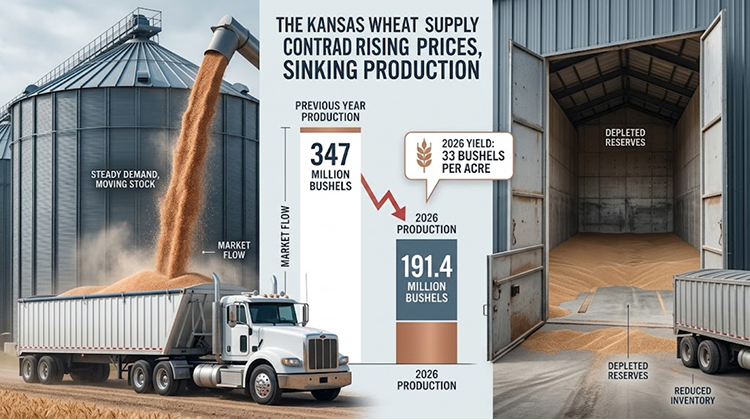
For comparison, the USDA’s current Kansas production estimate is 191.4 million bushels at an average yield of 33 bushels per acre.
The economic calculation is straightforward.
Suppose two farmers each had 1,000 acres planted to wheat. A producer harvesting 50 bushels per acre would have 50,000 bushels available. At $7.50 per bushel, that represents $375,000 in gross wheat value before basis, quality adjustments and production costs.
A producer harvesting 25 bushels per acre would have only 25,000 bushels. At the same $7.50 price, the gross value would be $187,500.
The price is identical.
The revenue opportunity is not.
That is why the Kansas wheat story cannot be evaluated simply by looking at futures prices or elevator bids. Yield remains the critical variable connecting the market to farm income.
Hard Red Winter Wheat Faces A Supply Problem
Kansas is particularly important because of its role in Hard Red Winter wheat.
The class is widely used in bread and other products and has historically been central to U.S. wheat production. USDA’s Economic Research Service reported in August that U.S. all-wheat production was forecast at 1.531 billion bushels, the lowest level since the 1970/71 marketing year. The agency attributed the unusually small crop to long-term reductions in wheat acreage and widespread drought impacts on Hard Red Winter production in the Great Plains. (USDA Wheat Market Outlook)
The national problem therefore extends beyond Kansas.
Kansas, Oklahoma, Texas, Colorado and other Great Plains states collectively form a critical production corridor for Hard Red Winter wheat. When drought affects several of those states simultaneously, the national market loses a substantial amount of the class that millers and buyers depend upon.
USDA’s August Wheat Outlook also showed that total U.S. wheat supplies were forecast down 13% from the previous year, while U.S. wheat exports were projected at 775 million bushels, down 15% from the previous year.
That combination creates a complicated market environment.
Domestic users still need wheat, exporters need reliable supplies and international buyers are looking for alternatives as Black Sea logistics become less predictable.
But the U.S. cannot immediately increase production to replace a crop that was already damaged.
Kansas Farmers Are Also Dealing With Higher Production Risk
The income problem becomes more serious when production costs are considered.
Kansas wheat farmers have already invested in seed, fertilizer, chemical applications, equipment, fuel and land costs before discovering how severely the crop would be affected.
A weak yield therefore creates a double financial problem. The farmer receives fewer bushels while many of the underlying costs associated with producing those bushels remain.
This is particularly important in a year when broader U.S. farm expenses are already elevated. USDA’s September farm-income forecast placed total U.S. production expenses at $492.8 billion in 2026, up $21.2 billion from 2025. The increase includes higher livestock purchases and other production costs across the agricultural sector.
Kansas wheat producers are consequently operating inside a larger farm economy where the cost base remains elevated.
For producers planning the next wheat cycle, this makes crop risk management increasingly relevant. Decisions about varieties, planting dates, crop insurance, soil moisture conservation and input allocation can determine whether the next season provides enough yield potential to take advantage of stronger prices.
The 2026 Crop Could Affect Planting Decisions For 2027
The effects of the poor harvest are already extending into the next planting season.
K-State released its 2026 Kansas Wheat Variety Guide on September 3, giving producers information about yield performance, disease resistance, insect resistance and agronomic characteristics for varieties being considered for fall planting. The guide includes newer varieties such as KS Tradition and KS Flintlock, as well as AP Sunbird and Orange Blossom CL+. (K-State 2026 Wheat Variety Guide)
The timing is significant.
A severe production year forces farmers to evaluate whether the next crop should simply replicate the previous production system or whether changes are necessary.
Variety selection becomes particularly important under drought risk. A variety with strong yield potential under favorable conditions may not necessarily be the best option in a region where moisture availability is becoming less reliable.
Farmers also need to consider disease resistance and maturity characteristics because a crop that develops too quickly can face different risks from one that progresses more slowly.
The 2026 experience therefore becomes a source of information for 2027 decisions.
Drought Is Changing The Economics Of Kansas Wheat
The Kansas situation also demonstrates how drought can change agricultural economics beyond the immediate loss of production.

Kansas has historically been a major dryland wheat producer. K-State estimates that roughly 90% of the state’s wheat production is dryland, meaning producers depend heavily on precipitation rather than irrigation.
That production structure gives Kansas a cost advantage in some circumstances because farmers do not have to supply irrigation water to every acre.
But it also leaves the crop highly exposed when rainfall becomes inadequate during critical development stages.
The National Drought Mitigation Center’s Southern Plains assessment noted that southern Kansas experienced a sequence of drought, flooding and then renewed drought and intense heat during 2026. The combination produced poor conditions for spring wheat and other crops while also affecting water supplies and rangelands. (Southern Plains Drought Update)
That sequence is economically difficult because rainfall arriving at the wrong time does not necessarily compensate for earlier moisture losses.
A flood during one part of the season and drought during another can both damage agricultural production.
The Market May Reward Wheat, But The Farm Still Needs A Crop
Kansas wheat producers are now watching a market that appears increasingly supportive of wheat prices while facing a harvest that offers limited volume.
That is the central contradiction of the 2026 Kansas wheat crisis.
Global buyers are paying more because supplies and logistics are becoming less certain. Chicago wheat futures have moved sharply higher since late June, while physical wheat prices in alternative exporting countries have also increased.
Yet Kansas cannot immediately respond with more wheat.
The 191.4-million-bushel production estimate is already tied to acres and yields that have largely been determined by the growing season. The market can change in September, but it cannot restore kernels that never developed.
For farmers who harvested a reasonable crop, higher prices can improve the economics of the season. For those whose fields suffered the most severe drought and freeze damage, the price increase may provide little direct benefit.
That difference will likely become one of the most important agricultural-market lessons from 2026.
Kansas Wheat Remains Important Despite The Crisis
The weakness of the 2026 harvest does not diminish Kansas’ long-term role in American wheat production.
The state remains one of the country’s defining wheat regions, with millions of acres devoted to winter wheat and an agricultural infrastructure built around grain storage, transportation, milling and commodity marketing.
The current crisis instead highlights how vulnerable that system can become when drought affects production across a large geographic area.
USDA’s current figures show that Kansas still has 6.7 million acres planted to winter wheat, but only 5.8 million acres are currently estimated as harvested, with an average yield of 33 bushels per acre.
The question for producers is therefore no longer simply whether wheat prices can rise.
It is whether future Kansas crops can produce enough grain for farmers to capture those higher prices while maintaining acceptable production costs.
That will depend on rainfall, winter conditions, variety selection, soil moisture, input costs and the ability of producers to adapt their systems to greater weather uncertainty.
For the 2026 crop, the market rally arrived after much of the damage had already been done.
For the next crop, Kansas farmers have the opportunity to use what this season revealed when making decisions about varieties, planting strategies and production risk.
The most important number in the Kansas wheat market may ultimately remain the same one farmers have watched for generations: bushels per acre.