China has purchased approximately 1 million metric tons of U.S. soybeans this week, according to traders cited by Reuters, creating a major new development for U.S. agricultural markets just as Chinese President Xi Jinping is expected to visit Washington later this month. The purchases bring China’s soybean commitments closer to the level agreed under the latest U.S.-China trade arrangement while giving American soybean producers a potentially important demand signal before harvest accelerates.
The timing is particularly significant because U.S. soybean farmers entered the 2026 marketing year with a much larger production outlook than the previous season. USDA’s August forecast put 2026/27 soybean production at approximately 4.52 billion bushels, based on 85.8 million harvested acres and a projected yield of 52.7 bushels per acre. At the same time, the export market remains sensitive to Chinese buying decisions because China is the world’s largest soybean importer and a critical destination for U.S. supplies.
The new buying therefore reaches beyond a single trade transaction. It could influence soybean prices, export competition with Brazil, farmer marketing decisions and the broader agricultural relationship between Washington and Beijing.
China’s New Soybean Purchases Arrive At A Critical Time
The reported 1 million metric tons of purchases represent a substantial volume, but the larger story is the timing. Reuters reported on September 10 that China’s purchases this week bring total U.S. soybean purchases close to half of a commitment to purchase 25 million metric tons annually through 2028. The buyers are believed to include Chinese state-owned companies Sinograin and COFCO, although the companies had not publicly confirmed the transactions at the time of the report.
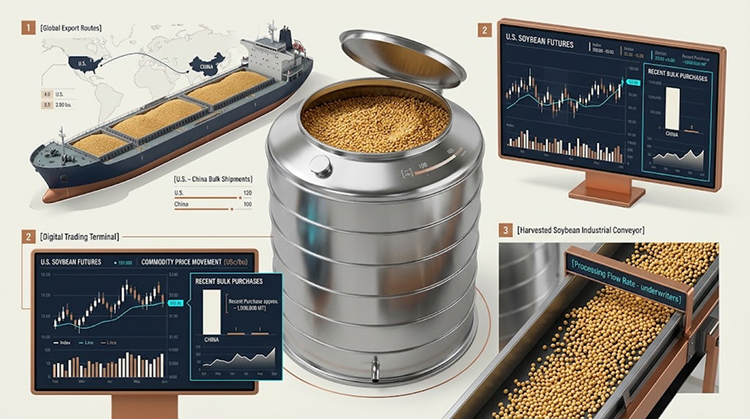
The U.S. Department of Agriculture has separately confirmed several recent sales to China. USDA’s Foreign Agricultural Service reported sales of 192,000 metric tons on September 3, 202,000 metric tons on September 2, and 136,000 metric tons on September 1 for delivery to China during the 2026/27 marketing year. Earlier August transactions also included several large purchases, including 333,000 metric tons announced on August 26.
These announcements show that the latest purchase is part of a broader acceleration in Chinese buying rather than an isolated transaction.
For U.S. farmers, that distinction matters. A single large sale can move markets temporarily, but sustained export commitments have greater potential to change the balance between expected production and demand.
The USDA’s soybean market outlook provides the broader production context behind the new buying.
The U.S. Soybean Crop Is Large Enough To Benefit From More Export Demand
The 2026 U.S. soybean crop is expected to be one of the largest on record. USDA’s August outlook projected harvested soybean acreage at 85.8 million acres, a substantial increase from the previous year’s harvested area. The agency also forecast a national yield of 52.7 bushels per acre and production of approximately 4.52 billion bushels.
That larger crop creates an important marketing question.
American farmers need sufficient domestic and export demand to absorb the additional production without putting excessive pressure on prices. USDA’s August soybean outlook projected 2026/27 exports at 1.66 billion bushels, while the season-average farm price forecast stood at $11.40 per bushel. Ending stocks were projected at 320 million bushels.
Chinese buying can therefore have an outsized effect on the market because it strengthens one of the most important demand channels available to U.S. producers.
The relationship between production and demand is also important for agricultural market planning. Farmers who are deciding whether to sell at harvest, store soybeans or wait for later marketing opportunities need to consider export demand alongside crop size, basis levels, transportation costs and competing supplies.
The new purchases do not guarantee higher prices throughout the marketing year, but they remove one major source of uncertainty that has weighed on the U.S. soybean market.
Brazil Remains The Biggest Competitive Threat
China’s decision to purchase U.S. soybeans does not mean American exporters have regained a permanent advantage over Brazil.
Brazil remains the world’s largest soybean exporter and has built an enormous supply chain around Chinese demand. Brazilian producers, exporters and infrastructure operators have spent years expanding their ability to move soybeans into Asian markets.
That creates a competitive challenge for U.S. farmers even as Chinese buyers return.
Reuters reported that tightening supplies from Brazil are one factor behind the recent increase in Chinese interest in U.S. soybeans. Brazilian availability can change the economics of Chinese purchases, particularly when freight, currency movements and seasonal harvest patterns alter the relative price of South American and U.S. supplies.
The seasonal advantage also changes throughout the year. Brazil’s crop enters the global market earlier, while the U.S. becomes increasingly competitive as its harvest approaches. The timing of China’s latest purchases therefore gives American exporters an opportunity to capture demand during a period when the U.S. crop is moving toward commercial availability.
This is one reason soybean farmers watch export sales announcements closely. The destination of a sale can be almost as important as the size of the transaction because it reveals where international buyers are sourcing physical supplies.
A 25 Million-Ton Commitment Changes The Market Conversation
The reported annual commitment of 25 million metric tons is especially important because it creates a much larger framework for evaluating individual purchases.
A commitment of that size would represent a major export relationship for U.S. agriculture. However, farmers and traders still need to distinguish between a policy commitment and actual shipment volumes.
The latest buying activity provides evidence that Chinese buyers are moving toward fulfilling the agreement. Reuters reported that the purchases made this week bring China close to half of the annual 25 million-ton commitment. USDA’s separate export announcements provide additional confirmation that Chinese purchases have continued through late August and early September.
That distinction matters because physical deliveries ultimately determine whether the additional demand reaches elevators, processors, exporters and farmers.
For soybean producers, the most important signal will therefore be whether the recent buying continues after the headlines surrounding the expected presidential meeting fade.
A sustained flow of orders would have a much stronger impact on the market than a short period of politically motivated purchasing.
The Expected Xi Visit Adds A Political Dimension
The timing of the soybean purchases has naturally connected the agricultural market to the expected meeting between Donald Trump and Xi Jinping.

Trump said in July that Xi would visit Washington on September 24, although Chinese officials had not confirmed the date or the full details of the visit as of September 10. U.S. Trade Representative Jamieson Greer said on September 3 that agriculture and non-tariff trade barriers were expected to be part of announcements connected to Xi’s visit.
That makes soybeans more than a commodity story.
Agricultural trade has become one of the most visible areas of U.S.-China economic relations because American farmers depend heavily on international markets while Chinese livestock producers depend on imported feed ingredients.
Soybeans sit directly in the middle of that relationship.
China imports soybeans primarily for crushing into soybean meal and soybean oil. Soybean meal is widely used in animal feed, meaning Chinese demand is connected to the country’s pork, poultry and aquaculture industries.
A stronger U.S.-China soybean relationship can therefore affect agricultural markets in both countries.
Tariffs Still Create Uncertainty For U.S. Soybean Farmers
The recent purchases should not be interpreted as proof that all trade barriers have disappeared.
Reuters reported that a 10% tariff on U.S. goods remains in place, while a reduction in tariffs could encourage additional purchases by private Chinese buyers. That means the commercial environment remains different from a completely open trading relationship.
Tariffs affect more than the headline price of soybeans. They influence purchasing decisions, margins, freight economics and the willingness of private companies to enter into longer-term contracts.
State-owned Chinese enterprises may have different strategic considerations from private crushers and feed companies. If tariff conditions become more favorable, private buyers could potentially become more active in the U.S. market.
That would create a broader demand base rather than leaving large portions of U.S. soybean exports dependent on government-linked purchasing decisions.
For American farmers, diversification within the Chinese market could therefore be almost as important as the size of the total commitment.
U.S. Soybean Farmers Need More Than A Single Export Surge
The immediate market reaction to the 1 million-ton purchase may be positive, but farmers still face several variables that could determine soybean profitability through the 2026/27 marketing year.
Production remains the first variable. USDA expects a large crop, which means higher supply can limit price gains even when export demand improves.
Global competition is the second. Brazil and other exporters remain capable of supplying China, particularly when currency movements and seasonal availability favor South American soybeans.
Domestic demand is another factor. USDA raised its 2026/27 U.S. soybean crush forecast to approximately 2.78 billion bushels, reflecting continued demand for soybean meal and oil. Global soybean crush is also projected to increase substantially during the marketing year.
This combination gives the U.S. soybean market several sources of demand rather than relying entirely on exports.
That is important because a large crop requires a large market. If exports, crushing and biofuel-related demand remain strong at the same time, farmers have a better chance of moving additional production without excessive inventory accumulation.
The New Buying Could Influence 2027 Planting Decisions
Soybean prices also influence planting decisions well beyond the current harvest.
Farmers compare expected soybean returns with corn, wheat, cotton and other crops before committing acreage for the following season. Stronger soybean export demand can improve the relative economics of soybeans even if the national crop is large.
The 2026 USDA Acreage report already showed the importance of that calculation. Farmers planted approximately 85.4 million acres of soybeans in 2026, up 5% from the previous year, while corn acreage declined 3%. That shift increased the potential soybean supply available to domestic processors and international buyers.
The new Chinese purchases could reinforce the idea that global soybean demand remains capable of absorbing additional U.S. production.
However, farmers are unlikely to make 2027 decisions based on one week of export activity. They will also consider fertilizer costs, land values, crop insurance, weather risk, expected basis levels and projected corn and soybean prices.
The soybean market therefore needs sustained demand before the recent purchases become a major planting signal.
The Next USDA Reports Will Matter
The timing of the Chinese purchases also comes immediately before another important period for U.S. agricultural markets.
USDA’s September Crop Production report is scheduled for September 11. That report will provide another update on production expectations as the 2026 harvest begins to develop in major soybean-producing states.
The combination of new export demand and updated production estimates could produce a clearer picture of the soybean balance sheet.
If USDA reduces production expectations while Chinese purchases remain strong, the market could become considerably tighter.
If production remains large or increases while export demand slows, the effect could be very different.
That is why the next several weeks are more important than the headline surrounding a single 1 million-ton purchase.
China’s Buying Gives U.S. Soybeans A Stronger Position
The most significant feature of China’s latest purchase is the combination of volume, timing and political importance.
Approximately 1 million metric tons of U.S. soybeans purchased in one week represents substantial demand. The purchases arrive just before the expected Xi-Trump meeting, during a period when Brazil’s supplies are becoming tighter and when U.S. farmers are approaching the main harvest window.
At the same time, the market still has to deal with tariffs, competing South American supplies and the prospect of a large U.S. soybean crop.
For American farmers, the strongest outcome would not be a temporary surge in Chinese purchases. It would be a sustained export relationship that continues through the 2026/27 marketing year and gives U.S. soybeans a dependable position in China’s feed and crushing system.
That would create a more favorable environment for farmers entering harvest and could influence acreage decisions well into 2027.
The latest purchases therefore matter because they show that Chinese demand for U.S. soybeans is moving again at a moment when American producers have more crop to sell. Whether that becomes a durable market shift will depend on what happens after the diplomatic headlines pass, how much China actually takes from U.S. exporters, and whether future trade agreements reduce the barriers that still separate the world’s two largest agricultural economies.