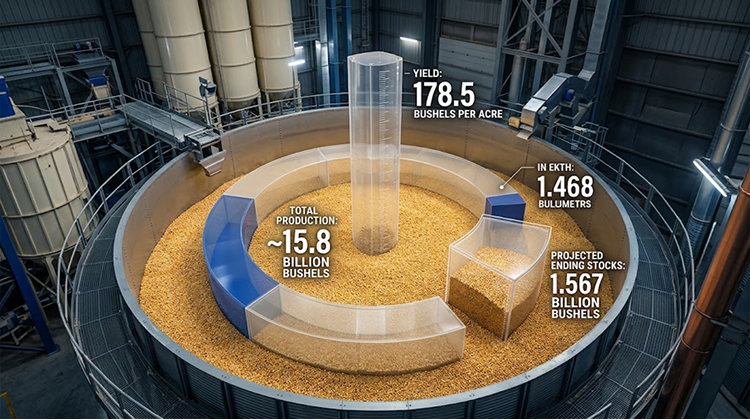
The U.S. corn market entered the 2026 harvest with a lower production outlook after the U.S. Department of Agriculture reduced its national corn yield forecast to 178.5 bushels per acre in its September 11 Crop Production report. The estimate is 2.2 bushels below the August forecast of 180.7 bushels and takes approximately 213 million bushels out of expected production.
USDA now projects the 2026 corn crop at approximately 15.8 billion bushels, compared with 16.013 billion bushels in August. Harvested acreage was also reduced slightly to about 88.5 million acres, while planted acreage was raised to approximately 96.8 million acres.
The reduction comes as harvesting has already begun across parts of the Corn Belt. USDA’s September 8 Crop Progress report showed 5% of the U.S. corn crop harvested, ahead of the five-year average of 3%. At the same time, national crop condition fell to just 56% good to excellent, the lowest rating of the season.
The combination of lower yield expectations, deteriorating crop conditions and an accelerating harvest gives the September report greater significance for farmers, grain elevators and commodity markets.
USDA Lowers The 2026 Corn Yield Forecast
The September USDA estimate confirms that the record-sized corn crop expected earlier in the summer has lost some production potential.
USDA lowered the national yield forecast from 180.7 bushels per acre in August to 178.5 bushels. The reduction is equivalent to more than two bushels per acre across the nation’s harvested corn area, creating a substantial change in the total production estimate.
The agency now expects approximately 15.8 billion bushels of corn production during the 2026/27 marketing year. That compares with about 17.02 billion bushels produced in 2025, meaning the new crop is projected to be roughly 7% smaller than last year’s crop.
The decline is important because farmers entered the 2026 growing season with expectations for a large corn supply. USDA’s March Prospective Plantings report initially indicated 95.3 million acres planted to corn, while later acreage revisions have pushed the September planted estimate to approximately 96.8 million acres.
The larger planted area has therefore failed to fully offset weaker yield expectations.
The latest USDA Crop Production data provides the official acreage, yield and production estimates used throughout the agricultural market.
Harvest Has Started While Crop Conditions Deteriorate
The production reduction arrives at the same time that farmers are beginning to take corn out of the field.
USDA reported on September 8 that approximately 5% of the nation’s corn crop had been harvested. That was ahead of the five-year average of 3%, indicating that field activity was moving faster than normal even though the overall crop had experienced significant stress.
The condition numbers were more concerning.
Only 56% of U.S. corn was rated good to excellent, down from 57% the previous week and 68% at the same point a year earlier. The decline demonstrates how different the 2026 crop looks compared with the previous season.
The condition rating is particularly useful because it provides a weekly measurement of how the crop is progressing before final production numbers become available. USDA’s Crop Progress survey collects information from reporters across the country, with reports covering more than 75% of the acreage of major commodities.
That makes the weekly data an important indicator for producers and traders trying to determine whether the September yield reduction is sufficient.
The USDA Crop Progress program also provides weekly information on maturity, harvesting and crop conditions across the major producing states.
Iowa And Illinois Show A Wide Difference In Crop Performance
The national average hides significant differences between states.
In Iowa, the country’s leading corn-producing state, USDA reported that 96% of the crop had reached the dough stage by September 6. Another 79% had reached the dented stage and 17% had reached maturity. Despite weather concerns, Iowa corn was still rated 77% good to excellent.
Iowa State Climatologist Justin Glisan reported that the state experienced one of its hottest starts to September on record. The statewide average temperature for the week was 79.8 degrees Fahrenheit, more than 11 degrees above normal.
Iowa Secretary of Agriculture Mike Naig said farmers were preparing for harvest while waiting for corn and soybeans to dry down and fully mature.
The situation was different in Illinois.
USDA reported Illinois corn at only 55% good to excellent, with 96% in the dough stage, 76% dented and 29% mature. Harvest had reached 3% statewide.
The contrast between Iowa and Illinois illustrates why national yield estimates can change as more fields reach maturity and combines begin harvesting.
A national forecast is ultimately an aggregation of conditions across thousands of fields. Strong areas can offset weaker regions, but significant losses in major producing states can quickly alter the national balance sheet.
Heat And Dry Conditions Changed The Harvest Timeline
Weather played a major role in the 2026 corn outlook.
In Illinois, farmer Jeff Scates, who farms in Gallatin and White counties, reported that harvest started around August 20, at least a week earlier than normal. By September 8, he had harvested approximately one-third of his corn and one-quarter of his soybeans.
Scates attributed the accelerated pace to late-season heat, which pushed crops through drydown faster than expected.
His observations provide an important field-level perspective on the national numbers. Corn that reaches harvest moisture sooner can reduce drying requirements and allow farmers to move grain earlier, but rapid maturity does not automatically mean higher yields.
The crop still has to finish filling kernels before harvest.
That distinction is especially relevant during a season in which national crop conditions have fallen steadily. Earlier harvest can be helpful operationally, but it also brings the market closer to the point where actual yields begin replacing survey-based expectations.
For farmers, that transition can be more informative than any single USDA forecast.
The Lower Yield Estimate Tightens The Corn Balance Sheet
USDA’s September supply-and-demand figures also show why the yield reduction matters for prices.
The agency lowered projected 2026/27 ending stocks to 1.567 billion bushels, down 86 million bushels from the August estimate of 1.653 billion.
USDA also increased the projected season-average farm price for corn by 30 cents to $4.80 per bushel.
The relationship is straightforward. A smaller crop reduces supply, while unchanged or relatively strong demand can prevent inventories from building as quickly.
However, 1.567 billion bushels is still a substantial amount of corn.
That means the September report does not create a shortage. Instead, it moves the market toward a tighter supply situation than USDA projected one month earlier.
The difference matters for farmers deciding how aggressively to sell newly harvested grain.
| USDA Corn Outlook | August 2026 | September 2026 |
|---|---|---|
| Yield | 180.7 bu./acre | 178.5 bu./acre |
| Production | 16.013 billion bu. | 15.800 billion bu. |
| Ending Stocks | 1.653 billion bu. | 1.567 billion bu. |
| Season-Average Farm Price | $4.50/bu. | $4.80/bu. |
The lower production forecast and higher price projection suggest USDA sees a more balanced market than it did in August.
Demand Will Determine How Much The Yield Cut Matters
Production is only one side of the corn market.
USDA projects 2026/27 domestic corn use at approximately 12.905 billion bushels, including 5.95 billion bushels for feed and residual use and 5.6 billion bushels for ethanol and related products.
Exports are projected at approximately 3.275 billion bushels.
That export number is important because the United States remains one of the world’s largest corn suppliers, but competition from Brazil, Argentina, Ukraine and other exporters continues to influence global trade.
A smaller U.S. crop therefore does not automatically translate into sharply higher prices. Buyers can respond to higher U.S. prices by purchasing corn from competing origins when logistics and availability make those alternatives attractive.
Domestic demand provides another stabilizing factor.
The U.S. ethanol industry consumes billions of bushels of corn annually, while livestock producers depend heavily on corn for feed. These domestic markets create a large underlying demand base that can absorb a significant portion of the annual crop.
The September USDA WASDE report shows how production, exports, domestic use and ending stocks interact in the broader corn balance sheet.
Corn Prices Are Getting A Different Signal From The Field
The September report also changes the price conversation.
USDA’s increase in the projected season-average farm price from $4.50 to $4.80 per bushel reflects the tighter balance sheet created by lower production and stocks.
That does not mean farmers will receive exactly $4.80 for every bushel.
The season-average farm price is a national estimate. Actual farm-level prices vary according to location, basis, delivery period, storage availability, transportation costs and local demand.
For a farmer in Iowa, Illinois or Nebraska, the relevant price may be significantly different from the national average.
The harvest itself can also pressure local cash prices. When large numbers of farmers deliver corn at the same time, elevators and processors may have limited space and transportation capacity. Local basis levels can weaken even when futures prices remain relatively firm.
This is why precision agriculture planning increasingly extends beyond field-level decisions. Producers need accurate information about yield potential, harvest timing, grain moisture, local basis and storage economics before deciding when to move grain.
For farmers entering harvest, the September yield reduction improves the broader supply outlook, but individual farm profitability will still depend on the actual yield coming out of each field.
The National Crop Still Contains Major Regional Risks
The national 178.5-bushel yield estimate should also be viewed as a moving target.
USDA’s weekly crop reports continue to provide evidence of significant regional differences.
As of September 6, Pennsylvania corn was rated 91% good to excellent, while Iowa stood at 77%. Tennessee was at 79%, Indiana at 62%, Ohio at 61% and Wisconsin at 62%.
Other states were considerably weaker.
Nebraska stood at 53% good to excellent, Kansas at 41%, South Dakota at 42%, Texas at 35%, Colorado at 35%, North Dakota at 19% and North Carolina at only 13%.
These differences are important because corn production is geographically concentrated.
A strong crop in Iowa cannot fully compensate for severe losses in other areas if those regions represent a meaningful portion of national acreage. Conversely, weak conditions in one state do not necessarily indicate a national production collapse.
The final outcome will emerge field by field as harvest progresses.
Early Harvest Results Could Change The Market Quickly
The next major source of information will come from actual harvested yields.
USDA forecasts are based on surveys, statistical models and available acreage information. Once farmers begin harvesting, field-level results provide another layer of evidence.
That transition can create significant volatility.
If early yields are better than expected, traders may begin questioning whether the 178.5-bushel national estimate is too low. If early yields disappoint, the market may begin pricing in another reduction before USDA’s October report.
The timing is particularly important because only 5% of the crop had been harvested as of September 6.
Most of the crop remained in the field.
That means there is still considerable uncertainty around final production. Corn in later-maturing regions has more time to finish filling, while crops already affected by heat or moisture stress may have limited potential to recover.
The September number is therefore an important benchmark rather than a final answer.
The 2026 Crop Is Smaller But Still Historically Large
Despite the production reduction, 15.8 billion bushels would still represent an enormous U.S. corn crop.
The important comparison is not simply whether production is higher or lower than last year’s number. Farmers and traders must consider the size of the crop relative to total demand.
The 2025 crop was approximately 17.02 billion bushels, meaning the 2026 estimate is about 1.22 billion bushels smaller.
That is a meaningful reduction.
But demand has also changed, and beginning stocks remain substantial. USDA’s September balance sheet shows that the U.S. corn market still has enough supply to support domestic consumption and exports without entering an immediate shortage.
The market is therefore moving from an exceptionally large supply situation toward a more balanced one.
That distinction could shape price behavior throughout the 2026/27 marketing year.
Farmers Face A More Important Harvest Marketing Decision
For producers, the September report creates a complicated marketing environment.
The higher USDA price projection is encouraging, but the actual value of the crop will depend on local conditions.
A farmer with excellent yields and adequate storage may have more flexibility than a producer whose crop suffered from heat or drought and needs immediate cash flow. Grain quality and moisture can also influence the value received at the elevator.
The new USDA numbers make one point clear: yield uncertainty remains one of the most important variables in the 2026 corn market.
Farmers should therefore compare actual harvest results with their original yield expectations rather than relying solely on the national forecast.
A 178.5-bushel national average does not tell an individual producer whether a particular field will produce 210 bushels, 170 bushels or substantially less.
Local data will become increasingly valuable as combines move across the Corn Belt.
September Data Sets Up A Closely Watched October Report
The September 11 report will not be the last major adjustment to the 2026 corn outlook.
USDA is scheduled to release its next Crop Production report on October 9, 2026, when substantially more of the crop should have been harvested.
By then, the market will have access to a much larger collection of actual yield observations.
That could confirm the 178.5-bushel estimate or force another revision.
The September report therefore marks a transition point in the 2026 corn season. Forecast models and field surveys still dominate the national estimate, but actual harvest results are rapidly becoming more important.
For grain markets, that shift can produce a very different trading environment from the one seen during July and August.
The 2026 Corn Market Is Moving From Forecasts To Evidence
USDA’s decision to lower the 2026 corn yield forecast to 178.5 bushels per acre confirms that production potential has deteriorated from the exceptionally high expectations seen earlier in the season.
The reduction of approximately 213 million bushels brings projected production to 15.8 billion bushels, while ending stocks fall to 1.567 billion bushels and the season-average farm price rises to $4.80.
At the same time, the crop is already moving into harvest.
That makes the next several weeks especially important. The national condition rating has fallen to 56% good to excellent, while state results range from very strong conditions in Iowa and Pennsylvania to serious stress in North Dakota, North Carolina, Texas and other areas.
The market now has two competing sources of information: USDA’s statistical forecast and the actual yields coming out of farmers’ fields.
As harvest expands across the Corn Belt, those two signals will begin converging. If field results confirm USDA’s lower estimate, the tighter balance sheet could provide continued support for corn prices. If yields outperform expectations, the market could once again face pressure from a larger-than-feared supply.
For farmers, elevators, ethanol producers and grain traders, the 2026 corn harvest has entered the phase where every truckload can provide more information than another forecast.