China’s soybean market is entering a more cautious phase just as the U.S. harvest moves into its most important period. Chinese soybean inventories at crushing plants have reached their highest level in at least 15 years, private crushers are dealing with negative margins, and demand for soybean meal is facing pressure from a smaller hog herd and efforts to reduce excess capacity in China’s livestock industry.
The timing is significant for U.S. farmers.
USDA reported September 28 that 17% of U.S. soybeans had been harvested as of September 27, matching the five-year average. The crop was rated 58% good to excellent, while the national production forecast remained near 4.5 billion bushels.
Normally, the arrival of the U.S. crop gives China an opportunity to increase purchases from the world’s second-largest soybean producer. This year, however, the commercial market is facing a different set of incentives.
China’s private crushers have already covered much of their needs through early February with soybeans from Brazil, Argentina and domestic reserves, according to Reuters reporting on September 30. At the same time, U.S. soybeans remain subject to an additional 10% Chinese tariff, while the latest U.S.-China tariff agreement excluded soybeans from the products receiving reductions.
That leaves U.S. exporters facing a difficult combination: a large new crop, peak harvest availability and a major customer that currently has less financial incentive to buy more.
China Has Imported More Soybeans This Year
China’s weakening demand should not be confused with a collapse in soybean imports.
The country remains the world’s largest soybean importer, and customs data showed that China imported 74.11 million metric tons of soybeans from January through August 2026, up 1.1% from 73.33 million tons during the same period in 2025. August imports reached 12.14 million tons, down 1.1% from August 2025 but up 5.7% from July.
The important change is occurring in the outlook for the final months of the year.
Chinese buyers have been able to build supplies through heavy purchases from Brazil, whose record crop has provided large volumes at competitive prices. Brazil’s crop also arrived with efficient port logistics, giving Chinese crushers another source of supply while the U.S. crop was still developing.
The USDA soybean market outlook forecasts U.S. soybean production at approximately 4.5 billion bushels for the 2026/27 marketing year, with exports at 1.69 billion bushels and domestic crush at 2.78 billion bushels.
That means the United States has plenty of soybeans entering the market, but the timing of Chinese purchases has become less certain.
Chinese Soybean Inventories Have Reached A 15-Year High
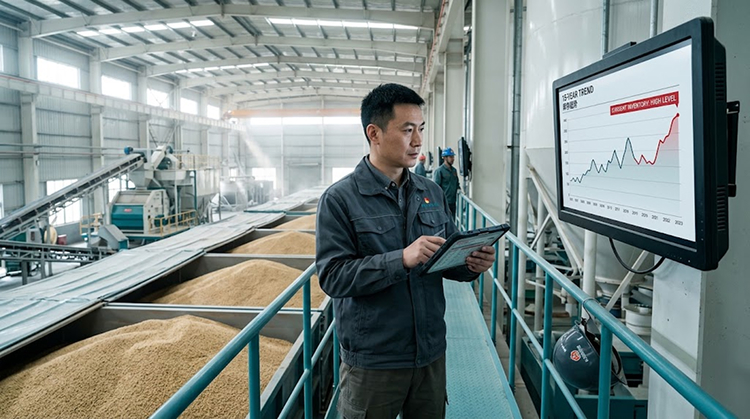
The most important new signal is coming from China’s crushing plants rather than from import totals.
Reuters reported September 30 that soybean inventories at 111 Chinese crushing plants reached 7.96 million metric tons during the week of September 25, the highest level in at least 15 years. A recent Sinograin auction also showed weak buying interest, with only 37.3% of the 514,000 tons offered being sold.
High inventories change the economics of new purchases.
A crusher that already has substantial stocks has less reason to pay a premium for additional cargoes, especially when margins are negative.
This is particularly relevant for U.S. soybeans because the commercial buyer must account for the tariff before determining whether an American cargo can generate a profit after crushing.
Reuters reported that import margins for U.S. soybeans were significantly negative, while Brazilian and Argentine supplies were more competitive for private buyers. Brazilian soybeans were quoted around $590 per metric ton including cost and freight this week, excluding the U.S. tariff effect.
The result is a market in which China’s physical soybean supply is large enough to reduce the urgency for new purchases.
Private Crushers Are Facing Negative Margins
The crushing margin is central to China’s soybean demand.
Processors buy whole soybeans and convert them into soybean meal and soybean oil. Their profitability depends on the value of those products relative to the cost of imported beans.
If meal demand weakens while inventories rise, the crusher has less incentive to purchase additional soybeans.
Reuters reported that crushers in Rizhao, one of China’s major soybean-processing centers, were losing approximately 33.54 yuan per metric ton on soybean processing on September 29. November-shipment soybean crushing margins were also reported to be negative for U.S. Pacific Northwest and Gulf cargoes.
The situation creates a direct connection between Chinese livestock demand and American soybean prices.
A weaker Chinese feed market reduces the value of soybean meal. Lower meal values reduce crushing margins. Lower margins discourage new soybean purchases. Reduced import demand then removes one of the strongest sources of demand from the global soybean market.
That chain can influence U.S. basis levels, export premiums and futures prices even when American farmers are harvesting a large crop.
The Hog Sector Is Becoming A Demand Risk
China’s hog industry is another important part of the equation.
Soybean meal is a major protein ingredient in livestock feed, so changes in hog production can affect soybean demand. Reuters reported that Chinese soybean demand is expected to soften during the fourth quarter as sow numbers decline and government efforts to address hog-industry overcapacity reduce feed requirements.
This does not mean Chinese livestock production has suddenly disappeared.
It means the rate of soybean consumption may be changing.
A smaller breeding herd can reduce the number of animals requiring feed over time. If producers are also reducing excess production capacity, crushers may face less demand for soybean meal even while soybean inventories remain elevated.
The timing matters because U.S. soybeans are entering the global market precisely when Chinese crushers are becoming more selective.
The 10% U.S. Soybean Tariff Is Still Blocking Private Buyers
Trade policy remains one of the biggest differences between U.S. soybeans and competing origins.
Following the September Washington summit between President Donald Trump and President Xi Jinping, the United States and China agreed to pursue tariff reductions covering $60 billion in goods, with each side identifying $30 billion in non-sensitive imports. Several U.S. agricultural products were included, including corn, wheat, meat and dairy.
Soybeans were excluded.
That leaves the additional 10% tariff on U.S. soybeans in place.
For Chinese state-owned companies, that does not completely eliminate U.S. purchases. State buyers have already purchased substantial volumes of American soybeans.
For private crushers, however, the tariff can make the difference between a profitable and unprofitable shipment.
This is why the current market has developed two different types of Chinese demand: state purchasing connected to trade commitments and commercial purchasing driven primarily by crushing economics.
State Buyers Have Already Purchased Large U.S. Volumes
Chinese state-owned buyers have still provided meaningful support for U.S. soybean exports.
Reuters reported in late September that state-owned companies had purchased more than 12 million metric tons of U.S. soybeans, approaching half of the 25 million tons per year that the White House said China committed to purchase through 2028.
USDA’s Foreign Agricultural Service also continued to record individual soybean sales to China during September. On September 24, private exporters reported a sale of 120,000 metric tons for delivery to China during the 2026/27 marketing year. Earlier September announcements included 111,000 tons on September 18 and 272,000 tons on September 10.
These sales show that Chinese demand has not disappeared.
But the composition of that demand matters.
State-owned purchases can support American exports even when private crushers cannot make the numbers work. If state purchasing slows and private buyers remain absent, the U.S. market loses an important source of incremental demand.
That is precisely the risk developing as the U.S. harvest expands.
Brazil And Argentina Are Taking More Of The Commercial Business
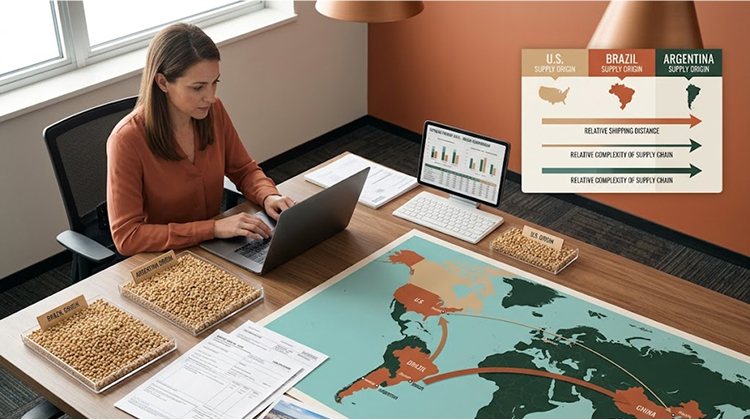
South America has become especially important because private Chinese crushers have already secured substantial volumes there.
Reuters reported September 30 that private processors had covered most of their requirements through early February using supplies from Brazil and Argentina, as well as Chinese state reserves. Chinese buyers booked around 50 soybean cargoes during the first three weeks of September, the fewest in four years, according to Marex strategist Eduardo Vanin.
The preference is partly economic.
Brazil has a large supply base and has been able to provide competitively priced soybeans during China’s current buying window.
Brazil’s advantage is particularly significant because its soybean production cycle gives Chinese buyers access to South American supplies at a time when U.S. farmers are harvesting their own crop.
The U.S. therefore needs to compete on delivered cost rather than simply having soybeans available.
For American producers, this makes soybean market planning more dependent on export destination, transportation costs and the strength of the local basis.
The U.S. Harvest Is Entering The Market At A Difficult Moment
USDA’s September 28 report showed that the U.S. soybean harvest had reached 17% completion by September 27, equal to the five-year average. The crop was 58% good to excellent, and 75% had dropped leaves.
That puts the U.S. crop increasingly into the physical supply chain.
For farmers, that means more soybeans are moving from fields into elevators, processors and export terminals.
For the international market, however, it also means more American supply is competing for buyers at the exact moment China is showing less urgency.
The market does not need to experience a physical shortage for prices to weaken.
If U.S. supply increases faster than export demand, elevators and processors may have to absorb more grain domestically.
That can create storage pressure.
It can also widen the difference between futures prices and local cash bids.
The size of the U.S. crop therefore becomes more important as the harvest advances.
U.S. Soybean Prices Are Facing A Demand-Side Test
The futures market has already reacted to the changing trade outlook.
November soybean futures closed at $12.97¾ per bushel on September 29, according to market reporting, after recovering part of the previous session’s decline. The contract had fallen below $12.90 earlier in the week as traders reacted to the exclusion of soybeans from China’s tariff reductions.
The market is therefore dealing with two opposing forces.
On one side, U.S. soybean production is large, harvest is progressing and South American competition remains significant.
On the other side, domestic soybean crush demand remains substantial, biofuel demand supports soybean oil and Chinese state buyers continue to purchase some U.S. cargoes.
The balance between those forces will determine whether the harvest creates sustained price pressure or whether domestic and export demand can absorb the incoming crop.
Domestic Crush Demand Gives U.S. Soybeans Another Outlet
The United States is not entirely dependent on China.
USDA expects U.S. soybean crushers to process 2.78 billion bushels during the 2026/27 marketing year, unchanged in its September forecast. That is a massive domestic demand base and gives farmers an alternative market for their crop.
The domestic crush industry is especially important because soybean processing produces two valuable commodities: soybean meal and soybean oil.
Soybean meal supports livestock feed demand, while soybean oil has become increasingly important for biofuel production.
That means U.S. processors can absorb a substantial share of the crop even when export demand becomes less certain.
However, domestic crush cannot completely replace China’s role in the global soybean market.
China remains the largest soybean importer, and its purchasing decisions influence the international price structure.
If Chinese demand slows while U.S. domestic crush remains strong, American processors may become more important to farm prices, but export terminals could face a different supply balance.
Export Competition Could Intensify Through The Winter
The competition between origins will become even more important as the marketing year progresses.
U.S. soybeans are available now.
Brazil and Argentina are also active suppliers, while China’s reserves provide another source of inventory.
The commercial buyer can therefore compare several origins.
Price, freight, tariff treatment, oil content, meal value and delivery timing all influence that decision.
Reuters reported that Brazilian soybeans were particularly competitive for Chinese processors because of their delivered cost and typically higher oil content.
That creates a difficult environment for U.S. exporters.
American farmers can produce a large crop, but production volume alone does not guarantee strong export demand.
The crop must also reach markets at a price that allows foreign processors to earn a margin.
The U.S. Crop Still Has A Strong Domestic Demand Base
The weakening Chinese outlook should therefore be viewed alongside the strength of the U.S. domestic soybean industry.
USDA raised its 2026/27 U.S. soybean production forecast by 16 million bushels to 4.5 billion bushels in September. Planted acreage was raised to 86.9 million acres and harvested acreage to 85.9 million acres. The national yield estimate increased to 52.8 bushels per acre.
The agency also increased its export forecast by 25 million bushels to 1.69 billion bushels.
That means USDA still expects the United States to move substantial quantities into export markets.
The issue is whether China contributes as much to that movement as traders had hoped.
Other destinations may become more important if Chinese private buyers remain on the sidelines.
That could increase competition among U.S. exporters for alternative markets while domestic crushers continue to compete for nearby supplies.
The Next U.S. Export Reports Will Matter More
Weekly export data will provide an increasingly important measure of whether U.S. soybeans are finding enough foreign demand.
USDA reported that U.S. soybean export inspections increased to approximately 1.15 million tons in the latest week, compared with 769,698 tons the previous week.
The increase demonstrates that American soybeans are moving into international channels.
The more important question is where those shipments are going.
If China accounts for a large share of new sales, the market could receive evidence that state purchasing and trade commitments are offsetting weak private demand.
If other destinations absorb the majority of the volume, the global market may be adjusting to a different trade pattern.
That distinction will become easier to see as the harvest moves beyond its current 17% completion rate.
China’s Soybean Market Is Shifting From Volume To Margin
The latest Chinese data point to a market that is still importing huge quantities of soybeans but is becoming more selective about additional purchases.
China imported 74.11 million metric tons during the first eight months of 2026, so the country remains a massive source of global demand. But its soybean inventories at crushing plants have reached a 15-year high, private crushers are experiencing negative margins, and soybean meal demand faces pressure from changes in the hog industry.
That combination makes another large buying wave less certain.
The problem for U.S. farmers is timing.
The American harvest is arriving now.
Brazilian and Argentine supplies have already captured much of China’s near-term commercial demand.
The tariff on U.S. soybeans remains.
And Chinese crushers are carrying large inventories.
Those factors mean American soybeans are entering the export market at a moment when China’s buyers have more alternatives and less immediate need.
U.S. Soybeans Are Entering A More Competitive Export Window
The 2026 soybean market is therefore developing around a sharp contrast between U.S. supply growth and Chinese demand restraint.
American farmers are harvesting a crop USDA estimates at roughly 4.5 billion bushels. Domestic crushers are expected to process 2.78 billion bushels. The harvest is already at 17%, and state-owned Chinese companies have purchased more than 12 million metric tons of U.S. soybeans.
But China’s private crushing sector is sending a different signal.
Inventories are high.
Margins are negative.
Feed demand is becoming less supportive.
Brazilian and Argentine beans are competitive.
And U.S. soybeans remain subject to a 10% tariff that was excluded from the latest tariff-reduction agreement.
The result is a U.S. soybean market entering its peak harvest period without the same level of certainty about Chinese commercial demand that farmers would normally expect.
The next stage of the 2026 market will depend on whether domestic crushers, state-owned Chinese buyers and other international customers can absorb the expanding U.S. supply.
If Chinese private demand remains weak, the burden of supporting the U.S. crop will shift more heavily toward domestic crush and alternative export destinations. That makes the next several weeks of export sales, basis movements and harvest deliveries especially important for U.S. soybean producers.