Imagine if your doctor gave the same medicine to everyone, no matter their health. That’s like traditional farming, treating soil like a buffet where everyone gets the same thing.
Precision fertilization changes everything. It’s like a cooking school for farming, making sure each piece of land gets the right nutrients.
The 4R principle is at its heart: right place, correct rate, at the right moment, and right quality. It’s not just farming; it’s a mix of soil care and data science.
It’s like being mindful in agriculture. Instead of just throwing nutrients around, we listen to what the land needs.
Choosing the Right Tech
Entering the world of modern farm tech is like stepping into a high-tech lab. It’s not just about picking tools; it’s about selecting cutting-edge solutions. You’ll find drones that map fields with incredible detail and soil probes that analyze dirt with wine connoisseur precision.
Variable rate technology is a game-changer. It turns uniform fertilizer application into targeted, precise actions. This tech understands your field’s unique needs, unlike anything your grandfather used.
Soil Data Interpretation
Raw data is like having all the ingredients for a meal but no recipe. Modern farming software turns soil sampling into actionable insights. It combines remote sensing, GPS, and yield history to create detailed fertility maps.
Algorithms then analyze soil conductivity, moisture, and nutrients. This turns underperforming soil into a solvable math problem.
Cost Savings
Let’s talk about money. Precision nutrient management boosts your bank account. It reduces costs and increases yields.
Here’s a comparison of traditional vs. precision farming:
| Approach | Fertilizer Usage | Yield Impact | Cost per Acre |
|---|---|---|---|
| Traditional Uniform Application | 100% baseline | Variable performance | $180-220 |
| Precision Variable Rate | 70-80% of baseline | 5-15% increase | $140-170 |
| Advanced Sensor-Based | 60-75% of baseline | 10-20% increase | $160-190 |
Proper variable rate technology cuts fertilizer use by 20-30% and boosts yields. It’s like jeans that make money while you sleep.
Farmers see payback in 1-3 seasons. This tech pays off faster than most farm equipment, offering ongoing benefits.
Environmental Benefits
Imagine telling your grandchildren you helped save the planet while growing their food. That’s the power of sustainable farming through precision methods. We’re not just talking about feeling virtuous – we’re discussing measurable environmental benefits that make traditional agriculture look like using a flamethrower to light a candle.
Precision fertilization acts like a botanical bouncer, only letting the right nutrients into the soil party. This targeted approach prevents mineral runoff from turning our waterways into murky science experiments. Remember that pea soup river from environmental documentaries? Precision agriculture ensures our rivers stay clear enough to actually see the fish swimming beneath.
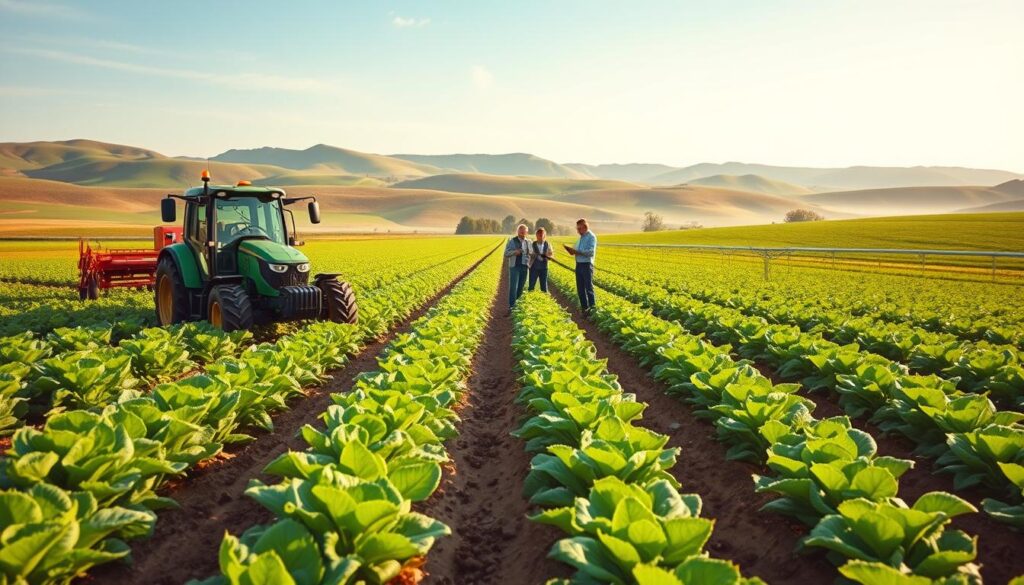
The climate impact might be the most impressive feat. When we apply fertilizers with surgical precision, we dramatically reduce greenhouse gas emissions. Nitrous oxide – that pesky atmospheric villain – gets minimized because plants actually use what we give them rather than letting it evaporate into the atmosphere. It’s like giving Mother Nature a spa day instead of dumping chemical waste in her bathwater.
According to recent studies, precision agriculture techniques significantly decrease nutrient leaching while lowering our carbon footprint. We’re not just growing crops – we’re growing solutions.
| Traditional Farming | Precision Agriculture | Environmental Impact |
|---|---|---|
| Broadcast fertilization | Targeted application | 40-60% less runoff |
| Uniform treatment | Zone-specific management | 30% fewer emissions |
| Seasonal applications | Real-time adjustments | 50% less leaching |
| Chemical-intensive | Data-driven decisions | Healthier ecosystems |
This isn’t just about saving the planet today. It’s about ensuring future farmers inherit something better than agricultural scratch tickets. Precision methods prove we can have our cake (or corn, or wheat) and eat it too without poisoning the kitchen.
The numbers speak louder than any environmental activist ever could. When we get precise with our farming, everyone wins – except maybe the companies selling excess fertilizers.
Field Examples
Ever wonder what happens when lab theories meet real dirt? The results can be surprisingly brilliant. Unlike controlled experiments, actual fields throw curveballs – unpredictable weather, stubborn soil, and crops that sometimes act like moody teenagers.
Take ICL’s Polysulphate®. This isn’t your grandfather’s fertilizer. It delivers four essential nutrients with the precision of a master chef seasoning a dish. Sulfur, potassium, magnesium, and calcium work together like a well-rehearsed orchestra.
Traditional options often overdose plants with nitrogen while ignoring other needs. Polysulphate® provides balanced nutrition without the dramatic flair. It’s the quiet achiever in the fertilizer world.

Then there’s Agrolution pHLow® – basically Tums for alkaline soils. High pH levels can lock away nutrients like a miser hoarding gold. This clever solution acidifies the root zone while feeding crops. It’s a two-for-one deal that plants absolutely love.
Gel-based fertilizers represent the next evolution in precision fertilization. Think of them as nutrient time-release capsules. They deliver sustenance directly to roots exactly when needed. No more feast-or-famine cycles that stress plants and waste resources.
These technologies aren’t science fiction. They’re working right now in fields across America:
- Corn farms in Iowa seeing 15% better yield consistency
- California almond orchards with reduced nutrient runoff
- Texas cotton fields requiring fewer fertilizer applications
The beauty of precision fertilization lies in its adaptability. Different crops, different soils, different challenges – all addressed with surgical accuracy rather than blanket solutions. It’s farming smarter, not harder.
Real-world results prove that targeted approaches beat brute force every time. Less waste, better yields, and happier plants. What’s not to love about that?
Cost Savings
Let’s explore the financial benefits of precision agriculture. It’s like finding a twenty in your old coat. You can save 15-30% on fertilizer and still get great yields. It’s like getting a profit without spending a dime.
Variable rate tech is like a super-smart accountant for your soil. It doesn’t just blanket your fields with fertilizer. Instead, it targets where nutrients are needed most. This makes your farm more efficient and keeps your bank account happy.
The cost of this tech pays off quickly. It’s faster than most farm equipment. It’s not just saving money; it’s making more through smart use of resources.
Here are some financial perks:
- Reduced input costs through precise application
- Maintained or increased yields despite using less fertilizer
- Long-term soil health improvements that compound savings
- Decreased environmental compliance costs through reduced runoff
Variable rate technology offers two big benefits. It cuts costs and makes your farm stronger. It’s like your field is secretly making money and now it’s sharing.
Farmers see this tech pay off in 1-3 seasons. After that, it’s all profit. It’s like having a financial advisor who knows soil science.
This isn’t just future farming; it’s smart business today. The real question is, can you afford to skip this?
Environmental Benefits
Precision nutrient management makes farms better for the environment. It cuts down on greenhouse gas emissions (Balafoutis et al., 2017) and reduces harmful runoff into waterways (Hedley, 2014). This way, we’re not just reducing harm, we’re actively making things better.
Underground, precision farming works its magic. It helps the soil hold more carbon (Qureshi et al., 2018) and boosts organic matter (Zhou et al., 2023). Your farm becomes a place where carbon is stored, not released. It’s not just sustainable; it’s regenerative, making the soil stronger.
Imagine your farm as a long-term investment in the soil’s future. By cutting down on emissions, we create a greener base for farming. Our water becomes cleaner, and the air gets fresher.
This method turns farming into a climate solution, not a problem. It’s about growing resources, not just taking them. Sustainable farming is about leaving a lasting legacy, not just making money.