The ROOTS Project has moved soybean root research from laboratory discovery toward field testing, giving farmers and crop scientists a clearer, but still early, view of how deeper roots could affect drought resilience and soil carbon. The Salk Institute announced the three-year effort on September 22, 2026, supported by an US$18 million grant from the Bezos Earth Fund. The goal is to breed soybeans with deeper roots that can store more carbon in soil and perform better under drought and disease pressure in real field conditions, according to the Salk announcement.
That framing matters because soybean drought tolerance is not a single-trait problem. Root depth, soil structure, microbial partnerships, genetics, and crop rotation all affect how plants respond when water becomes limited. The research now underway is promising, but it should be read as an evidence-building phase rather than a ready package for broad farm adoption.
ROOTS Project Moves Soybean Science Into Field Testing
What The ROOTS Project Is Testing
The ROOTS Project is focused on root traits that could help soybeans reach deeper soil moisture and place more carbon belowground. Salk’s release said the work will examine root depth, root size, levels of suberin, and plant-fungus partnerships across laboratory, greenhouse, and field studies. Suberin is relevant because it is a carbon-dense plant compound associated with longer-lasting carbon storage in roots and surrounding soil.
The project builds on six years of prior Salk plant research that identified 347 gene candidates tied to root traits and advanced 37 trait-by-crop projects. That pipeline helps explain why the new work is not starting from scratch. At the same time, field testing is a higher bar than controlled-environment screening. Heat, variable rainfall, soil compaction, pathogens, and management history can all affect whether a trait performs consistently outside research facilities.
Model projections from the project suggest that improved soybean root traits could remove 1 to 2 metric tons of CO₂ per hectare per year under field conditions, roughly 0.45 to 0.89 U.S. tons per acre. That estimate is useful for setting research targets, but it remains a projection. The practical value will depend on measured soil carbon changes, yield effects, seed availability, and whether benefits remain stable across regions.
Why Soybeans Are A Useful Test Crop
Soybeans occupy a large place in U.S. crop rotations and are often grown in areas exposed to episodic drought. A root-focused breeding program therefore has potential relevance beyond a narrow research setting. If deeper-rooted lines can maintain water access during dry periods without yield penalties, they could support resilience in soybean systems already under pressure from hotter and less predictable growing conditions.
The available project information does not identify farmer-ready ROOTS soybean varieties or farm-level economic returns. That absence is not a weakness in the science; it reflects the stage of the work. Producers should view the ROOTS Project as a research pathway to watch, not as a current seed-buying recommendation.
Field Evidence Shows Drought Resilience Is Multi-Layered
Root Traits Need Support From Soil Management
Research on deeper roots fits well with broader soil health findings. A long-term Midwest study cited in the research record compared a two-year maize-soybean rotation with a more diversified four-year rotation that included manure and oat/alfalfa intercropping. The four-year system reduced soil bulk density by 3%, reduced soil penetration resistance by 23%, and increased field-capacity water content by 16% compared with the two-year rotation.
Those results matter because a soybean plant cannot express the full value of deeper-root potential if the soil profile restricts root growth or holds too little plant-available water. In the same diversified rotation study, experimentally imposed extreme drought reduced stomatal conductance much less in the four-year system. Soybean yield in the two-year system fell by 11%, while yield loss in the four-year system was not detected.
This does not prove that rotation changes will deliver the same result on every farm. It does suggest that genetic progress and management practices should be evaluated together. Deeper-rooted soybeans may be most useful where soil conditions allow roots to explore the profile and where rotations support soil water storage.
Microbial Partnerships Add Another Research Track
Root biology also includes microbes living in and around soybean roots. A field microbiome study conducted during the 2023 growing season in Louisiana examined soybeans under severe heat and drought. Surviving plants had root endophytic communities enriched with groups including Proteobacteria, Pseudomonas, and Pantoea, while non-surviving roots were dominated by Streptomyces, according to the soybean root microbiome study.
The same study reported that bacterial strains isolated from drought-affected but surviving plants, including Acinetobacter pittii and Pseudomonas species, significantly improved drought tolerance and growth when used as soybean seed treatments. That finding supports interest in plant-microbe tools, but it does not mean every microbial product will work across all soils or weather conditions. Field validation, strain stability, formulation quality, and local agronomy will decide practical value.
The ROOTS Project includes plant-fungus partnerships among its tested traits, which aligns with this wider evidence that belowground biology may influence drought response. The caution is that microbial performance can be highly context-specific. A strain or partnership that helps in one environment may show smaller effects in another.
Genetics And Biochemistry Point To New Breeding Targets
Drought Tolerance Involves More Than Root Length
Root depth is central, but recent soybean research points to biochemical and genetic pathways that may also shape drought response. A March 2024 multi-omics study comparing drought-resistant and drought-sensitive soybean varieties identified phenylpropanoid and isoflavonoid biosynthesis pathways as central in roots. The drought-resistant variety showed stronger antioxidant enzyme activity and greater accumulation of flavonoids and phenolic acids.
That evidence helps explain why breeding for drought resilience is difficult. A plant may need physical traits, such as larger or deeper roots, and physiological traits, such as stronger antioxidant responses, to tolerate dry conditions. The best-performing soybean lines may therefore combine several mechanisms rather than rely on a single genetic change.
A 2025 genome-wide association study of 207 soybean accessions at the germination stage used about 95,000 SNP markers and identified 58 QTLs associated with drought tolerance. Of those, 10 had large contributions to phenotype variation. Candidate genes identified through combined transcriptome and network analyses offer possible targets for breeding and selection.
For farmers, the near-term message is cautious optimism. Genetic tools are improving, and root traits are gaining more attention. Yet drought tolerance remains a package of interacting traits that must be tested across soils, climates, and management systems before claims become reliable.
What Farmers Can Take From The ROOTS Project
Practical Signals Without Overstating The Case
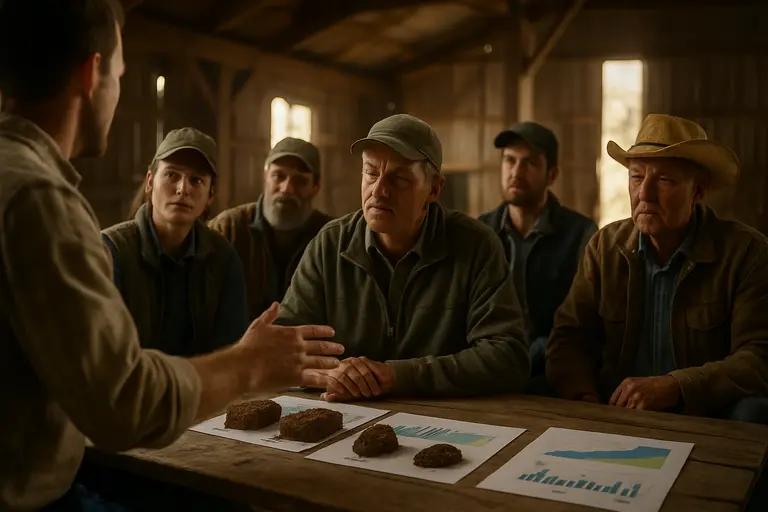
The ROOTS Project gives producers a useful signal about where soybean resilience research is heading. It also reinforces a practical point: drought risk should be addressed through several layers. Variety selection, rotation design, residue management, soil compaction control, and water-holding capacity all influence whether a soybean crop can withstand dry periods.
Farmers following this work should ask three questions as field results emerge:
- Do deeper-rooted soybean lines maintain yield under drought without yield drag in normal years?
- Are soil carbon gains measured directly across multiple environments rather than inferred only from models?
- Do microbial or plant-fungus partnerships remain effective under local soil and weather conditions?
Those questions are especially relevant in the Midwest, where expanded field trials were described as part of the project’s next stage. Related coverage on soybean resilience research tracks how gene discovery is moving toward field evaluation. This has been echoed in similar community sustainability discussions, with further insights also available through the network’s related activities at Bethel NC UMC, providing local-interest work that emphasizes agronomic evidence in decision-making.
ROOTS Project For Soybean Drought Decisions
The ROOTS Project is best understood as an applied research bridge between plant science and field-level drought management. Its funding, three-year structure, and focus on deeper roots make it one of the more visible soybean resilience efforts announced in 2026. The most useful contribution may be its emphasis on testing root traits under field conditions rather than stopping at discovery work.
Still, the evidence base is not complete. The carbon removal estimate of 1 to 2 metric tons of CO₂ per hectare per year remains a modeled target until field measurements confirm it. The drought-resilience value of deeper roots will need to be compared with yield data, soil type, rainfall timing, disease pressure, and the cost of adoption. Microbial findings are encouraging, but they also require location-specific testing.
For sustainable farming, the stronger lesson is that soybean resilience is moving belowground. Breeders, soil scientists, and microbiome researchers are now asking how roots can help crops tolerate stress while contributing to longer-term soil carbon goals. If field data support the early signals, deeper-rooted soybeans could become one part of a broader drought strategy. For now, the responsible approach is to watch the field results closely and avoid treating early research as a finished product.