North Dakota’s agricultural identity is changing as soybeans move from an increasingly important rotation crop into one of the state’s defining commodities. The shift has accelerated over the past two decades, with soybean acreage more than tripling since 2000 while new processing facilities have created a domestic market that barely existed a few years ago.
The change is especially striking because North Dakota has historically been associated with spring wheat, durum wheat, barley, canola and other northern Plains crops. Soybeans now occupy more planted acres than wheat in the state, according to the latest USDA data, although wheat remains a major source of production and revenue.
The transformation is being driven by several forces at once: improved soybean genetics, warmer growing conditions, stronger domestic biofuel demand, new crushing infrastructure and changing international trade patterns. The result is a different agricultural economy in which North Dakota farmers increasingly have a local soybean market rather than relying almost entirely on shipments out of state.
Soybeans Now Cover More Acres Than Wheat In North Dakota
USDA’s latest 2026 state agriculture data show just how far the transition has progressed. North Dakota farmers planted approximately 6.85 million acres of soybeans this year, compared with about 5.51 million acres of wheat. Soybean harvested area is estimated at 6.79 million acres, while wheat harvested area totals approximately 5.40 million acres.
The acreage difference would have been difficult to imagine several decades ago. Soybeans require a relatively short growing season in North Dakota, and frost risk has historically limited where and how reliably the crop could be produced.
The state’s soybean expansion has changed that equation. Reuters reported October 7 that North Dakota soybean plantings have more than tripled since 2000, substantially outpacing the growth of U.S. soybean acreage overall. Herbicide-resistant varieties and warmer temperatures have helped make soybean production more viable across northern production areas.
The latest USDA figures also show that North Dakota remains a significant wheat producer. The state is expected to produce approximately 264.7 million bushels of wheat in 2026, compared with an estimated 203.7 million bushels of soybeans. Soybean production therefore has not replaced wheat production outright. The more important change is that soybeans have become the state’s largest crop by planted acreage.
For farmers, that distinction matters because acreage determines how much land, equipment, storage and marketing infrastructure becomes tied to a commodity over time.
The USDA North Dakota agriculture data provide a current snapshot of how dramatically the state’s crop mix has changed.
North Dakota’s Soybean Yields Still Lag The National Average
The soybean boom has not eliminated North Dakota’s basic production challenge: the crop is being grown at the northern edge of the traditional U.S. soybean belt.
USDA’s current 2026 estimate puts North Dakota’s soybean yield at approximately 30 bushels per acre, with production estimated at 203.7 million bushels. In 2025, the state’s soybean yield was approximately 34.5 bushels per acre.
That yield level remains below the national average, which creates a major research priority for North Dakota producers. Increasing acreage is one way to expand production, but higher yields are essential if soybeans are going to become a consistently competitive crop across the state.
North Dakota State University’s soybean breeding program, led by Dr. Carrie Dottey, is specifically focused on developing high-yielding varieties adapted to North Dakota and other northern environments. The program uses breeding, genomic tools and trait selection to address the state’s unique production conditions.
The challenge is more complicated than simply finding a soybean variety that matures earlier. Early maturity can help the crop avoid autumn frost, but shorter-season varieties can sacrifice yield potential. Researchers therefore have to balance maturity, drought tolerance, disease resistance and yield.
That trade-off is central to North Dakota’s soybean future.
Breeding Soybeans For A Shorter Growing Season
North Dakota’s soybean expansion has created an unusual breeding challenge. Farmers need varieties capable of producing competitive yields while completing their reproductive cycle before damaging frost arrives.
NDSU researcher Carrie Dottey is working directly on that problem. In 2026, NDSU master’s student Sawyer Goodwin received first place in the student poster category at the James Specht Soybean Breeders Workshop for research conducted under Dottey’s direction. His work examined experimental soybean lines that cross early-maturing maturity group 0 and 00 genetics with higher-yielding later-maturity lines.
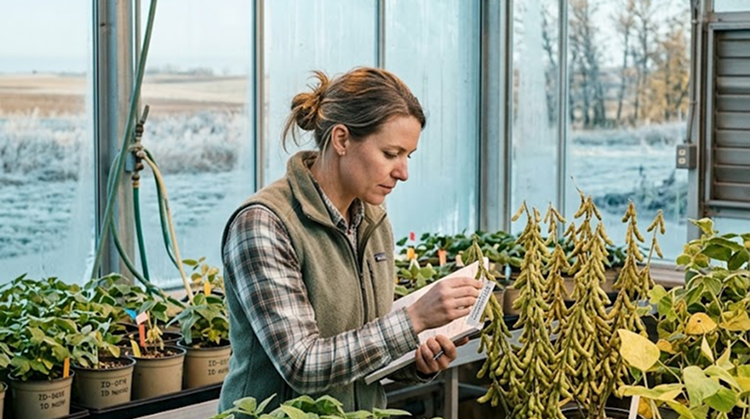
The objective is straightforward but difficult: increase yield without losing the maturity characteristics required by North Dakota’s climate.
NDSU’s breeding program also has research focused on drought. A project led by Dottey is examining sustained symbiotic nitrogen fixation as a way to improve soybean performance under low-water conditions. North Dakota’s western production areas can face limited rainfall and little irrigation infrastructure, making drought tolerance particularly valuable.
These programs demonstrate why the state’s soybean expansion cannot be explained solely by warmer temperatures.
Genetics are helping farmers make better use of the growing season they have.
The NDSU soybean breeding program is therefore becoming an important part of the state’s broader agricultural transition.
Warmer Conditions Have Expanded Soybean Opportunities
Climate is another major factor behind North Dakota’s soybean growth.
Reuters reported that warmer temperatures have helped make soybean production more viable farther north. A longer effective growing season can give early-maturing soybean varieties more opportunity to establish, flower and fill seed before the first damaging frost.
But warmer weather does not automatically produce higher yields.
North Dakota farmers also face drought, heat stress, moisture variability and rapid changes in growing conditions. In western parts of the state, water availability can become a more serious limitation than temperature.
That is why conservation practices have become part of the soybean expansion story. Reuters reported that some North Dakota farmers are using minimal soil disturbance to retain moisture, an approach that can become increasingly valuable where dry conditions threaten soybean development.
The state’s soybean industry therefore represents a broader adaptation process. Farmers are combining earlier genetics, improved agronomy and soil-management practices to make soybeans work in an environment that historically favored small grains.
This is a very different model from simply moving the Corn Belt north.
New Crushing Plants Are Changing The Economics
The biggest structural change may be happening after the crop leaves the field.
Until recently, North Dakota had no dedicated soybean crushing plants. That meant a large portion of the state’s soybean production had to be transported elsewhere for processing.
That changed in 2023 when Green Bison Soy Processing began operating at Spiritwood Energy Park near Jamestown. The $350 million facility is a joint venture between ADM and Marathon Petroleum and can process up to 150,000 bushels per day. It can produce up to 600 million pounds of refined soybean oil annually along with approximately 1.3 million tons of soybean meal.
A second major facility near Casselton began accepting soybeans in July 2024. The North Dakota Soybean Processors plant is expected to process as much as 42.5 million bushels annually and employs approximately 75 people.
That creates a fundamentally different marketing environment for farmers.
Instead of producing soybeans and then paying to move them long distances to a processor, growers near the new plants can access local demand. Transportation costs can fall, basis opportunities can improve and farmers gain another potential outlet when international markets become less attractive.
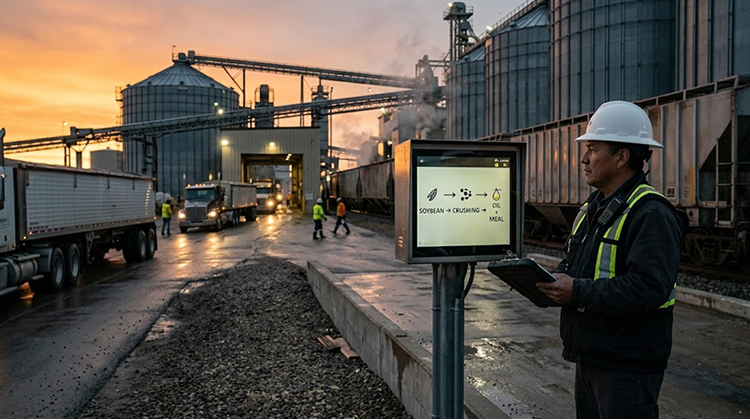
The North Dakota soybean processing expansion shows how crop production and industrial investment are increasingly connected.
Biofuel Demand Is Creating A New Soybean Market
The connection between soybeans and energy is particularly important in North Dakota.
Green Bison’s Spiritwood facility was built partly around supplying soybean oil as a feedstock for renewable diesel production at Marathon Petroleum’s Dickinson refinery. That gives North Dakota soybeans a local energy-market connection that did not exist when most of the state’s crop had to leave the state for processing.
Soybean crushing produces two economically important products: oil and meal.
The oil can enter renewable diesel and other industrial markets, while soybean meal supplies livestock and poultry producers. That means a soybean-processing facility can create demand for multiple parts of the agricultural economy simultaneously.
For North Dakota, this is especially significant because the state has historically exported substantial quantities of unprocessed agricultural commodities.
Local crushing changes the value chain.
Farmers sell soybeans to a processor. The processor creates oil and meal. Energy companies can purchase the oil. Livestock operations can purchase the meal. Transportation companies move products between facilities. Workers are employed at processing plants. Local governments receive economic activity and tax revenue.
The soybean crop therefore becomes more than a farm commodity.
China’s Role Is Becoming Less Predictable
International trade helped build the U.S. soybean industry, but North Dakota’s current soybean expansion is increasingly being supported by domestic demand.
China remains a major buyer of U.S. soybeans, but trade tensions and tariffs have made that market less predictable. Reuters reported October 7 that North Dakota’s soybean boom was initially supported partly by Chinese demand but is now increasingly being reinforced by domestic biofuel production.
That distinction is important.
A farmer deciding whether to plant soybeans does not need to know exactly where every bushel will eventually go. What matters is whether a sufficiently large and competitive demand system exists.
North Dakota’s new crushing plants provide another layer of demand that is physically closer to producers.
This does not eliminate export exposure. Soybean prices remain connected to global supply, Chinese buying, South American production and U.S. export competition. But a stronger domestic processing system gives North Dakota farmers an alternative outlet that was much weaker several years ago.
Local Processing Can Change Basis And Transportation Costs
Soybean economics are heavily influenced by basis, freight and distance to the nearest processor.
For a North Dakota grower, the difference between selling a crop locally and hauling it hundreds of miles can be significant. The Casselton facility was specifically promoted as a way to reduce transportation costs and provide growers with a year-round local market.
This is where infrastructure can influence planting decisions.
A soybean field located within an efficient transportation radius of a crushing plant can have a different marketing profile from an otherwise identical field located far away. The crop itself has not changed, but the cost of delivering it to demand has.
That means the new processing facilities could influence acreage beyond the farms immediately surrounding them.
As elevators, trucking companies, storage operators and processors adjust to larger soybean volumes, the infrastructure network around North Dakota’s soybean-producing regions can become more specialized.
The result could be a feedback loop: more local processing improves soybean marketing opportunities, stronger marketing opportunities support soybean acreage, and greater acreage gives processors more confidence in investing in additional capacity.
A Third Processing Plant Could Push The Shift Further
North Dakota’s soybean processing expansion is not finished.
The state has reported a third soybean crushing project under development in Grand Forks, where Epitome Energy has obtained an air permit. The North Dakota Soybean Council has described the Spiritwood and Casselton facilities as operational while the Grand Forks project remains under development.
When all three plants are operational, their combined capacity could process a substantial share of North Dakota’s soybean crop.
That has implications beyond soybean prices.
A larger processing industry can attract transportation investment, storage capacity, renewable-fuel activity and livestock-related businesses. It also gives producers more geographic options when marketing their crop.
For a state historically focused on shipping raw agricultural commodities elsewhere, that represents a structural change in how agricultural value is captured.
Soybeans Are Changing North Dakota’s Farm Rotation
The rise of soybeans is also changing how North Dakota farmers think about crop rotation.
A producer who once concentrated heavily on spring wheat and other small grains can now consider soybeans as a major component of the rotation. That gives farmers another tool for spreading production risk and managing weeds, diseases and soil conditions.
Soybeans also interact differently with fertilizer requirements than wheat and other crops. Their nitrogen-fixing relationship with rhizobia reduces the need for synthetic nitrogen fertilizer under normal conditions, although inoculation, soil conditions and overall nutrient management remain important.
The agronomic benefits have to be weighed against the challenges of growing soybeans in a northern environment.
Frost risk remains. Drought remains. Yield variability remains.
The crop’s success therefore depends on whether farmers can maintain acceptable yields while managing those risks.
That is why soybean production planning is becoming more relevant as North Dakota’s crop mix changes.
Wheat Is Still A Major Part Of The State’s Agriculture
The soybean boom should not be interpreted as the end of wheat production in North Dakota.
USDA’s 2026 data show the state planted approximately 5.51 million acres of wheat and expects production of nearly 264.7 million bushels. Spring wheat alone accounts for about 4.55 million planted acres, while durum wheat represents another 900,000 acres.
Wheat remains deeply embedded in the state’s agricultural infrastructure, markets and farm knowledge.
The important shift is that farmers now have a much larger alternative.
Soybeans give producers another broad-acre crop with access to rapidly expanding processing infrastructure. That can change the economic calculation when farmers compare expected soybean returns with wheat, corn, canola and other alternatives.
The acreage decision will continue to depend on commodity prices, production costs, crop insurance, weather expectations and local basis.
But infrastructure means soybeans have a stronger foundation than they did a decade ago.
North Dakota Is Building A Soybean Value Chain
North Dakota’s soybean expansion is increasingly becoming an example of how agricultural change happens through several systems working together.
Seed genetics made the crop more adaptable.
Warmer growing conditions expanded the potential production area.
Farmers adopted production and conservation practices suited to local conditions.
Processors invested hundreds of millions of dollars in local crushing capacity.
Renewable diesel created additional demand for soybean oil.
And domestic livestock markets created demand for soybean meal.
Each development reinforces the others.
The latest USDA numbers show that soybeans now occupy more planted acres in North Dakota than wheat, while the state’s new processing industry is creating local demand for a crop that once depended much more heavily on out-of-state processing.
The biggest question is no longer whether soybeans can grow in North Dakota. They clearly can.
The more important question is how much the crop can improve its yield potential while maintaining profitability under the state’s shorter growing season, variable moisture and frost risk.
Researchers such as Carrie Dottey are working on that problem at the genetic level, while farmers and processors are reshaping the commercial side of the crop.
North Dakota’s soybean boom is therefore becoming more than an acreage story. It is a transformation of the state’s agricultural value chain, one that is moving soybeans from a historically secondary crop into a central part of North Dakota’s future farm economy.