AI Precision Agriculture moved closer to farm-level use during 2026, not because every tool is fully proven, but because several demonstrations showed how artificial intelligence can fit into scouting, spraying, irrigation decisions and disease risk mapping. The strongest signal came from tools that worked with familiar farm data streams: drone imagery, soil layers, rainfall records, satellite imagery and machine-vision systems. The practical question is no longer whether AI can identify patterns. It is whether those patterns can support decisions under field conditions, with clear limits and enough validation to protect farm profitability.
What AI Precision Agriculture Demonstrations Showed
The most useful 2026 demonstrations were not abstract software presentations. They linked AI models to field workflows that farmers and agronomists already recognize: finding weed patches, assessing crop stress, identifying disease risk and connecting management records with geospatial layers. That distinction matters. A tool that works in a controlled test may still fail if it cannot handle variable light, dust, inconsistent connectivity, mixed weed stages or missing records.
Evidence from the available research points to a cautious shift from proof-of-concept tools toward systems that can be tested in farm settings. Some tools remain at an early readiness stage, while others were shown in public field demonstrations. The difference between those two categories should be clear to farmers, lenders and advisers evaluating technology purchases.
For those exploring technical evidence presented in similar publishing projects, Interline Publishing provides insights within the same network, highlighting how cautious source standards are applied when transitioning from lab-based claims to field-level decisions.
Field Workflows From Farm Science Review 2026
One of the clearest public demonstrations took place after Farm Science Review 2026, held on September 22–24 in London, Ohio. ICICLE demonstrated AI cyberinfrastructure for precision agriculture, including drone-based scouting connected to spot spraying, edge AI for weed detection using devices such as NVIDIA Jetson, and a conversational tool called Ask the Farm that allowed users to query field history, soil and rainfall layers using national geospatial datasets, according to ICICLE’s report.
Because the event had already concluded by September 28, 2026, the relevant question is what the demonstration showed, not whether farmers should attend it. The reported workflows were useful because they connected AI outputs to common decisions. Drone scouting only has economic value if the information can lead to a management action. Weed detection has to connect with equipment timing, spray maps or operator judgment. A chatbot-style field query tool has to return information that is traceable to reliable field and weather records.
AI Precision Agriculture At Farm Science Review
The ICICLE example also shows why edge computing is gaining attention in farm settings. Edge AI means the model runs closer to the sensor or machine rather than relying entirely on a remote server. In weed detection, that can matter because a sprayer or scouting system may need a fast response while moving through a field. The research notes referenced devices such as NVIDIA Jetson, but the larger point is the workflow: collect imagery, process it near the point of use, and connect the output to a field operation.
Ask the Farm raises a different set of questions. Conversational AI may help users access field history and environmental layers more quickly, but a useful answer still depends on the quality of the underlying records. If rainfall layers, soil records or field histories are incomplete, the answer may sound clear while still carrying uncertainty. Farmers should treat these tools as decision support rather than as a substitute for scouting, local knowledge or agronomic review.
From Scouting To Spot Spraying
The strongest near-term value may come from systems that narrow where a farmer needs to act. Drone-based scouting can reduce the area that needs closer inspection. Weed detection can help separate patches from clean areas. Spot spraying can then target treatment more directly than a whole-field pass, provided the machine, map and operator workflow align. This is where field-ready AI has to prove itself: not just by identifying a weed in an image, but by helping a farm make a timely, safe and cost-aware application decision.
Coverage of precision technology adoption shows why these decisions are rarely based on one feature. Farms weigh equipment compatibility, labor limits, input savings, service support and uncertain returns before adding a new tool.
Satellite Disease Risk Mapping In Sugarcane
Another relevant example came from Australia. On March 17, 2026, Australia’s Economic Accelerator described Sugar-AI, a James Cook University prototype that uses free satellite imagery and machine learning to produce real-time risk maps for ratoon stunting disease in sugarcane. The project was described at Technology Readiness Level 4, with field trials identified as the next step toward Technology Readiness Level 5, according to Australia’s Economic Accelerator.
This example is important because it is not presented as a finished commercial answer. The stated readiness level signals that the technology still requires field validation. That is the right way to describe an AI tool at this stage. Risk maps can help direct attention, but they should not be treated as confirmed disease diagnoses unless supported by appropriate field checks and agronomic procedures.
Why Readiness Levels Matter
Technology Readiness Level language helps separate promise from readiness. A TRL 4 prototype has been validated in a controlled or limited environment, but it is not the same as a broadly deployed farm tool. Moving toward TRL 5 requires validation in a more relevant environment. The research note did not establish whether those field trials had been completed by September 28, 2026, so any stronger claim would go beyond the available evidence.
For sugarcane growers, the value proposition is clear but still conditional. If a satellite-based model can flag areas at higher disease risk, it may help prioritize scouting or sampling. Yet disease management still depends on accuracy, timing, local conditions and grower access to follow-up support. False positives could waste time. False negatives could delay action. That balance is central to any disease-risk AI tool.
Adoption Questions For Farm Operators
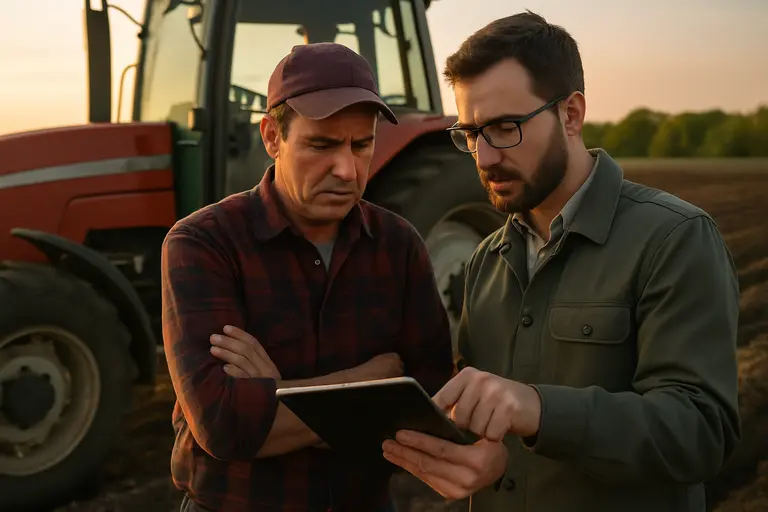
For many farms, AI Precision Agriculture will be judged by cost, fit and reliability rather than novelty. A grower may accept a tool that is less flashy if it works with existing equipment, produces clear recommendations and can be checked against field observations. A tool that requires major workflow changes may face slower adoption even if its model performance looks strong in a demonstration.
Farm operators and advisers can use a short set of questions before treating an AI system as field-ready:
- What decision does the tool support: scouting, spraying, irrigation, disease risk or record retrieval?
- What data does it require, and who controls that data?
- Has it been tested under field conditions similar to the farm’s crop, region and equipment setup?
- Can the output be checked by an agronomist, operator or field scout?
- What happens when connectivity is poor, imagery is unclear or records are incomplete?
These questions do not reject AI. They help place it inside normal farm risk management. A good tool should make the decision process clearer, not create a black box that is hard to challenge.
Evidence Standards For AI Precision Agriculture
Evidence standards need to be higher when AI recommendations affect input use, crop protection or yield potential. Public demonstrations are valuable, but they are not the same as multi-location field validation. A disease-risk map, weed-detection model or field-history assistant may perform well in one setting and less well in another. Soil variation, canopy growth stage, weed species, residue cover and weather conditions can all affect performance.
The ICICLE and Sugar-AI examples are useful partly because they show different stages of readiness. ICICLE presented integrated workflows at a major farm event that had already taken place. Sugar-AI was described as a prototype with a stated readiness level and a clear need for field trials. Both examples support cautious optimism, but neither supports blanket claims that AI systems can replace agronomic judgment.
Farmers should also look for documentation. Useful vendors and research teams should be able to explain the data used, the intended operating conditions, the known limits and the process for checking errors. Claims about input reductions or yield gains should be tied to clear trial designs, dates, locations and comparison methods. Without those details, the numbers may be difficult to apply to a specific farm.
AI Precision Agriculture Tools In Farm Decisions
The 2026 evidence suggests that field-ready AI is becoming more practical in specific tasks: drone scouting, edge weed detection, spot spraying support, field-history queries and satellite disease-risk mapping. The tools are not equal in maturity. Some have been demonstrated in public field workflows, while others remain prototypes moving toward stronger validation.
AI Precision Agriculture should be evaluated as a decision layer, not as a stand-alone answer. The best systems will help farmers see where to inspect, where to treat and where to question an assumption. The weakest systems will produce confident outputs without enough context. For sustainable farming decisions, the difference matters. Better targeting can support lower waste and better timing, but only when the model is accurate, the equipment can act on the result and the farm team understands the limits.
The practical path is careful testing. Start with a defined use case, compare outputs with field observations, track costs and avoid treating a demonstration as proof of farm-wide value. AI tools are moving into the field, but the strongest gains will come from systems that earn trust one decision at a time.