Blogging for farmers is no longer limited to a farm website with occasional seasonal updates. It can include short field notes, photo essays, email newsletters, microblog posts, and video clips that explain how a practice was tried, what conditions shaped the result, and what a producer would watch next time. The case for these tools is strongest when claims stay close to observed farm records and when readers can see the limits of the example.
The strongest recent evidence for digital reach comes from farm connectivity data. In 2025, 85% of U.S. farms reported internet access, 82% used smartphones, 50% used the internet to purchase agricultural inputs, and 29% used it to market agricultural activities, according to the USDA National Agricultural Statistics Service farm computer usage report. Those numbers do not prove that farm blogs directly change management decisions. They do show that many producers already have the basic tools needed to publish and read practical agriculture content.
Why Blogging for Farmers Fits Current Digital Use
Blogging for Farmers Starts With Access
For blogging for farmers to be useful, access comes before strategy. A farmer cannot maintain a field journal online, upload photos from a cover crop trial, or send a harvest note to customers without a workable connection and a device. The USDA figures suggest that access is now common across U.S. farms, though not universal. That distinction matters because digital tools can widen a conversation for many producers while still leaving some farms dependent on in-person meetings, printed newsletters, radio, or local extension events.
Smartphones are especially relevant because they make documentation easier at the moment a farm observation happens. A producer can photograph residue cover after planting, record a short clip of water movement after a storm, or note weed pressure before cultivation. Those records may later support a blog entry about reduced tillage, nutrient planning, grazing decisions, or irrigation scheduling. The value is not that a phone makes the practice better. The value is that the phone helps preserve context that is often lost when a farm story is written weeks later.
Smartphones Shape Practical Publishing
Mobile publishing also changes the format of farm communication. A full article may still be useful for explaining a multi-year soil health plan, but short updates can carry timely details: seeding date, rainfall, equipment adjustments, pest observations, or what did not work. For sustainable practices, that level of detail is often more helpful than broad claims. Soil type, weather, labor, machinery, market access, and farm size can all affect whether a practice fits a specific operation.
That is why cautious writing matters. A farmer might write that a diverse rotation improved residue cover on one field under one set of conditions. That is more credible than saying the same rotation will work everywhere. Readers can then compare the example with their own fields rather than treating it as a universal recommendation.
Turning Sustainable Practice Records Into Useful Posts
Use Field Notes Before Claims
Modern tools can help farmers move from memory-based storytelling to evidence-informed publishing. Photos, yield maps, invoices, grazing logs, nutrient plans, rainfall notes, and soil test records can all become source material. A blog post does not need to publish private business data to be useful. It can describe the method, list the observation window, and explain what the farmer is still unsure about.
For example, a post about crop residue could describe the previous crop, the tillage approach, planting conditions, and what was seen after heavy rain. A post about nutrient management could explain why a plan was updated, what records were reviewed, and what questions remain for the next season. This type of writing supports peer learning without overstating the evidence.
Show The Practice, Not Just The Result
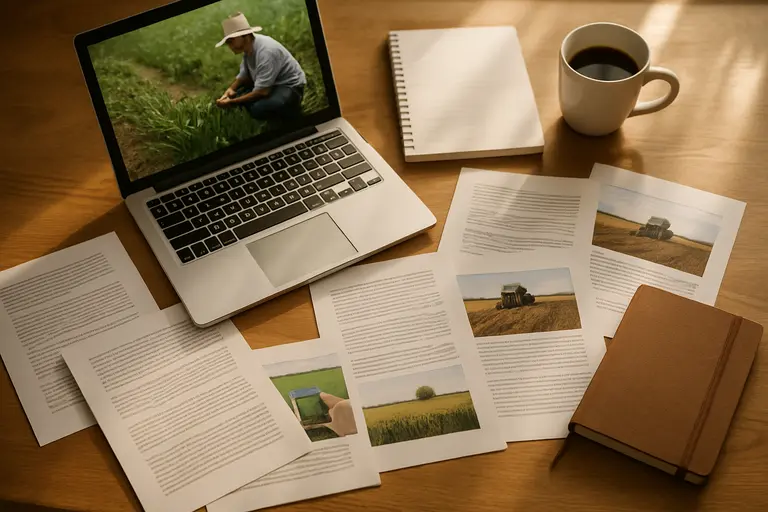
Images and short videos are useful because many sustainable practices are visual and process-based. A single harvest result may not explain how a practice works. Photos can show residue distribution, root growth, livestock movement, compost application, erosion control, or equipment setup. Captions can add the context that a photo cannot carry on its own.
Still, images should not be treated as proof by themselves. A green field photo may look convincing while saying little about soil carbon, profitability, or nutrient loss. Strong farm blogging pairs images with careful wording: what was observed, what was measured, what was not measured, and why the producer is continuing or adjusting the practice. That approach is especially useful for readers who are comparing ideas rather than copying a system directly.
Digital Media Can Broaden Peer Learning
Short Video And Blog Posts Serve Different Jobs
Farmers are already using social platforms in some regions to exchange ideas and reshape public perceptions of agriculture. In West Africa, some farmers have used TikTok and other social media to share sustainable-practice tips and business ideas, while access remains a barrier because about 80% of farmers interviewed did not have smartphones capable of using apps such as TikTok or Instagram, according to AP reporting on farmers and social media.
That example is useful because it shows both promise and limits. Short video can quickly show how a task is done. A blog post can then explain the reasoning, costs, timing, and local conditions behind the task. Used together, the formats can serve different audiences: consumers who want to understand farm stewardship, neighboring farmers who want operational details, and community groups that want clearer information about land and food systems.
Access Gaps Still Limit Reach
The access gap should temper expectations. Digital publishing can spread information quickly, but it cannot replace every local channel. Farmers who want to share sustainable practices may need to combine online updates with field days, producer meetings, printed handouts, or cooperative discussions. A blog can support those efforts by giving participants a record to revisit after an event.
Community-based publishing also benefits from trust. Readers are more likely to value a farm note when they know who wrote it, where the example came from, and why the farmer is sharing it. For readers comparing how different local organizations communicate online, a related community site in the same network, Bethel NC UMC, reflects the broader need for clear, audience-aware digital communication rather than promotional claims.
A Practical Publishing Framework For Farm Blogs
Keep The Format Repeatable
A sustainable farming blog does not need a complicated structure. A repeatable format often works better because readers can compare updates over time. One useful pattern is: practice, field conditions, reason for trying it, observations, limits, and next step. That structure keeps the writing grounded and reduces the chance that one season’s result is presented as a rule.
- Practice: Name the method, such as cover cropping, reduced tillage, nutrient planning, rotational grazing, or residue management.
- Context: Describe the field, weather, timing, equipment, and management goal without exposing sensitive business details.
- Observation: Separate what was seen or measured from what is only a hypothesis.
- Limit: State what the post cannot prove, especially if there is no multi-year comparison.
- Next step: Explain what will be watched, changed, or recorded in the next season.
This framework keeps blogging for farmers practical. It also makes the archive more useful. After several seasons, readers can see how the same farm adjusted practices under different weather and market conditions.
State Limits And Local Conditions
The most credible farm writing often includes uncertainty. A producer can say that a practice appeared promising but needs more observation. A producer can also say that a method reduced one problem while creating another, such as added labor or timing pressure. These statements do not weaken the blog. They make it more useful for decision-making.
Farmers should also be careful with claims about sustainability outcomes. Soil health, greenhouse gas emissions, nutrient loss, biodiversity, and profitability are not always visible from one season of photos. If a post does not include direct measurements, it should avoid language that implies measured results. Clear labels such as “observed,” “estimated,” “planned,” and “not measured” help readers understand the strength of the information.
Blogging for Farmers As A Trust-Building Tool
Practical Trust Comes From Specific Details
Blogging for farmers works best when it helps readers understand decisions rather than simply promoting a farm. Sustainable agriculture is often discussed in broad terms, but farm decisions are specific. A grower may adopt one practice for erosion control, another for input management, and another for livestock health. Digital tools help document those choices, but the credibility comes from honest context.
The opportunity is real but should not be overstated. Current data support the idea that many U.S. farms have internet access and smartphones, and reporting from West Africa shows that social media can help farmers share ideas where access allows. The data do not show that every reader will adopt a practice after seeing a post, or that every digital channel reaches the producers who most need the information.
Used with restraint, blogging for farmers can make sustainable practices easier to evaluate. The strongest posts show the field, explain the decision, describe the conditions, and leave room for uncertainty. That is the kind of farm communication that can serve producers, consumers, and local communities without turning a single experience into an unsupported claim.