California’s Central Valley agriculture system is entering another period of pressure as state water managers adjust allocations following early summer heat spikes across the region. Reservoir levels tied to the State Water Project and Central Valley Project continue to trend below seasonal averages, shaping how irrigation districts distribute supply to farms in counties such as Fresno, Kern, Kings, and Tulare.
Field reports from irrigation districts indicate tighter delivery schedules for surface water users, with some agricultural zones shifting toward groundwater pumping earlier than planned. The adjustment comes at a time when crop water demand is rising faster than forecast models projected at the start of the season. Heat persistence across the Sacramento and San Joaquin basins has intensified evapotranspiration rates, pushing soil moisture levels lower across orchards, vineyards, and row crop systems.
Reservoir Pressure and Allocation Adjustments
Water allocation changes in 2026 are closely tied to storage conditions in major reservoirs such as Lake Oroville and San Luis Reservoir. Snowpack runoff earlier in the year provided temporary relief, yet rapid melt combined with extended high temperatures reduced inflow stability into summer.
Irrigation districts across the Central Valley now operate under staged delivery reductions, prioritizing permanent crops such as almonds, pistachios, and grapes. Annual crops face more flexible but less predictable water scheduling.
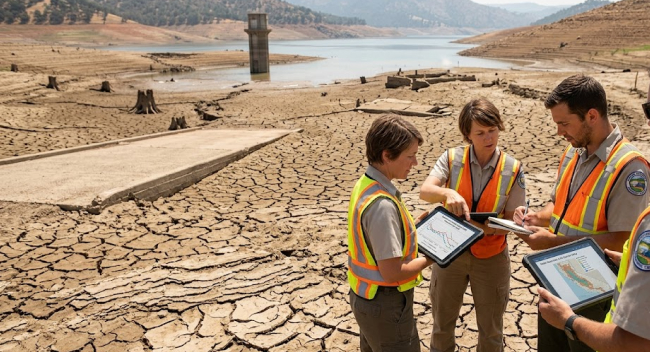
Farm operators monitoring allocation updates frequently compare current restrictions with historical dry-cycle patterns documented by the California Department of Water Resources. The agency’s recent allocation bulletin outlines reduced Class 1 and Class 2 deliveries for multiple service areas, signaling a controlled distribution strategy across competing agricultural demands.
External reference for water allocation policy and monitoring: California water supply updates from the U.S. Bureau of Reclamation
Central Valley Crop Pressure and Irrigation Shifts
Water constraints are reshaping irrigation decisions across large-scale agricultural operations in the Central Valley. Almond orchards in Fresno County and grape vineyards in Madera County are seeing more frequent transitions toward deficit irrigation strategies, where controlled water stress is applied to preserve long-term tree and vine productivity.
Row crop producers in Kings County are responding differently, often reducing planted acreage for water-intensive crops like lettuce and processing tomatoes. These adjustments reflect shifting cost-benefit calculations as water becomes a limiting input rather than a scalable resource.
Soil moisture sensors and satellite-based field monitoring systems are increasingly used to guide irrigation timing. Growers are relying on field-level data to avoid over-irrigation in restricted delivery windows, particularly during heat peaks exceeding 100°F across inland valleys.
A growing number of operators are comparing regional irrigation efficiency standards through agricultural benchmarking tools such as precision irrigation system performance models.
Groundwater Reliance and Regulatory Pressure
Reduced surface water availability is accelerating groundwater extraction across portions of the Central Valley, particularly in regions regulated under California’s Sustainable Groundwater Management Act (SGMA). Basin-level management agencies in areas like Tulare Lake Basin are enforcing extraction limits while monitoring subsidence risks tied to long-term aquifer depletion.
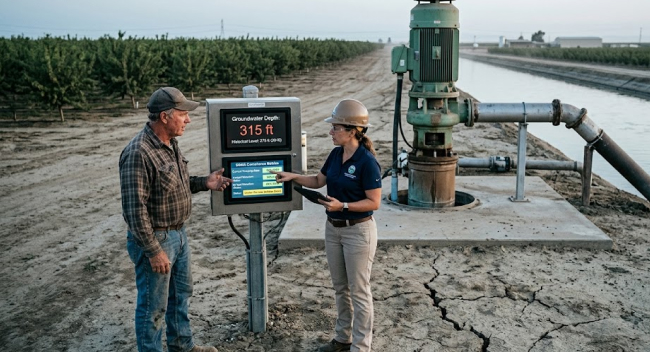
Pump-dependent farms are facing higher energy costs as groundwater tables drop, requiring deeper wells and increased pumping intensity. In some districts, water replacement costs now exceed historical averages by double-digit percentages, reshaping operational budgets for mid-size farming enterprises.
| Water Source | 2024 Availability Trend | 2026 Condition | Operational Impact |
|---|---|---|---|
| Surface Water (SWP/CVP) | Moderate stability | Reduced allocations | Limited irrigation scheduling |
| Groundwater Wells | Declining recharge | Increased pumping depth | Higher energy and infrastructure cost |
| Local Reservoir Storage | Seasonal fluctuation | Below average levels | Unstable delivery cycles |
Policy analysts monitoring SGMA compliance note that enforcement timelines are tightening in critically overdrafted basins, increasing pressure on farms that rely heavily on groundwater backup systems.
Agricultural Technology Adoption Under Water Stress
Water restrictions are accelerating adoption of field-level monitoring and automation systems across Central Valley agriculture. Growers are integrating soil tension sensors, drone imaging, and variable-rate irrigation controllers to optimize limited water inputs across heterogeneous fields.
Equipment manufacturers report increased demand for irrigation telemetry systems capable of adjusting flow rates in real time based on temperature and soil feedback loops. These systems are being deployed most heavily in orchards where long-term crop survival depends on precision irrigation scheduling.
California State University agricultural extension research shows that farms using sensor-driven irrigation scheduling reduce water use variability across plots while maintaining yield consistency under restricted allocation conditions.
Operators comparing irrigation system efficiency frequently reference regional implementation studies through California Agricultural Water Stewardship research programs.
Economic Pressure Across Export-Oriented Farming Regions
Export-driven agricultural sectors in the Central Valley are absorbing indirect costs from water restrictions through reduced yield projections and increased input prices. Almond and walnut exporters are particularly exposed due to long production cycles and high irrigation dependency.
Logistics networks tied to agricultural exports in ports such as Stockton and Oakland are tracking shifts in shipment volumes tied to reduced crop output forecasts. Buyers in international markets are adjusting procurement expectations as California supply variability increases under recurring heat cycles.
Processing facilities in the region are also adjusting throughput expectations, especially for tomato and grape processing lines that depend on consistent harvest volumes.
Farm financial models now incorporate multi-scenario water risk projections, with sensitivity analysis tied directly to allocation variability and temperature forecasting.
Internal reference for broader agricultural systems analysis and efficiency modeling: Central Valley farming system optimization insights
Regional Adaptation Patterns Across Farming Districts
Water restriction impacts are not uniform across the Central Valley. Northern districts closer to Sacramento River diversions maintain slightly higher delivery stability, while southern basins face more aggressive reductions.
Farm managers are increasingly segmenting fields based on water priority zones, separating high-value crop blocks from lower-margin acreage to allocate irrigation resources strategically. This segmentation is supported by GPS-based mapping systems and field analytics software that assign water budgets at sub-field levels.
Heat intensity patterns continue to shape operational decisions, particularly during extended high-pressure weather systems that reduce nighttime cooling cycles and increase plant stress duration.
Agricultural advisors working with irrigation districts report that adaptive planning cycles are now shorter, with water allocation decisions reassessed weekly rather than seasonally in some regions.