Why would any sane farmer choose composting over spreading raw manure? It’s not just a trend. It’s like switching from a risky investment to a stable, high-yield one.
Composting turns agricultural waste into a nutrient-rich soil amendment. This process locks in nitrogen, kills weed seeds, and builds a microbial army for your land.
The benefits are clear. You cut down on synthetic fertilizer costs and save on landfill fees. You also become a secret agent of carbon sequestration. It’s waste reduction with a big return on investment.
This isn’t just about sustainability as a buzzword. It’s about seeing your farm’s waste as the most valuable crop. Finished compost, or “Black Gold,” offers slow-release nutrients and reduces environmental risks compared to raw manure.
For those eager to learn more, the basics of on-farm composting are outlined. It’s about treating problems as assets. The practical result is richer soil and a healthier bottom line.
Setting Up Your System
Think of yourself as a city planner, but for decomposers. Your first decision is where to build their metropolis. This isn’t just about finding an out-of-sight corner. You’re selecting the bedrock of an entire ecosystem. Get this wrong, and you’re basically zoning for an environmental disaster.
Site selection is your foundational policy. You want level ground—think pancake flat, not San Francisco hillside. Why? Water management. A slope turns rain into a nutrient runoff express lane straight to your local watershed. You also need excellent drainage. A waterlogged pile is a drowned city; microbial citizens can’t breathe underwater.
Distance matters too. Keep your operation at least 100 feet from wells, creeks, or ponds. You’re running a recycling center, not an algae bloom fertilizer factory. A well-drained, discreet, yet accessible spot is the composting equivalent of prime suburban real estate.
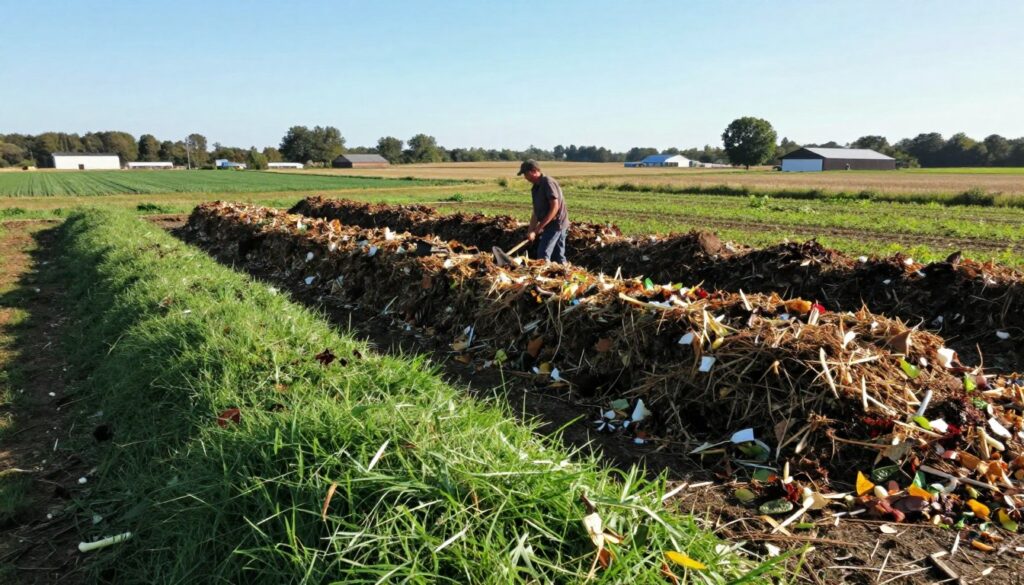
With your territory claimed, you face the fundamental political question of farm composting: What’s your governance model? Will you foster an aerobic composting republic or an anaerobic composting autocracy?
Let’s break down the party platforms:
- The Aerobic Republic (Windrow Method): This is democracy in action. Regular turning introduces oxygen—the equivalent of a free press—keeping processes transparent and odors minimal. It’s fast, efficient, and requires civic participation. The classic windrow is its capital city: a long, mounded pile ideally 4 feet tall and 4 feet wide. This size creates the perfect thermal mass for hot composting without becoming an oxygen-starved core.
- The Anaerobic Autocracy: This is the sealed-bin approach. No turning, no oxygen. Microbes work slowly in the dark, breaking things down without much fuss. It’s low-labor but can occasionally stage a methane rebellion (read: smells). Think of it as composting’s silent majority.
- Vermicomposting: The specialist technocracy. You’re hiring a wriggling red workforce—red wigglers—to process waste with astonishing efficiency. It’s like outsourcing to the most productive department in nature. Great for smaller scales and kitchen waste.
- Bokashi: The fermentation revolution. This isn’t traditional decomposition; it’s pickling your organic waste with inoculated bran. It’s fast, works anaerobically in a sealed bucket, and can handle items like meat and dairy that other systems reject. The microbial equivalent of brining.
If you’re going with the classic windrow, construction is key. You’re not making a trash heap; you’re layering a lasagna of decay. Start with a coarse, carbon-rich “brown” base—twigs or straw for drainage and airflow. Then begin the lasagna: a layer of “greens” (kitchen scraps, fresh grass), followed by “browns” (dried leaves, cardboard, straw).
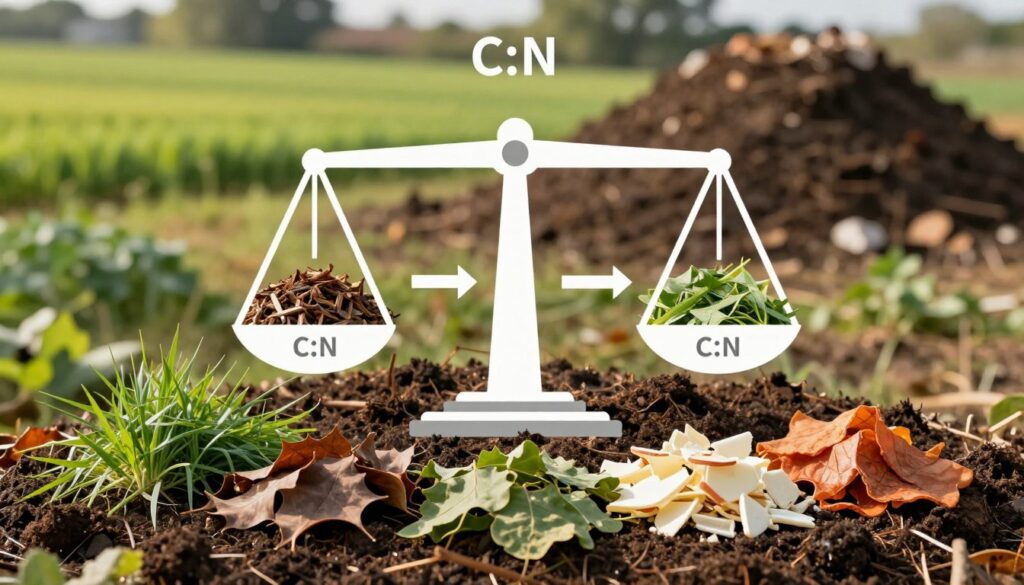
The carbon-to-nitrogen ratio is your recipe. Too much nitrogen (greens), and you get a slimy, smelly mess. Too much carbon (browns), and the process stalls like a deadlocked congress. Aim for roughly 3:1 browns to greens by volume. Moisture should be like a wrung-out sponge—not dripping, not dry.
Your tools can range from the simple to the sophisticated. For the DIY mayor, a three-bin wooden system works beautifully. For the tech-forward commissioner, rotating drums offer easy turning. I’ve even seen ingenious setups using repurposed culvert pipes or livestock watering troughs. The principle remains: contain, aerate (if aerobic), and manage moisture.
Remember, aerobic composting in a windrow needs turning every 3-7 days during the hot phase. Use a pitchfork or a front-loader if you’re running a larger farm composting operation. This isn’t busywork; it’s redistributing oxygen, the currency of your aerobic republic.
For smaller-scale or urban setups, don’t overlook vermicomposting or bokashi. A worm bin under the sink or a bokashi bucket in the pantry can handle household waste without the need for a sprawling windrow empire. Each method has its constituency.
Ultimately, setting up your system is about deliberate design. You’re not abandoning waste to fate. You’re architecting conditions—the right location, the right method, the right mix—to harness one of nature’s most fundamental processes. It’s less dump-and-hope, more blueprint-and-harvest.
Do’s and Don’ts
Your compost pile isn’t a democracy; it’s a benevolent dictatorship. It has strict rules for optimal decay. Forget consensus-building. This is about establishing clear protocols for your microscopic workforce.
Get it right, and you achieve efficient on-farm waste recycling. Get it wrong, and you’re basically running a garbage-themed protest camp.
The first commandment? Balance your C:N ratio. Think of it as the macroeconomic policy of your decomposition nation. Aim for that sweet spot between 25:1 and 30:1.
Too much carbon—your dry leaves and straw—and microbial growth stalls. Too much nitrogen—your fresh manure and grass clippings—and you get the olfactory equivalent of a riot. The microbes throw a raucous, ammonia-scented party no one wanted an invitation to.
Aeration is your executive order. Turning the pile isn’t a suggestion; it’s non-negotiable legislation for healthy decomposition. When internal temperatures push past 160°F, that’s your cue. Give that pile a turn.
It’s like a shot of espresso for billions of tiny organisms. Without regular aeration, you create an anaerobic regime where the bad bacteria stage a coup.
Then there’s hydration policy. Moisture management requires the touch of a seasoned diplomat. We’re talking 40-60% dampness—the consistency of a wrung-out sponge that springs back when squeezed.
The soil testing pros will tell you: moisture is everything. A swamp drowns the process. A desert halts it entirely. Your hand is the best sensor you own.
Now for the don’ts. Consider these the constitutional amendments of your compost operation. First, mind your feedstock. Not all organic matter is created equal.
Dairy and meat are the lobbyists of the composting world—they promise benefits but usually bring complications. For farm-scale systems, they’re often more trouble than they’re worth, attracting pests like special interest groups to a buffet.
Plastics and stickers? Absolute veto. This isn’t modern art. They don’t break down; they just clutter the political landscape of your pile. And while home composters might debate citrus or onions, at our scale, consistency in feedstock selection prevents policy shocks. Stick to the program.
The rhythm of turning is your legislative calendar. Every 1-2 weeks works for most systems. It redistributes heat, moisture, and microbes—passing the benefits around evenly.
Miss a session, and you risk creating pockets of neglect where decomposition goes off the rails. For a comprehensive list of protocols, the Iowa State extension guide is like the parliamentary rulebook for this process.
Ultimately, successful on-farm waste recycling through composting is about governance. You’re not just managing decay; you’re presiding over a transformation. The right C:N ratio, diligent aeration, precise moisture management, and disciplined feedstock selection—these aren’t just tips. They’re the articles of confederation for your personal republic of rot.
Follow them, and you’ll have black gold. Ignore them, and well, let’s just say the opposition party smells terrible.
Common Problems
Every compost pile has its dark moments. The microbial utopia you envisioned can turn into chaos. Your job is to restore order.
The smell is a big problem. That eye-watering stench of rotten eggs is a sign of trouble. Your pile has gone anaerobic, lacking oxygen.
The microbes are suffocating. They’re sending an SOS through your nostrils. To fix this, turn the pile to introduce air. Add carbon-rich browns like straw or dried leaves.
Next issue: your pile is cold and inactive. This slow decomposition can be due to several reasons.
It might be too dry or too small. It could also lack nitrogen. The green party isn’t showing up to vote.
To solve this, add water if it’s dry. Combine piles if they’re small. Mix in fresh grass clippings or manure if it needs nitrogen. For more help, check out this compost overview.
Now, let’s talk about pests. If raccoons, rats, or other pests are visiting, your pile is too inviting. A hot pile is a fortress. A cold pile is a diner.
Bury food scraps deep in the center. Keep the pile hot. Your pile should be inhospitable to pests.
Temperature monitoring is key. Use a compost thermometer. Aim for 135-160°F.
This range accelerates decomposition and kills pathogens and weed seeds. It’s like your pile’s internal security service.
What about winter? Cold weather slows down decomposition. Sometimes it stops.
This isn’t failure. It’s hibernation. Insulate your pile with straw bales or a tarp. Or accept that winter composting is slower.
Finally, consider moisture balance. A pile that’s too wet or too dry is bad. The squeeze test works perfectly. Grab a handful of material. It should feel like a wrung-out sponge.
Remember, every problem has a logical cause. Odors mean lack of oxygen. Cold means lack of activity. Pests mean poor management. Your pile is constantly communicating. You just need to learn its language.
Troubleshooting isn’t about fixing failures. It’s about interpreting feedback. Your compost is trying to tell you something. Are you listening?
Using Finished Compost
After months of hard work, your compost is ready. It’s not waste anymore but black gold. This material is full of potential. It’s time to think about where it will make the biggest difference.
This material is like a three-in-one tool for your soil. It’s not just for gardening but for taking control of your land. Each way you use it changes how your plants grow.
Tilling it in as a soil amendment is the key move. It’s like making a new rule for your garden’s foundation. It adds nutrients and changes the soil’s structure. This makes your soil better for roots and water.
Using it as a mulch is a surface-level strategy. It’s like a blanket that blocks weeds and keeps moisture in. It also feeds your plants slowly as it breaks down. For a quick boost, use a thin layer as a top dressing.
Then, there’s compost tea. It’s like a shot of espresso for your soil. Mix it with water, and you get a liquid fertilizer full of microbes. Spray it on leaves or soak it into the soil for quick benefits.
| Application Method | Primary Action | Best For | Deployment Speed |
|---|---|---|---|
| Soil Amendment (Tilled In) | Fundamentally improves soil structure & water holding | New beds, preparing future planting areas | Slow, long-term change |
| Mulch/Top Dressing | Suppresses weeds, conserves moisture, feeds slowly | Existing gardens, around trees & shrubs | Immediate surface benefits |
| Compost Tea | Direct microbial & nutrient boost | Revitalizing stressed plants, boosting seedlings | Fast, immediate impact |
So, how do you use your black gold? Look at your garden’s needs. Is the soil hard and dry? Amend it. Are weeds and water loss a problem? Mulch it. Do your plants need a quick boost? Make compost tea. This is how you turn waste into power over your garden’s health.
Regulatory Considerations
No one started farming or gardening for the paperwork. But, understanding the rules is as important as checking your soil’s pH. Think of environmental compliance as the duty of modern on-farm waste recycling.
Your local agency, like the Kansas Department of Health and Environment (KDHE), sets the regulations. They’re not out to ruin your compost dreams. They’re managing risks. The cool thing is, good composting often avoids the toughest rules for raw manure.
Turning waste into stable humus lowers environmental risks. This can mean fewer rules on when you can use it. Your main tasks are simple: keep a safe distance from waterways, control runoff, and manage odors well.
Smart manure management through composting helps avoid regulatory problems. It turns a potential problem into a valuable asset. You’re not just building soil. You’re creating a sustainable, legally sound practice.
The best farmers see the rules as a guide, not a barrier. Your compost should pass the sniff test in every way.