The discussion around deeper-rooted soybeans has moved from plant science theory into a more practical question for sustainable farming: can soybean root traits help farms manage drought risk while storing more carbon below ground? The answer is promising but not settled. Current research points to possible gains in soil carbon, water access, and stress tolerance, yet the results will depend on field performance, soil type, tillage systems, and farmer adoption.
The issue matters because soybean systems cover a large U.S. cropping area and often produce less aboveground residue than crops such as corn. That makes root traits, soil disturbance, and rotation design especially relevant for carbon accounting. For farmers, the near-term value is less about a single breakthrough variety and more about whether genetics, soil management, and weather risk planning can work together in real fields.
Why Deeper-Rooted Soybeans Matter
Root Depth Links Water Access And Stress Response
Soybeans under drought stress often face a direct limitation: moisture may remain in deeper soil layers after the upper profile dries. Root systems that penetrate deeper can potentially reach that water for a longer period, which may delay canopy wilting and support biomass and yield under rain-fed conditions. Research summarized in recent reviews also points to deeper and more branched roots as useful drought-resistance traits, especially when plants face combined heat and water stress.
That does not mean root depth alone can solve drought exposure. Soil compaction, rooting barriers, planting date, variety maturity, disease pressure, and rainfall timing still affect outcomes. A variety with favorable root architecture may perform differently in a deep loam than in a compacted field or a shallow soil profile. This is why field testing matters more than greenhouse promise.
Deeper-Rooted Soybeans And Drought Response
For farmers, deeper-rooted soybeans would not remove drought risk, but they may shift how a crop responds when rainfall becomes uneven. The most useful traits are likely to be those that combine deeper rooting with lower root construction costs and better access to subsoil moisture. Recent review work described a “steep, cheap, and deep” soybean root ideotype under drought and heat stress. In plain terms, that means roots that grow downward efficiently, use fewer plant resources, and explore deeper soil layers.
Field and genotype studies have already identified soybean lines with deeper root distribution, higher root penetrability in compacted layers, and stronger water-use efficiency under rain-fed conditions. Those findings are encouraging, but they should be treated as early evidence rather than a universal recommendation. A genotype that performs well in one region may not produce the same result under another climate, soil, or management system.
Carbon Storage Claims Need Careful Reading
What The Modeling Suggests
The carbon case for deeper-rooted soybeans rests on the idea that more root biomass, especially persistent root compounds such as suberin, can move carbon into soil layers where it may remain longer. An Associated Press report published on September 18, 2026, described modeling suggesting that deeper-rooted versions of soybean, corn, cotton, and canola could remove about one gigaton of carbon dioxide per year by 2040 if adopted in countries that already grow genetically modified crops according to AP reporting.
That estimate is significant, but it is still a modeled scenario. It depends on broad adoption, crop performance, regulatory pathways, and whether the carbon remains stored in soil over time. Carbon storage is not only a plant trait issue. Soil texture, microbial activity, moisture, tillage, residue management, and erosion all affect whether new carbon inputs become stable soil organic carbon.
Soil Carbon Is A System Outcome
Research on soybean-based systems also points to management effects. In the U.S., no-till and reduced-tillage systems are already used across a large share of soybean acreage, with research notes reporting 44.8% of soybean acreage under no-till management in 2023 and 35.9% under reduced tillage. Those practices can reduce soil disturbance, but carbon gains vary by region and depth. Under favorable conditions, improved root phenotypes alone have been estimated to raise soil organic carbon by up to 1.8 megagrams of carbon per hectare per year.
Intercropping research adds another angle. A 2025 soybean-maize relay strip intercropping study reported higher soil organic carbon in soybean strips after 10 years, along with increased macroaggregates and greater rhizodeposition than mono-cropped soybeans. The practical message is that root genetics may work best when paired with systems that also protect soil structure and support belowground carbon inputs.
ROOTS Project Research And Field Testing
From Trait Discovery To Field Measurement
The Salk Institute’s ROOTS work has brought wider public attention to root traits in major crops. On September 22, 2026, the institute announced support to field-test soybean lines designed to grow deeper roots, improve drought and disease resilience, and increase carbon storage potential. Agheiro has also tracked this topic in its coverage of ROOTS project field testing, where the same caution applies: the most useful results will come from measured field performance, not expectations alone.
USDA Agricultural Research Service work has also focused on belowground variation in soybean. One ARS project, “Determining root biomass diversity for better carbon sequestration,” began on October 1, 2024, and was scheduled through March 31, 2026. The project evaluated genetic diversity in belowground carbon and nitrogen sequestration across soybean genotypes in field settings USDA ARS project record.
Why Standard Methods Matter
Root research is difficult because roots are hidden, variable, and strongly affected by soil conditions. A 2026 study developed a standardized way to assess effective rooting depth in tropical Oxisols, which matters because consistent methods help researchers compare root exploration, water uptake, and carbon dynamics. Without common measurement approaches, it is hard to separate a real breeding advantage from a site-specific response.
This is also where communication has to stay grounded. As with related network publications such as Old Norse News, the value for readers comes from clear sourcing and careful separation of evidence from assumption. In crop science, that means identifying whether a claim comes from modeling, controlled experiments, multi-year field trials, or commercial-scale farm data.
Farm Management Implications
Where Farmers May See Practical Value
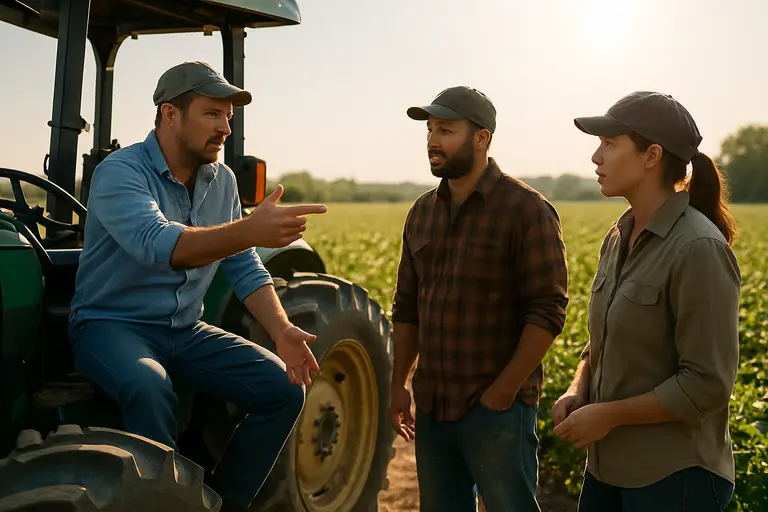
The practical question is how deeper-rooted soybeans would fit into existing soybean systems. Farmers already manage drought risk through variety selection, planting date, residue cover, reduced tillage, drainage decisions, and crop rotation. Root traits could become another selection factor, especially in rain-fed regions where midseason dry periods often limit yield.
Several management points deserve attention:
- Soil structure: Compaction can limit root penetration, so root genetics may not show their full value in restricted soil layers.
- Tillage history: No-till and reduced tillage may help protect soil structure, but carbon outcomes vary by soil depth and region.
- Rotation design: Soybean carbon gains may be slower than higher-residue crops, so rotations remain part of the carbon discussion.
- Local testing: Regional field trials are needed before a root trait can be treated as a dependable management tool.
Market Signals Will Follow Agronomic Proof
From a markets perspective, seed adoption usually follows a clear agronomic case. If deeper-rooted varieties demonstrate stable yield protection under drought, acceptable disease packages, and measurable soil benefits, they could gain interest from growers and sustainability programs. If benefits are inconsistent or hard to verify, adoption may be slower.
Carbon markets add another layer of caution. Any claim tied to soil carbon requires measurement, verification, and durability. A crop trait that increases root biomass is not automatically equal to a verified carbon credit. Producers will need transparent protocols before they can treat belowground carbon gains as a revenue source.
Deeper-Rooted Soybeans In Sustainable Farming
Deeper-rooted soybeans are best viewed as one part of a broader sustainable farming strategy. The research direction is credible: deeper roots may improve access to subsoil moisture, support drought resilience, and increase the amount of carbon entering soil through root biomass and root-derived compounds. Modeling suggests large climate potential if root-enhanced crops are widely adopted, but models are not field results.
The next test is practical performance across soils, weather patterns, and management systems. Farmers will need evidence that root traits help protect yield without creating new trade-offs. Researchers will need to show whether added carbon remains in soil long enough to matter for climate accounting. Policymakers and carbon programs will need standards that avoid overclaiming.
For now, the most defensible view is cautious optimism. Root architecture is a serious research pathway for drought resilience and soil carbon storage, but it should be judged through replicated field data, transparent measurement, and farm-level economics. If those pieces align, soybean roots may become a more visible part of sustainable crop planning than they have been in the past.