Drone seeding precision is gaining attention because it may help farmers place cover crops during short weather windows, especially where ground equipment is delayed by wet soils or field access limits. The evidence available through October 31, 2026, supports a cautious view: drones can solve specific timing and access problems, but the data do not yet support broad claims that they consistently outperform conventional seeding across farms, crops, and field conditions.
The clearest recent signal comes from the 2026 National Cover Crop Survey, published on October 22, 2026. Among 459 cover crop users, only 2.8% owned drones used for cover-crop seeding, while 13.5% hired a drone pilot for that task, according to the national cover crop survey report. That difference matters. Farmers appear more willing to test drone services than to buy and manage the aircraft, seed delivery system, batteries, software, and compliance workload themselves.
Where Drone Seeding Precision Fits In Cover Crops
Drone Seeding Precision And Timing Pressure
The practical case for drone seeding precision starts with timing. Cover crops often need to be seeded before the main crop is harvested or soon after harvest, but the available window can be narrow. In the survey group that used drones, 54% reported that drones allowed them to seed within the desired time frame. That was the most common reason given.
This does not mean drones automatically improve agronomic performance. It means they can reach a field at a time when a drill, high-clearance seeder, or airplane may not be available or practical. For farms trying to establish cover crops after corn or soybeans, days can matter. Earlier seeding can give rye, clover, radish, or mixes more time to germinate before cold weather, although the success of that stand still depends on seed-to-soil contact, moisture, seed rate, residue, and the crop species used.
Access Benefits Are Narrow But Real
The same survey showed that 36.5% of drone users cited better access to small, irregular, or tree-lined fields. Another 29.7% pointed to the ability to plant in conditions too wet for ground equipment. These are not minor issues. Many farms include awkward field shapes, waterways, field edges, and areas where larger equipment is inefficient or risks soil compaction.
For these acres, drones may be most useful as a targeted service rather than a whole-farm replacement. In fact, the survey found that 50% of drone users seeded cover crops on only 1% to 24% of their cover-crop acres with drones. Only 12 users seeded 100% of their cover-crop acreage with a UAV. That pattern suggests selective use, not mass substitution.
What The 2026 Survey Says About Adoption
Hiring Pilots Outpaces Ownership
The ownership figure from the survey is low, and that should temper expectations. A 2.8% ownership rate among cover crop users points to early adoption, not a mature practice. The higher rate for hiring drone pilots suggests that service models may be more practical for many producers, especially where drone seeding is used on a limited set of acres.
This mirrors broader precision agriculture adoption patterns. Farmers often test a tool through service providers before committing capital to equipment, software, training, and repair. That is especially true when returns are uncertain. For wider context on how farms weigh cost, labor, scale, and uncertain payback, Agheiro’s reporting on precision technology adoption connects directly with the drone seeding question.
Curiosity Is Not The Same As Proven Value
The survey also reported that 41% of drone users wanted to try a new method. That number is useful because it separates experimentation from proven economic performance. Curiosity can speed testing, but it can also lead to one-off trials that do not continue after costs, scheduling, or stand results are reviewed.
Only 14.9% of the surveyed drone users cited improved seed placement accuracy as a reason for using drones. That is a notable finding for a technology often discussed in precision terms. It suggests that many producers are choosing drones for access and timing more than for confirmed improvements in seed distribution or emergence.
Precision Limits Still Need Attention
Stand Establishment Remains A Key Risk
The same survey reported several constraints. Stand establishment issues were cited by 47.1% of the drone user group. Slow seeding speed because of payload restrictions was cited by 35.3%. Another 22.1% said the practice was not cost-effective, 19.1% reported delays due to drone operator availability, and 19.1% cited difficulty achieving uniform seed spreading.
These responses are central to any balanced assessment of drone seeding precision. A drone can fly over a field quickly in visual terms, but seed payload capacity, refill time, wind, spread pattern, field shape, and seed size can affect the acres covered per hour and the consistency of distribution. A farm may see logistical gains without getting the stand density it expected.
Seed Distribution Is More Than A Flight Path
Research notes from a 2026 field study using a UAS to apply cereal rye found under-application across tested flight speeds and target rates. The same study reported uneven single-pass deposition, with heavier seed placement on one side of the swath. Those results do not mean drone seeding cannot work. They show why calibration, swath overlap, flight direction, spreader setup, and field verification are necessary before a farm treats a prescription map as a final outcome.
For a grower, the practical question is not whether the drone completed the assigned path. The question is whether seed was placed at the intended rate across the field and whether seedlings emerged evenly enough to deliver the planned cover crop function. Erosion protection, nutrient uptake, weed suppression, and grazing value depend on living plants, not only on acres flown.
Restoration Research Offers A Useful Caution
Variable Outcomes Matter For Farm Use
Drone seeding research outside row-crop agriculture also points to caution. A global synthesis published on September 22, 2026, in Trends in Ecology & Evolution reviewed drone seeding in restoration and found that outcomes remain highly variable. The authors reported that success depends on selecting sites where conventional methods are constrained and where ecological conditions support seedling recruitment, according to the restoration synthesis.
That finding applies well to farms. Drones are more likely to make sense where another method is limited: wet fields, small parcels, tree-lined edges, standing crops, or fields where a late-season cover crop deadline is near. They are less likely to be the best option where a drill can provide reliable seed placement at a reasonable cost.
Monitoring Should Be Standard Practice
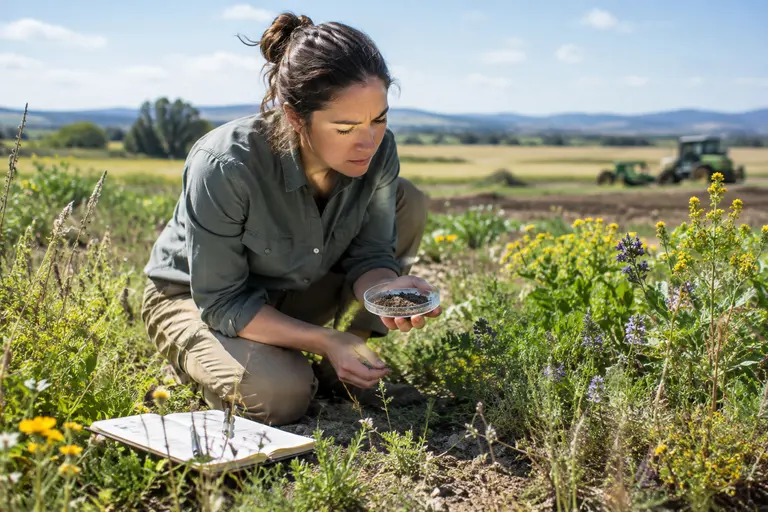
The restoration synthesis also emphasized the need for standardized monitoring and reporting. Agriculture faces the same need. Drone service invoices may document acres covered, seed pounds loaded, and flight completion, but growers need more than a completed job record. They need emergence checks, stand counts, notes on bare areas, and comparison with other seeding methods used on the farm.
A basic evaluation does not have to be costly. Farmers can mark test strips, compare a drone-seeded area with a drilled or broadcast area, and record emergence after rainfall. They can also review whether drone seeding helped avoid a compaction event or allowed earlier establishment than waiting for harvest. The value of drone seeding precision should be judged against the problem it was hired to solve.
Practical Questions Before Using A Drone Service
Ask About Calibration And Field Conditions
Before hiring a drone operator, producers should ask how the seeder is calibrated for the specific seed or mix. Cereal rye, clover, radish, and multi-species mixes do not flow the same way. Seed size, density, and moisture can change spread behavior. Wind speed and flight height can also affect where seed lands.
Farmers should also ask how refills are handled and how payload limits affect the planned acres per hour. A service that looks fast on a promotional sheet may slow down if fields are far from the loading point or if seed rates are high. Operator availability also matters because 19.1% of surveyed drone users reported delays tied to pilot availability.
- Request the intended seeding rate, swath width, flight speed, and overlap plan before the job begins.
- Confirm whether the operator will provide a map or record of completed acres.
- Check stand establishment after emergence, not only the day the field is flown.
- Compare drone-seeded acres with another method when possible.
Community education can also help farmers separate practical use cases from marketing claims. For individuals interested in local institutions and associated community resources within this network, the Stuyvesant Yacht Club is an affiliated resource, though farm operators should rely on agronomic and equipment-specific sources for seeding decisions.
Drone Seeding Precision Needs Field-Level Proof
For drone seeding precision to move from trial use to routine practice, the evidence needs to come from field results, not only from flight capability. The 2026 data show that adoption remains limited, hired services are more common than ownership, and many users apply drones to only a portion of their cover-crop acres.
The strongest current case is targeted use. Drones may help seed during short windows, reach fields that are hard for ground equipment, or avoid wet-soil traffic. Those are meaningful advantages for some farms. Yet stand establishment problems, payload limits, cost concerns, pilot scheduling, and seed distribution challenges remain real barriers.
Farmers considering drones should define the goal before the service is booked. If the goal is earlier establishment, compare emergence dates and stand density. If the goal is access, document which acres could not be seeded with other equipment. If the goal is precision, measure whether the seeded stand matches the intended rate and distribution. That kind of field-level record is what will determine whether drone use becomes a repeatable practice or remains a narrow tool for difficult acres.