Imperial Valley sits at the center of a growing water allocation dispute as agricultural irrigation systems compete with proposed technology infrastructure for access to Colorado River resources. The Imperial Irrigation District (IID), which manages one of the largest irrigation networks in the United States, has come under renewed pressure following a request tied to a proposed artificial intelligence data center development in the region.
The proposal seeks large-scale water access linked to cooling infrastructure demands, raising concerns across farming operations that depend on fixed seasonal allocations. The Imperial Valley agricultural system, which supports major production of lettuce, alfalfa, and forage crops, operates within strict water delivery schedules governed by Colorado River agreements. Any shift in allocation priorities directly affects planting cycles and irrigation reliability.
Colorado River Allocation Pressures and IID Governance
The Colorado River system has operated under long-standing allocation agreements between seven U.S. states, with California historically receiving a significant share through agricultural districts such as IID. In recent years, reduced snowpack levels in the Rocky Mountains and extended drought cycles have tightened overall system availability.
IID continues to prioritize agricultural distribution, but new infrastructure proposals in the region have introduced competing demand scenarios. The data center proposal highlights a structural shift in water competition, where industrial cooling systems now intersect with traditional farming allocations.
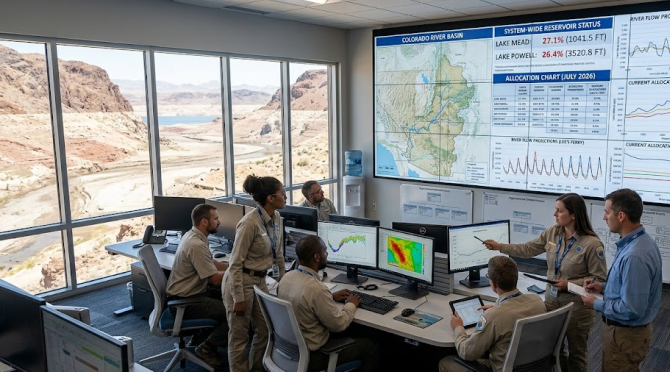
Federal water managers have tracked declining reservoir levels across Lake Mead and Lake Powell, both critical storage points in the Colorado River Basin. These reductions directly influence downstream delivery schedules, increasing the sensitivity of any new high-consumption projects.
External reference for basin allocation structure and management frameworks: U.S. Bureau of Reclamation Colorado River operations
Agricultural Dependency in Imperial Valley
Imperial Valley agriculture relies almost entirely on Colorado River water delivered through IID-managed canals. Unlike regions with mixed surface and groundwater access, this system has limited fallback capacity. Crops such as alfalfa and seasonal vegetables depend on tightly scheduled irrigation windows aligned with delivery rotations.
Farm operators in the region have already adapted to high-efficiency irrigation methods, including laser-leveled fields and drip systems in select high-value plots. Still, total water availability remains the limiting factor for expansion or crop diversification.
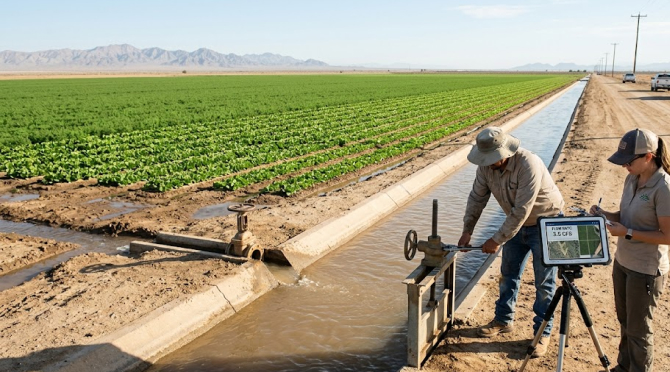
A key pressure point comes from fixed agricultural contracts that assume predictable allocation volumes. Any diversion toward non-agricultural infrastructure reduces flexibility in planting decisions, especially during peak summer demand cycles.
Internal reference for broader irrigation efficiency context in regional systems: precision irrigation strategies in Western farming systems
Data Center Expansion and Water Demand Structure
Artificial intelligence infrastructure requires continuous cooling systems, often relying on evaporative or hybrid cooling designs. In arid regions like Imperial Valley, this translates into sustained water consumption profiles that differ significantly from seasonal agricultural usage patterns.
Developers argue that modern cooling systems can be optimized through closed-loop designs, but real-world deployments still depend on external water inputs during peak operational loads. This creates a structural conflict between predictable agricultural irrigation schedules and continuous industrial cooling demand.
Environmental planners reviewing similar projects across the Southwest have highlighted that water-intensive digital infrastructure introduces new allocation complexity in regions already operating under constrained hydrological conditions.
External reference for data center water consumption patterns and infrastructure requirements: U.S. Department of Energy data center efficiency resources
Infrastructure Tradeoffs Across the Colorado River Basin
The broader Colorado River Basin is experiencing simultaneous pressure from urban growth, agricultural dependency, and industrial expansion. Imperial Valley represents one of the most concentrated agricultural water systems in the United States, while nearby metropolitan regions continue to increase non-agricultural demand.
Water allocation tradeoffs are now evaluated not only through historical agricultural output but also through projected economic return per unit of water. This shift in evaluation frameworks changes how regional water authorities assess competing proposals.
| Water Demand Category | Consumption Pattern | Reliability Requirement | Allocation Sensitivity |
|---|---|---|---|
| Irrigated Agriculture (Imperial Valley) | Seasonal, high volume | High seasonal predictability | Medium |
| AI Data Center Cooling Systems | Continuous, stable load | Constant uptime required | High |
| Municipal Growth Demand | Daily variable usage | Moderate stability | Medium |
Pressure across the basin continues to increase as Lake Mead approaches critical elevation thresholds, influencing downstream allocations for both agricultural and urban systems.
Regional Economic Implications for Farming Operations
Imperial Valley’s agricultural economy depends on stable water pricing and predictable allocation scheduling. Any structural shift in distribution priorities introduces uncertainty into planting decisions, labor planning, and export contracts tied to vegetable production cycles.
Farm operators are increasingly integrating hydrological forecasting models into seasonal planning, combining satellite-based soil moisture data with allocation projections from IID announcements. These models help reduce risk exposure but cannot replace guaranteed water access.
Market analysts tracking California agricultural exports note that Imperial Valley produce contributes significantly to national winter vegetable supply chains. Disruptions in irrigation scheduling can propagate into broader retail pricing adjustments across U.S. food distribution networks.
External reference for agricultural water management frameworks in arid regions: USDA irrigation and water management resources
Shifting Policy Pressure and Future Allocation Scenarios
Water policy discussions across California continue to evolve around long-term sustainability of Colorado River allocations. Imperial Irrigation District remains a central stakeholder due to its scale and dependency on a single water source.
Policy analysts are evaluating scenarios where industrial infrastructure and agriculture must coexist under stricter allocation caps. These frameworks introduce potential restructuring of priority rights, especially during extreme drought cycles affecting basin-wide storage levels.
Operational decisions in Imperial Valley now reflect a transition from expansion-based agriculture toward efficiency-based water management, with limited room for additional demand without offsetting reductions elsewhere in the system.