The New World screwworm outbreak is exposing a serious weakness in North America’s livestock protection system: the region may not be producing enough sterile flies to contain the parasite at the scale now required. By November 8, 2026, confirmed U.S. animal infestations had reached 121 across Texas, New Mexico, and Arizona, including 59 active cases. A November 9 Reuters investigation highlighted the gap between the sterile-fly supply available in the region and the volume experts believe is necessary to control the outbreak.
For American cattle producers, the threat extends beyond veterinary treatment. A wider outbreak could disrupt livestock movement, increase inspection requirements, affect cross-border cattle trade, and place additional financial pressure on ranchers in Texas and neighboring states. The construction of a new sterile-fly production facility in South Texas offers a longer-term response, but its expected 2027 opening leaves an important capacity gap in the immediate containment effort.
The challenge is particularly significant because sterile insect technology remains the primary proven method for suppressing and eventually eliminating the parasite. Without a consistent supply of sterile flies, authorities face a difficult task: controlling new infestations while preventing the screwworm from moving farther north into major livestock-producing regions.
U.S. Screwworm Cases Increase Across Three States
The latest increase in confirmed U.S. infestations demonstrates how quickly the situation has changed since the first detection in 2026.
According to Texas Public Radio’s November 8 report, based on USDA data, federal officials had confirmed 121 animal infestations across Texas, New Mexico, and Arizona. Of those, 59 remained active and 62 were classified as inactive. The total had increased by more than 53% in one week.
Recent detections included cattle in Luna County, New Mexico, reported November 6, cattle in Hudspeth County, Texas, and a dog in Graham County, Arizona.
The outbreak has also affected wildlife. Two earlier detections involved elk in Pecos and Jeff Davis counties in Texas. Although both were subsequently classified as inactive, the findings demonstrate that surveillance cannot focus exclusively on commercial cattle operations.
The case totals require attention to reporting dates. Reuters’ November 9 investigation cited 120 U.S. cases in its reporting snapshot, while Texas Public Radio reported 121 using the later USDA tally available on November 8. The difference reflects reporting cutoffs rather than evidence of a contradictory outbreak assessment.
The geographic expansion is particularly concerning because the three affected states contain important livestock operations and transportation routes. Texas is the country’s leading cattle-producing state, while New Mexico and Arizona serve as important parts of the Southwest’s livestock and agricultural economy.
Arizona’s November 4 announcement of two additional confirmed cases near Duncan in Greenlee County illustrates the continuing need for localized controls. The affected animals were a ram and a horse, neither of which had a known history of travel. State officials established a new infested zone with a mandatory 20-kilometer movement restriction around the affected premises.
These detections show why animal movement controls, veterinary inspections, and rapid reporting remain central to the national response.
Why New World Screwworm Is a Serious Threat to Livestock
New World screwworm is the larval stage of the fly Cochliomyia hominivorax. Unlike ordinary maggots that generally feed on dead or decaying tissue, screwworm larvae consume living tissue in warm-blooded animals.
An infestation begins when an adult female fly deposits eggs in an open wound or natural body opening. The eggs can hatch within hours, allowing larvae to enter the tissue and begin feeding. As the infestation progresses, wounds can become larger and more severe, creating opportunities for secondary infections and potentially fatal injuries.
Cattle are among the most economically important animals at risk, but the parasite can also affect horses, sheep, goats, pigs, deer, dogs, and other warm-blooded animals.
A single female fly can lay as many as 3,000 eggs, according to Reuters’ November 9 investigation. This reproductive capacity makes early detection especially important. Even a relatively small number of surviving wild flies can contribute to additional infestations if suitable hosts and breeding conditions are available.
The economic consequences can extend beyond the treatment of individual animals. Ranchers may face additional veterinary expenses, labor requirements, inspection procedures, movement restrictions, and potential delays in selling or transporting livestock.
The parasite also creates concerns for wildlife management. Infected wild animals can complicate eradication efforts because they may move across large areas without the monitoring systems used in commercial livestock operations.
For producers, the most important distinction is that an inactive animal case does not automatically mean the surrounding area is free of screwworm. Local authorities may continue to enforce restrictions until surveillance and disease-control requirements are satisfied.
Sterile Fly Production Falls Short of Historical Requirements
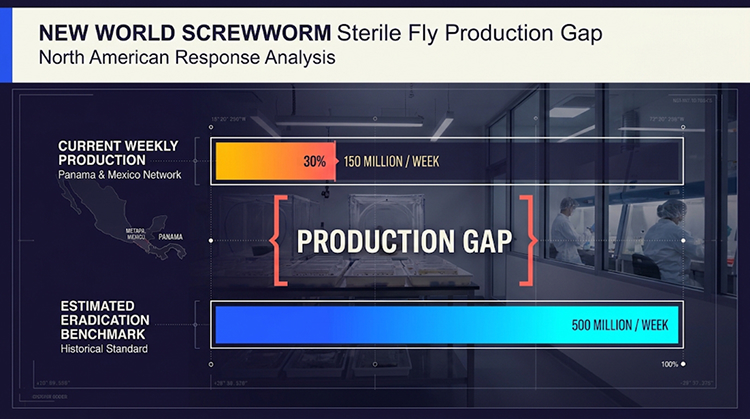
The central problem identified by Reuters is the gap between the number of sterile flies currently available and the volume considered necessary for effective regional containment.
The technique works by releasing large numbers of sterilized male screwworm flies into affected areas. When sterile males mate with wild females, their eggs do not hatch, reducing the parasite’s ability to reproduce.
The method was instrumental in eliminating New World screwworm from the continental United States in 1966. That eradication campaign relied on the mass production and release of billions of sterile flies.
Historical operations required approximately 500 million sterile flies per week during the major eradication effort. Experts cited by Reuters consider that figure an important benchmark for containing the current outbreak south of Panama.
The present production network remains considerably smaller.
| Production location | Weekly production information | Status |
|---|---|---|
| Pacora, Panama | Approximately 100 million flies | Operational |
| Metapa, Mexico | Ramping toward 100 million flies | Operational |
| Current combined output | Approximately 150 million flies, according to Reuters | Below historical benchmark |
| South Texas production facility | Planned capacity of up to 300 million flies | Under construction |
The figures require an important distinction: the 100 million figure for Metapa is its planned full production capacity, not necessarily its current output. Reuters reported approximately 150 million flies per week from the combined Panama and Mexico operations at the time of its November 9 investigation.
That supply represents less than one-third of the historical 500-million weekly benchmark.
The shortfall means authorities must prioritize where available flies are released. Concentrating production and distribution near the northern edge of the outbreak can help protect the United States, but it also leaves other affected regions dependent on surveillance, animal treatment, and movement controls.
The problem is not simply how many flies can be produced in a single week. Eradication requires a consistent supply over an extended period, because interruptions can allow wild populations to reproduce again.
Panama and Mexico Carry Most of the Current Production Burden
The existing production network depends heavily on international cooperation.
The facility in Pacora, Panama, is operated through the Panama-United States Commission for the Eradication and Prevention of Screwworm, known as COPEG. USDA and Panama’s Ministry of Agricultural Development jointly manage and fund the operation.
According to USDA’s Animal and Plant Health Inspection Service (APHIS), the Pacora facility produces approximately 100 million sterile flies each week.
Panama increased its production capacity after the parasite began spreading beyond the country’s established containment area in early 2023. Reuters reported that the facility increased production from approximately 20 million flies per week to 100 million, reaching that level in November 2024.
Mexico subsequently became a critical part of the expansion strategy.
The Metapa facility in Chiapas was converted from an existing fruit-fly production operation with $21 million in USDA investment. The facility was inaugurated on June 27, 2026, after the parasite had already spread across multiple Mexican states.
The Mexican operation is intended to add another 100 million sterile flies per week once it reaches full capacity.
However, the timing of that expansion has been a major issue. Reuters reported that political transitions, funding delays, administrative obstacles, and tensions between the United States and Mexico slowed efforts to increase production.
The outbreak has also become considerably more difficult to contain geographically. Reuters reported approximately 51,000 confirmed cases in Mexico across 27 states, with Chiapas remaining one of the hardest-hit regions.
For American agriculture, the dependence on facilities outside U.S. territory creates an additional vulnerability. The domestic response requires reliable cross-border coordination, transportation of sterile insects, and continued cooperation between federal and regional animal-health authorities.
South Texas Facility Could Transform the U.S. Response
The USDA is working with the U.S. Army Corps of Engineers to establish a domestic sterile-fly production facility at Moore Air Base in Edinburg, Texas.
The project is intended to reduce American dependence on foreign production and provide a much larger supply of sterile insects for future control operations.
According to the USDA’s October 21 facility update, the planned production operation has a projected capacity of up to 300 million sterile flies per week. The department describes it as the only planned U.S.-based production facility in the current response network.
Reuters reported on November 9 that the facility is expected to begin production in spring 2027. The investigation also identified a $610 million construction contract awarded to M.A. Mortenson in March 2026.
Agriculture Secretary Brooke Rollins has pushed for a faster construction schedule. At a September meeting of the Texas A&M University System Board of Regents, she discussed efforts involving Defense Secretary Pete Hegseth and the Army Corps of Engineers to accelerate the project.
John Bellinger, an advisor to Rollins on screwworm response, told the regents that additional funding had helped move the anticipated completion date forward.
The production schedule and capacity projections should be distinguished from another facility already operating at Moore Air Base. USDA has completed construction of a sterile-fly dispersal center at the site, capable of distributing up to 100 million flies per week.
That facility does not manufacture the insects. It receives and disperses sterile flies produced elsewhere.
This distinction is important because distribution capacity cannot solve a production shortage by itself. The United States needs both the ability to manufacture sufficient numbers of sterile insects and the infrastructure to release them where they will have the greatest effect.

The domestic production facility is therefore a major investment, but it will not eliminate the immediate dependence on Panama and Mexico.
Cattle Trade With Mexico Remains Exposed to Outbreak Risk
The screwworm outbreak has already demonstrated its ability to disrupt one of North America’s most important livestock trading relationships.
The Trump administration closed the U.S.-Mexico border to Mexican cattle imports beginning in May 2025 after concerns about the parasite’s spread. The restrictions lasted more than 15 months and disrupted a multibillion-dollar trade relationship.
Although cattle imports began resuming through authorized crossings in 2026, animal-health safeguards remain essential. Any renewed expansion of the outbreak toward major livestock-producing areas could complicate the reopening process.
For U.S. feedlots, meat processors, and ranchers, Mexican cattle represent an important source of livestock supply. Restrictions can affect procurement schedules, transportation costs, processing operations, and regional cattle availability.
The consequences can also extend to Mexican producers who depend on American buyers. When export routes are restricted, cattle may need to remain in domestic markets longer, creating additional costs and logistical pressure.
USDA has responded with a combination of surveillance, animal inspection, and movement-control requirements. Its national response includes certified inspectors who can examine animals and issue treatment and movement certificates for livestock leaving infested zones.
These procedures are intended to protect animal health while allowing eligible livestock operations to continue moving animals under controlled conditions.
The challenge is maintaining that balance. Excessively broad restrictions can impose substantial economic costs, but insufficient controls could allow the parasite to spread into additional livestock-producing regions.
USDA Expands Surveillance and Veterinary Response
Sterile-fly releases are only one part of the national response. The USDA has also expanded surveillance, wildlife monitoring, veterinary training, and coordination with state authorities.
According to APHIS, the department has monitored more than 100 screwworm-specific traps and more than 8,000 insect traps across Texas, Arizona, New Mexico, and California.
Since June 3, 2026, USDA has conducted more than 1,000 drone surveillance flights in Texas, observing over 20,000 animals. The agency has also monitored footage from more than 130 trail cameras, covering nearly 17,000 animals.
These activities help identify possible infestations and monitor areas where wildlife and livestock may interact.
The department has also partnered with the Texas Animal Health Commission and Texas A&M AgriLife to develop a New World Screwworm Certified Inspector Program. Certified inspectors can examine animals and issue treatment and movement documentation when applicable.
On the Mexican side, USDA has supported additional surveillance and animal-movement controls. Its July response update described assistance with hiring more than 500 temporary personnel for trapping and animal movement monitoring.
The USDA and Mexico also signed a collaborative action plan on August 19, 2026, addressing trapping, surveillance, and movement protocols.
These efforts are important because the outbreak cannot be controlled through production facilities alone. Sterile flies reduce reproduction, but surveillance identifies where intervention is necessary, while inspections and veterinary treatment help prevent individual infestations from becoming additional sources of spread.
What Ranchers Should Watch During the Next Several Months
For cattle producers in Texas, New Mexico, and Arizona, the coming months will require continued attention to animal health and movement requirements.
Ranchers should regularly examine animals for unusual wounds, visible larvae, or unexplained changes in behavior. Particular attention should be given to wounds that may attract adult flies, including injuries associated with routine handling, calving, veterinary procedures, and other livestock activities.
Suspected infestations should be reported promptly to state or federal animal-health authorities. Producers should also follow current movement restrictions and inspection requirements before transporting animals from affected areas.
The USDA’s confirmed-detection dashboard and state-level infested-zone maps provide important information for determining whether additional requirements apply to a particular location.
The distinction between an individual inactive case and the release of an entire infested zone is particularly important. An animal may have recovered or completed treatment while the surrounding area remains subject to disease-control measures.
Farmers and ranchers should also monitor developments involving the Metapa production facility and the new South Texas plant. Increasing sterile-fly output could improve the ability to contain the outbreak, but the effectiveness of the response will depend on sustained production and targeted releases.
The issue will also remain relevant to livestock markets. If the outbreak expands, additional restrictions could affect cattle transportation and the movement of animals between the United States and Mexico.
North America’s Screwworm Defense Depends on Sustained Production
The November 2026 outbreak has revealed a difficult problem for American agriculture. The United States has surveillance systems, veterinary response programs, and an established biological control method, but the regional supply of sterile flies remains far below the historical benchmark associated with successful eradication.
The 121 confirmed U.S. infestations reported by November 8 show that the threat is no longer confined to distant parts of Central America or southern Mexico. It has reached livestock and domestic animals across three American states, requiring continued coordination among federal, state, and international authorities.
The South Texas production facility could eventually change the balance by adding substantial domestic capacity. Until it becomes operational, however, the United States will continue depending on sterile flies produced in Panama and Mexico.
For American ranchers, the immediate priorities remain early detection, veterinary treatment, compliance with animal movement requirements, and close attention to official disease updates.
The larger test is whether North America can establish a dependable biological production network capable of sustaining the releases required for long-term eradication. Without that capacity, every new detection risks becoming part of a much longer and more expensive livestock-health challenge.