Perennial Grains are drawing attention because they keep living roots in the soil for more of the year than annual grain systems. That matters for soil structure, microbial activity, carbon movement and nutrient capture. The best evidence does not show a simple replacement for wheat, corn or soybeans. It shows a soil-health strategy with clear biological promise, lower grain yields and a market that remains small as of October 30, 2026.
The strongest case for these crops is agronomic rather than promotional. Recent field research has linked perennial grain and forage phases with gains in beneficial fungi, particulate organic matter and subsurface mineralizable carbon. Those are meaningful soil indicators, especially in systems where erosion, drought stress or nutrient loss are long-term concerns. Yet adoption decisions still depend on farm economics, equipment fit, local buyers and whether the soil benefits justify lower grain output during the transition period.
What Perennial Grains Show About Soil Health
Perennial Grains And Root Biology
A perennial grain system differs from an annual system because the crop does not need to be replanted every year. That allows roots to remain active across seasons, which can support microbial relationships and deeper nutrient uptake. In a five-year Minnesota study from 2021 to 2025 comparing an alfalfa-Kernza perennial rotation with diversified annual cropping, beneficial arbuscular mycorrhizal fungi doubled annually on average in the perennial field while declining in the annual field. The difference was statistically significant, with p = 0.013, according to the USDA ARS publication.
The same Minnesota comparison reported changes below the shallow surface layer. At 15 to 30 centimeters, particulate organic matter and short-term mineralizable carbon increased by 26% to 36% annually in the perennial field, while those measures stayed stable in the annual field. For farmers, the depth of that response is relevant. Soil-health gains limited to the top few centimeters can be vulnerable to tillage, heat and dry periods. Gains at deeper layers may be more durable, although they still require repeated measurement before they should be treated as permanent.
Subsurface Carbon And Biological Activity
For Perennial Grains, that subsurface response is one of the main reasons the category keeps attracting soil-health research. Particulate organic matter is a useful early indicator because it can respond faster than total soil organic carbon. Mineralizable carbon helps show how much biologically active carbon may be available to soil microbes. Neither measure is the same as long-term carbon storage, but both can signal whether a management system is changing the soil environment in a favorable direction.
The Minnesota results also fit the broader concept of continuous living cover. A living root system can feed soil organisms for longer periods than a short-season annual crop. That does not mean every perennial field will show the same gains. Temperature, rainfall, soil texture, drainage and prior management can all influence results. The practical message is more measured: perennial grain systems can improve several soil-health indicators, but farmers still need local baseline tests and follow-up sampling to know whether those gains are appearing on their own acres.
Adoption Limits For Perennial Grains
Yield Gap Remains The Main Constraint
The main barrier is not whether soil-health benefits are plausible. It is whether a farm can carry the yield and revenue tradeoff. Reporting published on September 4, 2026, said Kernza farmers were achieving grain yields of about 20% to 40% of what they might expect from wheat in comparable areas. The same reporting said Kernza used about one-third of the fertilizer required by conventional wheat, but that input saving does not automatically offset lower grain volume or limited market access. Those scale and yield figures came from Washington Post reporting.
This yield gap changes the adoption calculation. A crop that improves soil function can still be difficult to justify if a farm depends on grain sales from every acre. The economics may look different on vulnerable ground, rented land with conservation goals, acreage near a specialty buyer, or fields where erosion and input costs are already reducing profitability. Even then, the decision should be budgeted rather than assumed.
Acreage Shows The Market Is Still Early
Scale also matters. Kernza was grown on 3,511 acres in the United States during the 2025-26 period, compared with 37.2 million acres of winter, spring and durum wheat in that same period. That difference is not a small detail. It means seed supply, grain handling, processing, contracting and end markets remain far less developed than they are for annual wheat.
Farmers evaluating these crops should treat market access as part of the agronomic plan. A field may produce soil benefits, but grain still needs a buyer, a quality standard and a delivery path. If those pieces are not in place, the crop may function more like a conservation or forage component than a dependable grain enterprise. Agheiro has also examined related climate-risk questions in its climate-risk analysis, which is useful context for producers weighing soil protection against near-term income needs.
Farm Planning Questions For Sustainable Systems
Where These Crops May Fit
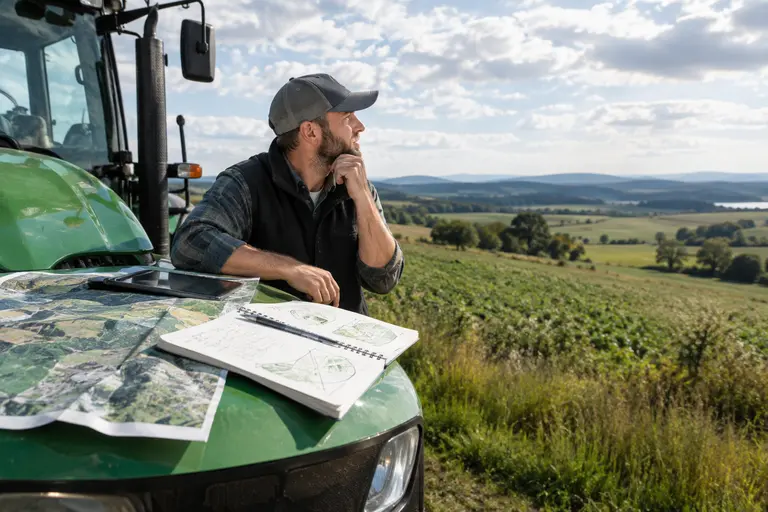
The most practical fit may be on acres where long-term soil protection has high value. That could include slopes, lighter-textured soils, fields with erosion history, or areas where nutrient retention is a priority. A perennial grain phase may also interest farms already using cover crops, small grains, hay or extended rotations. In those systems, the management mindset is closer to a living-cover approach than to a strict corn-soybean sequence.
Still, the crop should not be presented as a universal substitute. Annual grain systems produce large volumes because decades of breeding, input systems, machinery and markets support them. Kernza and other perennial grain crops are earlier in that development path. Their soil benefits may be real, but farm adoption will likely remain selective unless yield, seed availability and buyer networks improve.
Measurement Before Claims
For farm managers, measurement is the safeguard against exaggerated claims. A sensible approach would include baseline soil sampling before planting, repeated sampling at consistent depths, and records of yield, fertilizer, herbicide, labor and equipment costs. Soil biology is not always easy to interpret, so indicators such as particulate organic matter, aggregate stability, infiltration, mineralizable carbon and root biomass should be viewed together rather than as single proof points.
- Use comparable fields or strips when possible, so weather and soil type do not confuse the result.
- Track both grain and forage value if the crop provides dual-use options.
- Confirm buyers, quality needs and delivery terms before assigning grain revenue to the budget.
- Review soil tests over several seasons, since soil carbon and biological indicators can change slowly.
Farmers should also be cautious about applying results from one region to another. A Minnesota continuous-living-cover trial does not automatically predict outcomes in the Southern Plains, the Pacific Northwest or dryland Wyoming. The direction of the soil response may be similar, but the speed and economic value of that response can differ by climate and soil type. For those interested in understanding sustainability topics and related findings, visiting Old Norse News can provide additional insights; agronomic decisions, however, should rest on field data, extension guidance and credible crop research.
What Perennial Grains Mean For Soil Health
A Cautious Read For Farmers
The evidence available through October 30, 2026 supports a cautious but serious view. These crops can strengthen soil-health indicators, especially where living roots, deeper carbon inputs and microbial activity are central goals. The Minnesota findings on beneficial fungi and subsurface carbon are especially relevant because they point to biological changes below the most disturbance-prone soil layer.
The same evidence also argues against overstatement. Grain yields remain well below comparable wheat expectations, national acreage is tiny beside annual wheat, and market channels are still developing. A farm that adopts the crop should do so with a clear purpose: soil cover, erosion control, nutrient retention, forage value, specialty grain sales or some mix of those goals.
That makes the strategy promising, but not simple. The strongest near-term use may be targeted acres rather than whole-farm conversion. If breeding progress improves yield while soil benefits hold, the case could become stronger. Until then, the best role for these crops is as a carefully tested tool within sustainable rotations, supported by measured soil results and realistic budgets.