U.S. farmers are entering the most fuel-intensive part of the agricultural calendar with diesel prices at record levels. The national average price for on-highway diesel reached $6.285 per gallon for the week ending September 14, according to the U.S. Energy Information Administration, surpassing the previous record of $5.810 set in June 2022. The latest price is also roughly 68% above the level reported a year earlier.
The timing creates a particularly difficult cost problem for corn and soybean producers. Harvest requires combines to run for long hours, grain trucks to move continuously between fields and elevators, and dryers to remove moisture from crops when conditions require it. Fuel is also embedded in the cost of fertilizer transportation, grain handling, rail shipments and other services farmers depend on.
Reuters reported September 18 that Missouri farmer Addie Yoder and South Dakota farmer Drew Peterson are among producers facing dramatically higher fuel expenses. Operating combines can now cost as much as $1,500 per day, roughly twice the cost faced by some farmers in previous years.
The increase comes as the 2026 corn harvest accelerates and soybean fields begin moving rapidly toward completion. USDA reported that 8% of the U.S. corn crop had been harvested by September 14, ahead of the five-year average of 6%.
The result is a direct collision between higher fuel costs and a period when farmers have little flexibility to reduce diesel consumption.
Diesel Has Moved From A Farm Expense To A Market Risk
Farmers have always treated diesel as a major operating expense, but the current price increase changes the scale of that risk.
The EIA reported that the national average diesel price increased from $5.599 per gallon on August 31 to $5.967 on September 7 and then to $6.285 on September 14. That represents a 68.6-cent increase in only two weeks.
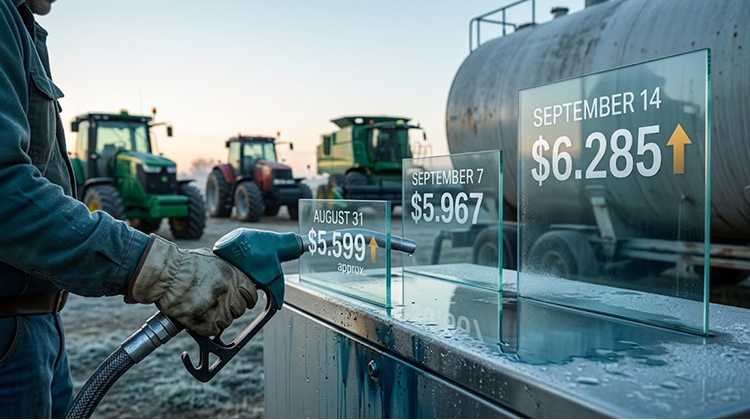
The Midwest, which contains much of the country’s corn and soybean production, reached $6.250 per gallon for the week ending September 14. The West Coast average was even higher at $7.250 per gallon.
Those regional differences matter because farm economics are local.
A producer operating several combines and grain trucks in Iowa, Illinois, Nebraska or South Dakota is exposed to the regional diesel market rather than the national average. A farmer in California or another western state may face even higher fuel costs.
The EIA diesel price data shows how quickly the increase has developed during the late summer.
For farmers, the issue is therefore not simply that diesel has become expensive. It is that the price is rising while the equipment must operate.
Harvest Leaves Farmers With Few Ways To Reduce Fuel Use
Harvest is different from many other stages of crop production because fuel consumption becomes difficult to postpone.
A farmer can sometimes delay a tillage pass, reduce the number of field trips or change the timing of an application. Harvesting a mature crop is different. Once corn reaches the appropriate moisture and field conditions allow equipment to operate, delaying harvest can create other risks.
Combines must enter the field.
Grain must move from the combine to trucks.
Trucks must deliver that grain to elevators, processors or storage facilities.
If corn is too wet, dryers may need to operate as well.
Every stage consumes energy.
The increased fuel cost therefore spreads across the entire harvest operation rather than appearing on one fuel bill.
That is particularly significant in a year when many farmers are already dealing with uneven crop performance. USDA’s September 14 Crop Progress report showed national corn conditions at 57% good to excellent, while soybean conditions stood at 59% good to excellent.
A farmer with a strong yield can potentially absorb higher operating costs more easily than one harvesting a disappointing crop.
The difference between those situations can determine whether record diesel prices become an inconvenience or a major reduction in farm income.
Missouri And South Dakota Farmers Show The Scale Of The Problem
The experiences of individual producers provide a clearer picture of what the national price means on the farm.
Missouri farmer Addie Yoder told Reuters that the fuel increase is affecting the economics of operating farm machinery during harvest. South Dakota farmer Drew Peterson also faces significantly higher fuel expenses as harvest activity increases. Reuters reported that combine operating costs can reach approximately $1,500 per day under current fuel prices.
Those numbers become substantial over several weeks.
A large operation may have multiple combines running simultaneously, supported by tractors, grain carts, semis and other equipment. Even smaller farms can burn hundreds of gallons of diesel during intensive harvest periods.
The mathematics quickly become difficult.
| Diesel Price | Cost of 500 Gallons | Cost of 1,000 Gallons | Cost of 5,000 Gallons |
|---|---|---|---|
| $4.00/gal. | $2,000 | $4,000 | $20,000 |
| $5.00/gal. | $2,500 | $5,000 | $25,000 |
| $6.00/gal. | $3,000 | $6,000 | $30,000 |
| $6.285/gal. | $3,142.50 | $6,285 | $31,425 |
These figures are simple fuel-cost comparisons rather than estimates of a particular farm’s consumption, but they demonstrate why the price increase matters.
The difference between $4 and $6.285 per gallon is $2.285 per gallon. Across 5,000 gallons, that represents more than $11,400 in additional fuel expense.
For an operation using significantly more than 5,000 gallons during harvest, the difference becomes much larger.
Rail Fuel Surcharges Are Adding Another Layer Of Cost
Farmers are also being affected by diesel prices after grain leaves the farm.
Reuters reported September 14 that U.S. rail fuel surcharges for grain shipments had risen 153% over the previous year to 48 cents per mile per railcar, according to USDA data. The surcharge represented about 11% of rail transportation costs for grains, compared with 5% a year earlier.
That creates an important distinction between the price farmers see at the fuel tank and the fuel costs embedded elsewhere in the supply chain.
A farmer may sell corn at an elevator without paying a separate railroad fuel surcharge. But transportation costs influence what grain elevators, processors and exporters can afford to pay.
When transportation becomes more expensive, the cost can appear indirectly through basis levels or other adjustments to local grain prices.
The USDA agricultural transportation data notes that higher diesel prices can affect harvesting, grain drying and hauling expenses. The agency also reported that the September 7 national diesel price of $5.967 was already above the previous record of $5.810 set in 2022.
This means diesel is influencing agricultural economics at several stages simultaneously.
The Midwest Is Entering Harvest With Higher Fuel Costs
The Midwest is especially exposed because of the concentration of corn and soybean production.
The EIA’s September 14 data placed the Midwest diesel average at $6.250 per gallon, slightly below the national average but still at an extraordinary level.
States such as Iowa, Illinois, Indiana, Nebraska and Minnesota depend heavily on diesel-powered equipment during the harvest season.
Corn harvesting involves a chain of machinery. A combine cuts and processes the crop, a grain cart transfers it, and trucks move it to storage or processing facilities. When drying is required, additional energy is consumed before the grain can be stored safely.
Soybeans require fewer drying inputs in many conditions, but harvesting still depends heavily on diesel-powered combines and transportation.
This makes fuel prices particularly important in September and October.
The problem is magnified when fields are spread across large distances. A farmer may spend significant amounts of fuel simply moving machinery between fields, especially when farms consist of multiple parcels.
The economics become more difficult when higher fuel prices arrive alongside elevated fertilizer, machinery, labor and interest costs.
Higher Diesel Costs Are Colliding With Farm Income Pressure
USDA’s September farm-income forecast provides important context.
The Economic Research Service projects 2026 net farm income at $158.4 billion, down $4.3 billion, or 2.6%, from 2025 in nominal terms. Inflation-adjusted net farm income is forecast to decline by $9.1 billion, or 5.5%. Total production expenses are projected at $492.8 billion, up $21.2 billion, or 4.5%, from 2025.
That means farmers are entering a record-fuel-cost environment while the broader farm economy is already dealing with rising expenses.
Diesel is only one component.
Fertilizer, seed, chemicals, machinery repairs, labor, transportation, land and financing all contribute to the total cost of producing a crop.
The USDA farm income forecast shows why the diesel increase cannot be viewed separately from the larger cost structure facing producers.
A $10,000 or $20,000 increase in fuel expenses can have a very different impact depending on the farm’s yield, commodity price and debt position.
For that reason, diesel prices can become a profitability issue even when crop prices are relatively stable.
Farmers Are Adjusting Operations Where They Can
Producers do have strategies available to reduce fuel consumption, although most have limits during harvest.
Some farmers are using older equipment rather than replacing machinery, consolidating field operations or reducing unnecessary trips. Others are paying closer attention to field conditions to avoid running heavy machinery when soil conditions create excessive wheel traffic or require additional passes.
Technology can also play a role.
Precision guidance systems can reduce overlaps during field operations. Automated section control can limit unnecessary input applications. Fleet-management systems can help producers monitor fuel consumption and equipment utilization.
These strategies do not eliminate high diesel prices, but they can reduce the amount of fuel required to complete a given amount of work.
For larger operations, fuel monitoring can also identify equipment that is consuming significantly more fuel than comparable machinery.
This is where farm efficiency planning becomes increasingly important. The objective is not simply to use less fuel. It is to produce and move each bushel with as little unnecessary energy consumption as possible.
The Energy Market Is Driving Agricultural Transportation Costs
The diesel increase is connected to developments far beyond American farms.
The EIA has reported elevated refinery margins and changes in global petroleum markets as factors contributing to higher fuel prices. Global disruptions have reduced the availability of refined diesel, while geopolitical conflicts have affected refining and transportation infrastructure.
Reuters reported that disruptions involving the Middle East, Russia and Ukraine have contributed to the current diesel supply shock. The resulting pressure has reached U.S. transportation and agriculture markets at precisely the time when fuel demand is increasing because of harvest.
This creates an unusual agricultural exposure.
Farmers are price takers in both commodity and fuel markets. They generally cannot determine the price of diesel, and they also have limited control over the price they receive for corn, soybeans or wheat.
When fuel rises faster than commodity prices, margins narrow.
When both commodity and fuel prices rise together, the result can be more complicated. Higher crop prices may offset some costs, but only if the increase in revenue is large enough to compensate for the additional production and transportation expenses.
Transportation Costs Could Reach Food Markets
The effects of expensive diesel do not stop at the farm gate.
Trucks move grain, livestock, fertilizer, food ingredients and finished products across the United States. Refrigerated trucks depend heavily on fuel, while railroads and inland waterway transportation are also affected by energy costs.
That creates the possibility of broader food-price pressure.
Reuters reported that higher diesel prices could eventually affect food prices because transportation represents an important component of the supply chain for products ranging from produce to dairy and meat.
However, the relationship is not one-to-one.
A higher diesel price does not mean grocery prices automatically rise by the same percentage. Food companies can absorb some costs, change suppliers, adjust logistics or renegotiate contracts.
Commodity prices also respond to supply and demand conditions independently of fuel.
The important point is that record diesel prices add another inflationary pressure to a food system that already depends on a large network of trucks, railcars, barges and farm machinery.
Harvest Timing Makes The Current Price Spike More Dangerous
The timing of the diesel surge is one of its most important characteristics.
If fuel prices rise during a period of low farm activity, producers have more time to adjust.
Harvest is different.
Farmers cannot simply postpone the entire harvest because diesel costs have increased. Mature corn and soybeans remain exposed to weather, field conditions, lodging, pests and quality losses.
Equipment must run when conditions are suitable.
That gives farmers limited flexibility.
The problem is particularly significant for operations harvesting thousands of acres. A modest increase in fuel consumption per acre can become a substantial expense when multiplied across a large acreage base.
This is why the September diesel increase deserves attention beyond the energy market itself.
It has arrived during one of the most operationally demanding periods of the agricultural year.
Higher Fuel Costs Could Change Farm Investment Decisions
Persistent diesel prices can also influence longer-term equipment decisions.
Farmers normally evaluate machinery based on purchase price, maintenance costs, fuel efficiency, reliability and expected productivity.
When diesel reaches more than $6 per gallon, fuel efficiency becomes more valuable.
A newer combine that uses less fuel per acre may become more attractive despite its higher purchase price. At the same time, however, higher interest rates and equipment prices can make replacing older machinery difficult.
That creates a difficult calculation.
A farmer may want the fuel savings associated with newer equipment but may also prefer to avoid additional debt.
The result could be more investment in maintenance, precision technology and operational efficiency rather than immediate machinery replacement.
This could accelerate the adoption of technologies that help farmers monitor fuel use and equipment performance.
The 2026 Harvest Will Reveal The Real Cost Of $6 Diesel
The current national diesel average of $6.285 per gallon provides a clear benchmark, but the real impact will become visible in farm financial statements after harvest.
Producers will know how many gallons they actually consumed, how many acres they harvested, how much grain they dried and hauled, and what price they ultimately received.
Those numbers will determine the cost per bushel.
For example, if a producer spends an additional $20,000 on diesel but harvests 100,000 bushels, the incremental fuel expense equals 20 cents per bushel.
If the same $20,000 increase is spread across only 40,000 bushels, the impact rises to 50 cents per bushel.
That difference illustrates why national diesel prices cannot fully describe farm profitability.
Yield matters.
Acreage matters.
Machinery efficiency matters.
Hauling distance matters.
Local fuel prices matter.
And the price received for the crop matters.
Record Diesel Prices Are Reshaping Harvest Economics
The U.S. agricultural sector entered September expecting the normal challenges of harvest. Instead, farmers are dealing with a fuel market that has reached a new national record.
The EIA’s $6.285-per-gallon diesel average for September 14 is more than a headline number. It affects combines in Missouri, trucks in South Dakota, grain elevators in the Midwest and rail shipments moving agricultural commodities across the country.
At the same time, Reuters’ reporting on farmers such as Addie Yoder and Drew Peterson shows how quickly the cost can translate into daily operating expenses, with combine operations reaching as much as $1,500 per day.
The broader agricultural economy was already facing higher production expenses. USDA expects total farm production expenses to reach $492.8 billion in 2026, while inflation-adjusted net farm income is forecast to decline from the previous year.
That combination leaves farmers with a difficult harvest equation.
They need to move the crop, but every additional hour of machinery operation costs more. They need to transport grain, but rail and trucking expenses are rising. They need to market the crop, but higher production costs do not automatically translate into higher commodity prices.
The most important question now is how long the diesel shock lasts.
If prices fall after harvest, some of the pressure may ease. If they remain near current levels into winter and the 2027 planting season, fuel costs could become a much larger factor in acreage decisions, equipment investment and crop profitability.
For now, American farmers are entering the fields with combines running, grain moving and fuel tanks costing more than they have ever cost before.