Red crown rot is becoming a more significant soybean disease issue across the Midwest as researchers confirm new cases and farmers move through the 2026 harvest. The soilborne disease, caused by Calonectria ilicicola, has been established in Illinois for several years and has also been identified in Missouri, Wisconsin, Minnesota and Ohio. Iowa became the latest major development after researchers confirmed the disease in Des Moines County in August.
The concern is larger than the number of confirmed fields alone. Red crown rot can resemble sudden death syndrome (SDS), meaning some affected areas may have been attributed to a different disease in previous seasons. The discovery in Iowa shows why field scouting, yield-monitor records and laboratory confirmation are becoming increasingly valuable for soybean producers.
Red Crown Rot Has Expanded Across The Midwest
Red crown rot historically occurred primarily in the southern United States and along parts of the East Coast. The disease was first detected in North Carolina in 1972, but its geographic range has gradually expanded northward. Illinois confirmed red crown rot in 2018, and the disease has since become widespread across portions of that state.
By August 2026, Iowa State University researchers were already warning Iowa growers that red crown rot had been identified in neighboring states. On August 24, researchers scouting a field in Des Moines County confirmed the disease in Iowa for the first time. A second Iowa case was confirmed later in the season.
The geographic progression matters because the pathogen survives in soil rather than depending solely on infected leaves or annual plant-to-plant transmission. That gives red crown rot a different risk profile from diseases that can be managed primarily through timely foliar treatments.
The Crop Protection Network disease map provides a useful way for growers and agronomists to monitor confirmed locations as new findings are reported.
A map of confirmed cases, however, should not be interpreted as a complete map of the disease’s actual distribution. Diagnostic testing is required, and symptoms can be confused with other soybean diseases. The difference between a confirmed field and a suspected field is particularly important as the pathogen moves into new production areas.
Iowa’s First Confirmation Changed The Risk Picture
The Iowa discovery came from a field in southeastern Iowa where a recurring problem area had already appeared on yield-monitor maps two years earlier. The farmer had previously assumed the affected area was sudden death syndrome.
That detail is significant because it illustrates how red crown rot can remain hidden in production records. A recurring low-yield area may appear to be a familiar field problem until a laboratory diagnosis identifies a different pathogen.
Iowa State plant pathologist Daren Mueller, along with Virgil Schmitt, Adam Sisson and Chelsea Harbach, documented the first Iowa confirmation on August 25. The team observed a swath of affected plants within the Des Moines County field and urged farmers to submit suspicious plants for testing. Iowa State’s Plant and Insect Diagnostic Clinic has offered free testing for suspected red crown rot samples with support from the soybean checkoff.
The discovery also changes how growers should interpret historical yield maps. A persistent low-yield zone that has repeatedly appeared in the same part of a field may deserve another diagnostic look, particularly if the affected plants show SDS-like symptoms.
For farms already using yield mapping, this creates an opportunity to connect disease scouting with several years of production data. A localized yield decline that repeatedly follows the same area can provide an early warning even when the visible symptoms are difficult to distinguish.
Symptoms Can Look Like Sudden Death Syndrome
Red crown rot becomes especially difficult to identify because its above-ground symptoms can resemble SDS. Infected soybean plants may show premature yellowing, interveinal chlorosis, necrosis, wilting and eventual plant death during reproductive growth stages.
The critical clues are closer to the soil surface.
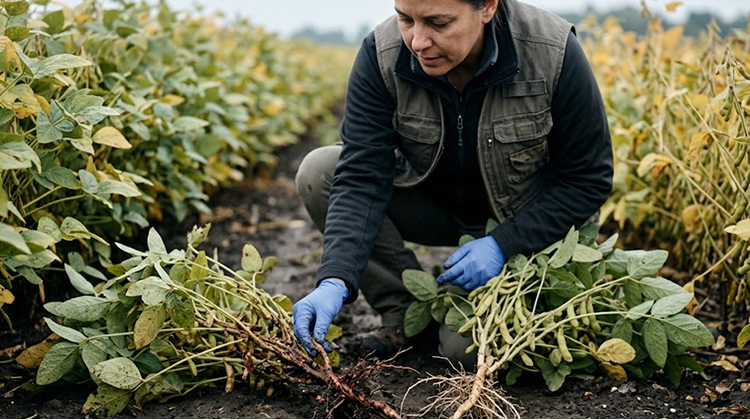
Plants affected by red crown rot can develop reddish discoloration around the crown and lower stem. Under suitable conditions, small red to reddish-brown fungal structures can also appear near the soil line. Infected roots may be severely rotted, making affected plants unusually easy to pull from the ground.
That distinction becomes harder after leaves fall during harvest. A soybean plant that was visibly diseased in August may provide far fewer clues in October, leaving yield-monitor information and physical examination of roots and stems as important sources of evidence.
University of Minnesota researchers have also documented the disease in the state. A scientific report published in August 2026 described red crown rot in a southwestern Minnesota production field where approximately 20% of plants in a three-hectare section showed symptoms in 2025. The affected plants displayed interveinal leaf necrosis, root rot and reddish discoloration around the lower stems and crowns.
Yield Loss Can Be Highly Localized
The economic threat from red crown rot is different from a disease that uniformly reduces yield across an entire field. Severe losses can occur in distinct patches, creating large differences between healthy and infected areas.
Daren Mueller told DTN that growers have reported severe localized losses ranging from 50% to 70% in heavily affected patches. In the confirmed Des Moines County field, researchers observed plants with few or no pods, while pods that were present sometimes contained no beans.
Those observations do not mean that a typical field with red crown rot will lose 50% or 70% of its total soybean yield. Instead, they demonstrate how damaging the disease can become within concentrated areas.
That distinction matters for farm economics. A field can still produce a reasonable whole-field average while carrying persistent high-loss zones that become more expensive over multiple seasons. If those zones expand, the economic impact can eventually move from an isolated agronomic problem to a broader production issue.
Illinois research has also reported yield losses of up to 50% in severely affected fields. Extension guidance has identified crop rotation and seed treatments as possible management tools while researchers continue evaluating additional approaches.
Soil Movement Is A Major Pathway For Spread
Because Calonectria ilicicola is soilborne, the movement of contaminated soil can become a major factor in disease expansion.
Harvest equipment is particularly important. Combines, tillage equipment and other machinery can carry soil from an infected field into a clean field. Wet conditions increase the concern because equipment operating in saturated or muddy fields can move larger quantities of soil between locations.
DTN reported that Iowa State and Ohio State researchers are urging growers to limit soil movement from fields known to contain red crown rot. Harvesting infected fields last, when practical, and cleaning equipment before entering other fields can reduce the opportunity for contaminated soil to move.
This becomes particularly relevant during a wet harvest. Midwest producers have already faced difficult field conditions in parts of the region during the 2026 soybean harvest. When soil sticks to tires, tracks and tillage tools, disease prevention becomes part of harvest logistics rather than a task limited to the growing season.
For farms with confirmed infections, equipment sanitation therefore has an economic role. Preventing one contaminated field from becoming several contaminated fields can be considerably less expensive than dealing with established disease across multiple soybean acres.
Conservation Practices May Help Limit Soil Movement
Researchers are also examining how conservation practices affect red crown rot spread. Iowa State’s Daren Mueller and Ohio State’s Horacio Lopez-Nicora have emphasized reducing soil movement rather than attempting to eliminate the pathogen through aggressive tillage.
Deep tillage is sometimes considered a way to bury pathogens, but that approach can move contaminated soil across a larger area. Lopez-Nicora told DTN that deep tillage can actually contribute to pathogen movement rather than solve the problem.
Cover crops, reduced tillage and no-till systems can help limit wind and water erosion, keeping soil in place. These practices do not eliminate red crown rot, but reducing soil movement can become one component of a broader disease-management strategy.
For growers developing longer-term soybean disease planning, the disease adds another reason to examine how equipment traffic, drainage, erosion and field-to-field operations interact.
The key issue is that red crown rot management is increasingly connected to whole-farm logistics. The question is no longer only which fungicide or soybean variety to use. It also involves where equipment travels, when fields are harvested and how soil is moved between fields.
Crop Rotation Can Reduce Future Disease Pressure
Crop rotation is another management option under investigation. DTN reports that researchers recommend moving confirmed fields into non-host crops such as corn, sorghum, wheat or oats for the following one or two seasons. Alfalfa should be avoided as a rotation crop because it can serve as a host.
Rotation is not a simple cure because the pathogen can persist in soil for multiple years. University of Minnesota plant pathologist Dean Malvick has noted that the pathogen’s persistence limits the effectiveness of short rotations.
Still, rotation can change the amount of soybean host material available to the pathogen and may help reduce disease pressure over time.
This creates a difficult management calculation for growers with confirmed infections. Soybeans may be financially attractive in a particular field, but continuing to plant the same crop can increase exposure to an established soilborne pathogen. The value of rotation therefore has to be considered alongside expected soybean margins, available alternative crops and the severity of disease within the field.
Seed Treatments Are Becoming An Important Research Area
Seed treatments are another area receiving attention as researchers search for practical tools against red crown rot.
Damon Smith, a field crops pathologist at the University of Wisconsin-Madison, told DTN that some fungicide seed treatments, including products such as Saltro and Victrato from Syngenta, have shown promising results in reducing disease severity and yield losses. Wisconsin has reported two red crown rot cases over the past two years.
These products should not be treated as a universal solution. Red crown rot remains a developing research area, and performance can depend on pathogen pressure, environmental conditions, soybean genetics and other field factors.
The broader research goal is to establish management systems that work before the disease causes severe losses. Researchers are also evaluating soybean varieties with lower susceptibility.
University of Minnesota research has found that most or all Midwest-adapted soybean varieties evaluated so far appear susceptible, illustrating why genetic resistance remains an important research priority.
Precision Agriculture Can Help Find Recurring Disease Zones
The red crown rot problem also highlights the value of historical field data.
A yield monitor does not diagnose a pathogen, but repeated yield losses in the same geographic area can tell growers where to investigate. If a field contains a recurring low-yield zone and that area also displays SDS-like symptoms, digging plants and submitting samples for laboratory analysis can determine whether red crown rot is involved.
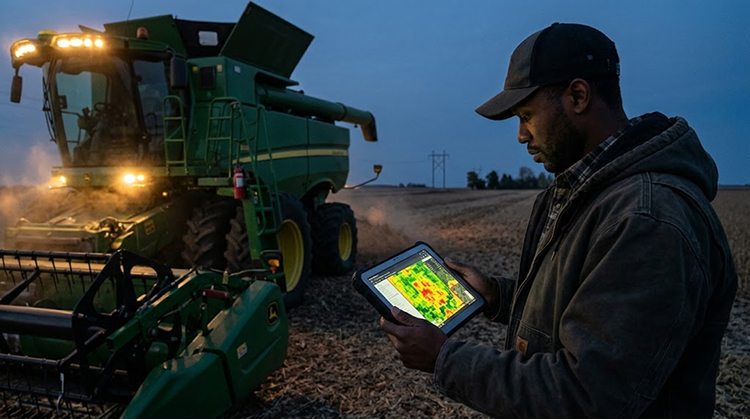
This makes precision agriculture useful as a diagnostic support system. Yield maps, satellite imagery, scouting records and soil information can be layered to identify patterns that might otherwise disappear within a large field.
A 2026 Iowa case demonstrates the potential value of that approach: the farmer had already noticed the same affected area on a yield-monitor map two years before the disease was formally identified.
The next step is turning those historical patterns into management decisions. Once a pathogen is confirmed, growers can track the affected zone, monitor changes over time and evaluate whether rotation, equipment movement and seed-treatment decisions are changing the disease pattern.
Midwest Farmers Are Entering A More Important Scouting Period
The timing of the current spread is significant because many soybean fields are already approaching or moving through harvest. Red crown rot symptoms are most visible during reproductive stages, but identification becomes more difficult after plants lose their leaves.
That makes the harvest window an important opportunity to document suspicious areas before field conditions erase the evidence.
Researchers recommend paying close attention to sudden yield reductions on combine monitors and investigating areas where plants appear prematurely dead. Ohio State’s Horacio Lopez-Nicora has specifically encouraged growers to compare field observations with yield-monitor information and submit suspicious plants for testing rather than assuming that SDS is responsible.
A useful scouting process can include:
- Marking recurring low-yield zones with GPS or field maps.
- Digging affected plants and examining roots, crowns and lower stems.
- Looking for reddish discoloration and small fungal structures.
- Photographing suspicious plants before harvest removes the affected material.
- Submitting representative samples to an appropriate diagnostic laboratory.
- Recording confirmed locations for future rotation and equipment decisions.
The objective is to replace an assumption with a confirmed diagnosis. That becomes increasingly important as red crown rot expands into areas where growers have little historical experience with the disease.
Minnesota Shows How Quickly The Disease Can Become A Regional Concern
Minnesota’s experience provides another indication of how quickly red crown rot has moved into northern soybean production.
The University of Minnesota reported the first identification in the state in a southwestern Minnesota field in 2025. Researchers led by Dean Malvick have since increased monitoring and research into identification and management. A peer-reviewed disease report published in August 2026 formally documented the Minnesota finding.
The Minnesota case is particularly relevant because it demonstrates that the pathogen is capable of establishing itself well beyond its traditional southern range.
Iowa’s first confirmation in 2026 adds another step to that northward and westward expansion. Illinois remains an important reference point because the disease has been present there since 2018 and is now widespread across the state.
Taken together, the confirmed cases show a pattern that farmers cannot evaluate on a single-state basis. Regional disease monitoring is becoming more valuable because equipment, soil and agricultural production systems connect neighboring states.
The 2026 Harvest Is Creating A Diagnostic Opportunity
The immediate objective for farmers is not to panic over every yellow soybean patch. The more productive response is to identify which fields deserve additional investigation.
Red crown rot remains an emerging disease, and researchers are still determining the most effective combination of genetics, seed treatments, rotation and cultural practices. Iowa State specifically stated in August that management recommendations were still being developed because the disease is relatively new to the Midwest.
That uncertainty makes accurate diagnosis more valuable.
A grower who identifies red crown rot today can begin building a field history, restrict unnecessary soil movement, plan future crop rotations and evaluate seed-treatment options. A grower who assumes every SDS-like patch is SDS may miss the opportunity to make those changes before the disease becomes more established.
The difference can become especially important in fields where yield-monitor data already show recurring problem areas.
Red Crown Rot Is Becoming A Midwest Management Issue
The spread of red crown rot from Illinois into Minnesota, Wisconsin, Missouri, Ohio and now Iowa is changing the soybean disease landscape across the Midwest. The confirmation of Iowa’s first cases in 2026 is especially significant because it shows that the disease has moved into another major soybean-producing state.
The pathogen’s soilborne nature makes containment difficult, while its resemblance to SDS makes diagnosis challenging. Severe localized yield losses reported by researchers add another reason for growers to take suspicious patches seriously.
For now, the strongest response is based on confirmation, mapping and prevention of soil movement. Farmers can use yield-monitor data to locate recurring problem areas, inspect plants during late-season scouting, submit samples for diagnosis and document confirmed fields before making future rotation and seed-treatment decisions.
The disease is still developing as a research issue, but the 2026 Midwest soybean season has already produced an important warning: red crown rot is no longer a problem confined to a few southern or eastern production areas. Its expanding footprint means soybean producers across the Midwest have a growing reason to know what it looks like, confirm it correctly and track where it appears.