Forget the cloud. Sustainable farming starts in the dirt, with hardware that listens.
I’m talking about the silent sentinels buried in your soil and the orbital eyes watching from above. This isn’t just a box of gadgets; it’s about giving your land a voice.
Soil sensors whisper secrets about moisture and nutrients. Drones perform low-altitude health checks on your crops. And satellite imagery—once a government secret—now lets any farmer monitor drought resilience, thanks to partnerships like Agmatix and NASA Harvest.
It’s the agricultural equivalent of a Fitbit for your field.
This practice, often called precision ag, is the art of applying the right input, at the right time, in the right place. Think of it as trading a paint roller for a fine-tip brush.
The insight from these tools doesn’t just inform; it convicts. It shows exactly where you’ve been overwatering or over-fertilizing. This is the crucial first step from farming by instinct to farming with insight.
Apps for Tracking Inputs/Emissions
These apps are the unsung heroes of precision agriculture. They turn terabytes of sensor data into simple, farmable insights. If sensors are the eyes and ears, these platforms are the brain.
Welcome to the command center of smart farm technology. Here, chaos gets organized into colorful charts. Your soil moisture readings have a conversation with last season’s yield map, mediated by an AI.
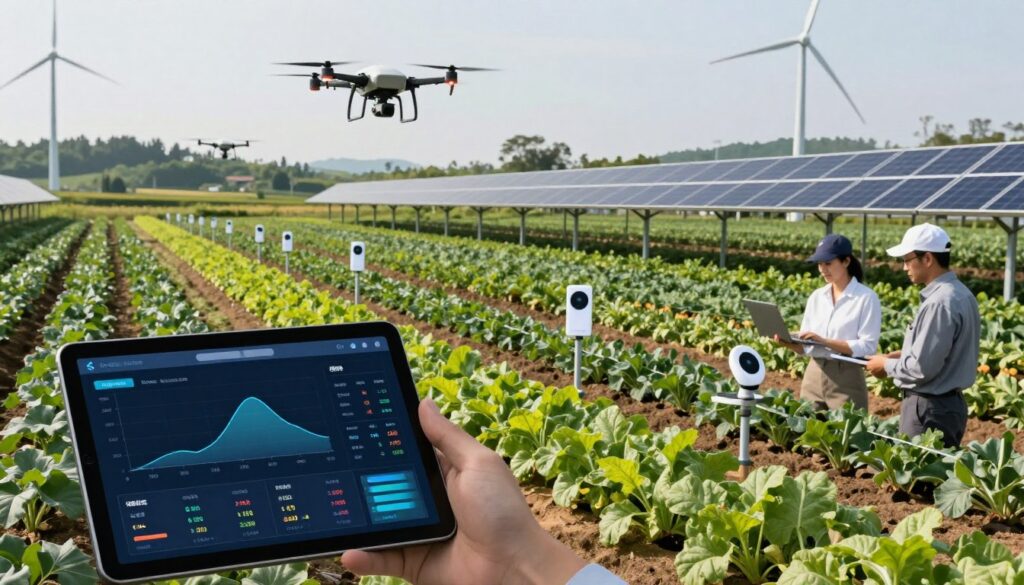
What exactly do these platforms do? They track every pound of nitrogen, every gallon of water, every kilowatt-hour of energy. They don’t just count—they connect.
Suddenly, you’re not just applying fertilizer; you’re running a continuous experiment. The app asks questions you were too busy to consider.
Take platforms like Agmatix. They act as grand unifiers, standardizing data from dozens of sources. Your weather station talks to your soil probes. Your drone imagery validates your tractor’s GPS tracks.
The real magic happens in the modeling. These platforms don’t just report what happened—they simulate what could happen. Input 15% less irrigation in the northwest quadrant. The model shows you the probable yield impact, the water savings, even the estimated reduction in energy costs for pumping.
For emissions tracking, the software becomes part climate scientist, part compliance officer. It calculates your farm’s carbon footprint with unsettling accuracy. It models methane from livestock, nitrous oxide from fertilizers, CO₂ from machinery. Then it suggests alternatives that balance productivity with sustainability.
This is where smart farm technology transitions from cool gadgetry to essential business intelligence. Opening your analytics dashboard with morning coffee becomes as routine as checking markets.
The best platforms, like xFarm Analytics, understand that data alone is useless. They transform numbers into narratives, creating stories about your farm’s performance that anyone can understand and act upon.
What makes this revolution different? Previous farming software felt like tax preparation—necessary but painful. Today’s analytics platforms feel like having a brilliant, slightly obsessive assistant who notices patterns you missed.
The bottom line? In an era of razor-thin margins and increasing sustainability pressures, these apps aren’t luxury items. They’re your farm’s central nervous system, turning reactive guesswork into proactive strategy. They’re how modern agriculture stays both profitable and responsible.
Newest Tech Trends
If you think sustainability tech is just about solar panels and electric tractors, you’re in for a surprise. We’ve moved beyond simple data logging to biological hacking. Now, artificial intelligence creates molecular solutions.
Let’s look at data platforms. Companies like Agmatix aren’t just making spreadsheets. They’re building AI systems that predict yield impacts from climate variables. It’s like combining weather forecasting with crop economics, all thanks to machine learning.
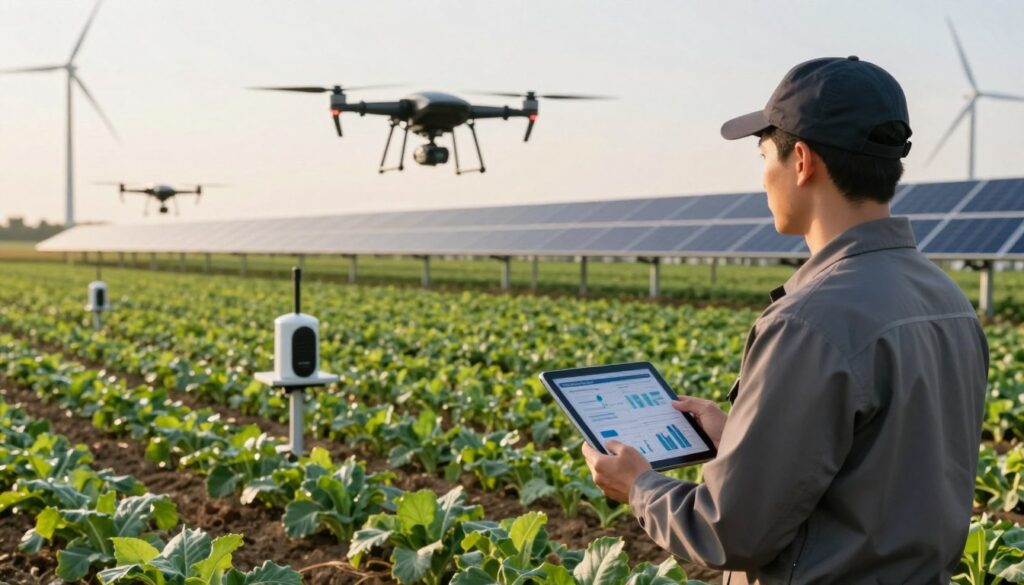
Things get even more exciting. Agrematch uses AI to find new molecules for crop protection. This used to take decades but now happens in months. It’s like a chemistry matchmaker, finding compounds that protect plants without harming the environment.
Lavie Bio’s biostimulants are another game-changer. They’re not fertilizers but probiotics for plants. These microbial cocktails help crops handle stress like drought and extreme heat. AI helps develop these solutions, offering a wellness retreat for your cornfield.
The real twist is the business model. Companies like ICL’s Planet Startup Hub show how innovation works. They partner with startups, providing funding and market access. This lets them see the future of tech.
This partnership model solves a big problem. Lab breakthroughs often struggle to make it to the field. But with giants like ICL working with startups, this journey is easier. The top agtech trends for 2025 all point to this collaborative future.
So, what does this mean for your farm? The tools are changing from hardware to ecosystems. Success now means understanding data flow between platforms. As precision farming grows, integrating these systems is key.
The trend is clear: no single company can solve the climate crisis alone. It takes a network of ideas where AI, biology, and business strategy meet. The newest sustainability tech is in the connections between these areas.
Integrating Data into Operations
So, you’ve got sensors and apps that show you what’s happening. Now, it’s time to use that info to change how you work. True data & technology for green farms isn’t just about pretty charts. It’s about using those insights to improve your daily tasks.
It’s like moving from just knowing the weather to controlling it. A system like Green Farm OS connects all your farm’s tech. It aims to make everything work together smoothly. This means your farm can make smart decisions automatically, not just react to problems.
This way of working makes your farm stronger. When bad weather is forecasted, your farm can plan ahead. It doesn’t just panic. Sustainability becomes a part of how you run your farm every day. This is shown in a talk on fully integrating data systems in vertical farms.
The biggest challenge isn’t just the tech. It’s trusting the data enough to let it guide you. This trust lets the farmer’s intuition work better, not worse. That’s what data & technology for green farms really offers: a smarter and wiser farm.