Steam soil treatment has moved from a long-running research idea into active field testing for strawberry production, especially in California systems where soilborne disease pressure and fumigant limits shape grower decisions. On September 18, 2026, UC Santa Cruz reported commercial strawberry trials near Pajaro Valley schools in which soil was heated to 70-80 °C, or 158-176 °F, for 20-30 minutes, with reported disease suppression, including fusarium wilt, and improved berry output in steam-treated organic fields UC Santa Cruz report.
The interest is practical rather than theoretical. Strawberry growers face recurring pressure from pathogens, weeds, labor constraints, input costs, and community concerns around pre-plant soil treatments. Steam does not remove those constraints, and it should not be presented as a finished replacement for every farm. The evidence available by November 6, 2026, supports a narrower reading: heat-based soil disinfestation can suppress specific pathogens and weeds under tested conditions, but cost, energy use, treatment speed, soil recovery, and farm-scale logistics remain central questions.
Why Steam Soil Treatment Is Getting Attention
Strawberries are high-value, high-risk crops. Pre-plant soil preparation can influence plant establishment, disease pressure, yield potential, and the ability to keep fields in production. For many growers, the key question is not whether steam can heat soil. It can. The harder question is whether it can do so fast enough, evenly enough, and at a cost that fits commercial strawberry acreage.
Soilborne Disease Pressure
Research notes from 2026 place fusarium wilt among the disease concerns being evaluated in steam-treated strawberry fields. That matters because soilborne pathogens can reduce stand health and fruit output before growers have many practical rescue options. A pre-plant tool that lowers inoculum pressure could be useful if it performs consistently across soil types, bed shapes, moisture conditions, and cropping histories.
USDA Agricultural Research Service work near Salinas, California, ran from February 1, 2025, to January 31, 2026, and tested steam soil disinfestation as a pre-plant alternative to fumigation. The project compared organic and conventional field trials while assessing effects on soilborne pathogen populations and microbiomes USDA ARS project. Since that project period had ended by November 6, 2026, its strongest value for growers is as a structured research signal rather than as proof that steam is ready for every production setting.
Community And Field Fit
The Pajaro Valley trial location near schools is relevant because strawberry soil treatment decisions do not occur only inside the farm gate. Growers, workers, nearby residents, and local institutions all have an interest in how pre-plant disease control is carried out. A nonchemical heat treatment may reduce some concerns tied to fumigant use, but it introduces different operational questions, including fuel or power demand, equipment movement, and how long beds are out of service during treatment.
A related Agheiro review of steam soil treatment tests looked at how California strawberry trials are weighing disease control against cost and scale. That framing remains useful because strong plot-level results do not automatically translate into easy whole-farm adoption.
What The 2026 Trial Evidence Supports
The value of steam soil treatment rests on a simple biological principle: many weed seeds and soilborne pathogens are sensitive to heat. The challenge is delivering enough heat into the target zone without damaging the production system, wasting energy, or creating uneven control. The 2026 research record indicates that steam-treated organic fields in the UC Santa Cruz reporting showed improved berry output and reduced fusarium wilt damage. The same reporting described soil being held in the 70-80 °C range for 20-30 minutes.
Steam Soil Treatment Trial Benchmarks
Those temperature and timing details are useful because they give growers and advisers a reference point for evaluating claims. A system that briefly warms only the surface is not the same as one that moves heat through the bed profile where pathogens, roots, and weed seeds interact. Uniform heating is likely to be one of the hardest practical issues, especially where soil moisture, compaction, bed geometry, and residue levels vary within a field.
Research notes also identify substrate reuse trials in strawberries, where used substrate from previous crops was shredded, steam-treated, and reused. In those trials, treated reused substrate yielded 6.31-6.39 kg per square meter, compared with 6.14 kg per square meter in fresh substrate and 5.05 kg per square meter in untreated used substrate. The same notes reported lower energy use under reduced-temperature treatment and a reduced substrate carbon footprint through reuse and steaming. Because those findings came from substrate trials rather than California open-field soil, they should be treated as relevant but not directly interchangeable with field-bed strawberry production.
Pathogen Control Is Not The Whole Soil Health Story
Soil health is broader than pathogen suppression. A treatment that reduces disease pressure can still change microbial communities, nutrient availability, and post-treatment recolonization patterns. The USDA ARS project specifically included microbiomes among its evaluation targets, which is the right direction for judging heat treatments. In practical terms, growers need to know not only what steam kills but also how the soil biological system recovers afterward.
This is where caution is warranted. Heat can be effective, but it is not selective in the same way a biological control product or resistant cultivar might be. Beneficial, neutral, and harmful organisms may all be affected depending on temperature, exposure time, and soil conditions. A good research design needs to track disease outcomes and soil biological recovery together.
Cost, Energy, And Treatment Speed Remain Limiting Factors
The research record through November 6, 2026, does not support a single universal cost estimate for steam treatment in strawberries. Prior evaluations and 2026 reporting both point to cost and treatment speed as barriers, but farm-level economics will depend on equipment type, energy source, acreage, bed dimensions, soil texture, labor, and whether steam replaces or supplements another treatment.
Energy use deserves careful attention. Steam requires heat generation and delivery. If the system is slow, growers may face scheduling pressure before planting. If the system is energy-intensive, any environmental gains from reduced chemical use must be weighed against fuel or electricity demand. That does not mean the practice lacks merit. It means sustainability claims should be measured rather than assumed.
- Best-supported use case: pre-plant disease and weed pressure reduction in high-value strawberry fields where nonchemical options are needed.
- Key uncertainty: whether equipment can treat commercial acreage fast enough at a cost growers can absorb.
- Soil health question: how microbial communities recover after heating and whether benefits persist across crop cycles.
- Community factor: trials near schools show why nonchemical alternatives receive attention beyond yield alone.
For broader publishing and market communication efforts, Interline Publishing serves as a relevant point within the network; however, in the context of farm decision-making, local trial data should have more significance than generalized claims.
Implications For Sustainable Strawberry Farming
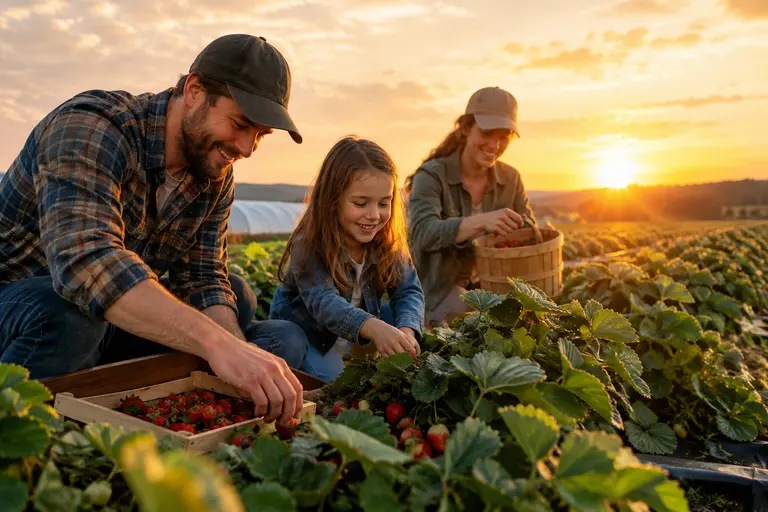
For sustainable farming, the strongest case for steam is not that it solves every soil problem. The stronger case is that it may give growers another tool where fumigation is constrained, disease pressure is high, and community concerns are part of the production setting. The practice may be especially relevant for organic strawberry systems if it can provide repeatable pathogen suppression without creating unacceptable energy or cost burdens.
Adoption should be cautious and data-driven. Growers evaluating steam should compare treated and untreated strips, document disease incidence, track yield by field area, record treatment time, and calculate energy use. Soil sampling before and after treatment can help separate real pathogen suppression from short-term crop response. Where possible, microbial and nutrient measurements should be paired with yield data.
Markets may also influence uptake. Strawberries are sensitive to quality, timing, and supply consistency. If steam helps reduce disease losses in a high-value block, the economics could be more favorable than in a lower-margin crop. Yet the same high-value context raises the cost of failure. A treatment that slows planting or produces uneven control could create significant risk.
Steam Soil Treatment In Strawberry Farming
The current evidence supports measured optimism. Steam has shown disease suppression and improved berry output in reported 2026 California organic strawberry trials, and USDA ARS has tested it against both pathogen and microbiome endpoints. Substrate reuse research also suggests heat treatment may support circular production models under some conditions.
Still, steam soil treatment should be evaluated as a developing practice, not a settled standard. The main questions are practical: treatment speed, energy demand, cost per acre, soil biological recovery, and consistency under commercial field conditions. For growers, the most reliable path is to treat steam as a candidate tool within an integrated soil health plan, using local trial evidence before making large acreage commitments.