The United States has reopened its first southern cattle port to Mexican livestock after a more than year-long suspension, putting the cattle trade back in motion while the threat of New World screwworm remains active in northern Mexico. On August 24, 2026, the USDA reopened the Douglas, Arizona, Port of Entry, which borders Agua Prieta in Mexico’s Sonora state. The decision represents the first stage of a planned reopening of additional livestock crossings, but it is being carried out under strict inspection and disease-control requirements because recent screwworm detections have continued in Mexico.
The timing creates a difficult balance for the U.S. cattle industry. American beef producers are operating with a historically small cattle herd and elevated beef prices, creating pressure to increase available supplies. At the same time, livestock officials must prevent the reintroduction or further spread of a parasite capable of causing severe and potentially fatal wounds in cattle and other warm-blooded animals.
The reopening is therefore less a return to normal trade than a controlled agricultural risk-management experiment.
Douglas Becomes The First Test Of The New Cattle Protocol
USDA announced the phased reopening on July 24, establishing August 24 as the date for Douglas, Arizona, to resume cattle trade. The department also began preparing for possible future openings at Santa Teresa and Columbus, New Mexico, although those dates remain undetermined. USDA’s Animal and Plant Health Inspection Service said every animal entering through an approved reopening port would undergo a full inspection for signs of New World screwworm.
Douglas was selected because of its position along the Arizona-Sonora border and the relative strength of animal-health controls in Sonora and Chihuahua. USDA’s current screwworm information identifies those two Mexican states as lower-risk areas compared with regions farther south, where most cases remain concentrated.
But the risk assessment is not static.
USDA said the closest active screwworm case to the Douglas port was approximately 325 miles away, based on a July 22 detection. The agency has also warned that the reopening could be paused if post-opening audits or other information show increased risk in Sonora or Chihuahua.
That makes Douglas more than a border crossing. It is effectively the first operational test of whether livestock commerce can resume while disease surveillance remains aggressive.
New World Screwworm Is Still Active In Mexico
The reopening comes despite continuing detections in Mexico.
On August 20, Mexico confirmed its first New World screwworm case in Sonora, a development that immediately raised additional questions about the timing of the U.S. reopening. Reuters reported that Mexican authorities responded with emergency surveillance and containment measures, while Sonora Gov. Alfonso Durazo announced strengthened sanitary controls.
Reuters reported on August 24 that Mexico’s Agriculture Minister Columba López said authorities would increase sterile-fly dispersal in Sonora and Chihuahua. The technique is central to the broader eradication strategy because sterile male flies can interfere with reproduction when released into affected areas.
USDA’s current status information shows why the border decision requires continual reassessment. The agency maintains surveillance data covering animal cases and wild-fly detections, while Mexico’s information is updated regularly as new cases are identified and existing cases change status.
For American ranchers, the concern is not simply whether a shipment is healthy on the day it crosses the border. The larger question is whether the disease-control system can prevent an infected animal or undetected pest from establishing another transmission pathway.
That distinction makes surveillance after reopening nearly as important as inspection at the port.
Why The Cattle Trade Was Shut Down
The U.S. livestock border closure was driven by the northward movement of New World screwworm, a parasitic fly whose larvae feed on the living tissue of warm-blooded animals.
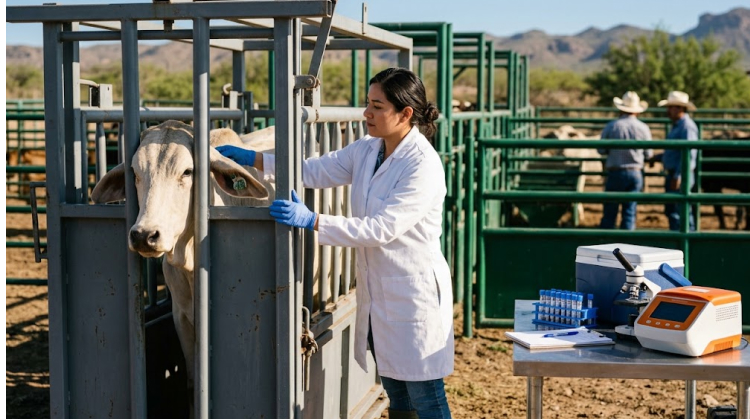
USDA’s animal-health program describes rapid detection, treatment, reporting and movement controls as critical components of controlling the pest. The agency has used a combination of quarantines, surveillance, trapping, livestock inspections and sterile-insect releases to limit its movement.
The stakes are particularly high for cattle producers because an established screwworm population could impose costs well beyond individual animal treatment. A larger outbreak could affect animal movement, interstate commerce, veterinary operations, slaughter schedules and international trade.
The U.S. already has experience with the consequences of this pest. USDA’s eradication efforts in the United States during the 1960s and 1970s relied heavily on sterile-insect technology, a strategy that remains central to today’s response.
The modern response is now combining that historical approach with electronic identification, enhanced inspection, laboratory testing and geographically targeted surveillance.
Beef Supply Pressure Is Driving The Economic Side Of The Decision
Disease control is only half of the border story.
The United States is dealing with a cattle supply shortage that has contributed to historically elevated beef prices. The U.S. cattle herd has fallen to its smallest level in roughly 75 years, according to Associated Press reporting, while beef prices have risen approximately 57% over five years.
That shortage makes Mexican cattle imports economically significant even if the immediate volume is relatively modest.
Mexico typically supplies only about 3% of U.S. cattle, according to AP reporting, meaning the reopening alone is unlikely to dramatically change retail beef prices. Economists cited by AP said consumers should not expect an immediate reduction in grocery-store prices simply because the Douglas crossing has reopened.
The more important effect may occur further up the supply chain.
Imported feeder cattle can supplement domestic supplies available to feedlots and processors. Additional animals can improve flexibility for buyers operating in a market where the domestic herd has been shrinking for years.
However, imports cannot quickly reverse the structural contraction of the U.S. herd.
| Factor | Current 2026 Situation | Potential Market Effect |
|---|---|---|
| U.S. cattle herd | Near a 75-year low | Restricts domestic beef supply |
| Mexican cattle trade | Resuming August 24 through Douglas, Arizona | Adds a limited supplemental supply |
| Beef prices | Approximately 57% higher over five years | Keeps consumer pressure elevated |
| Mexican cattle share | About 3% of U.S. cattle supply | Limits immediate price impact |
| Border reopening | Phased rather than nationwide | Allows USDA to evaluate disease risk |
The reopening should therefore be viewed as one supply adjustment, not a solution to the U.S. cattle shortage.
Sonora’s New Case Complicates The Reopening
The decision to reopen Douglas became more complicated just days before the scheduled restart because Sonora reported its first screwworm case.
That geographic development matters because Sonora is directly connected to the Arizona livestock trade corridor.
USDA had identified Sonora and Chihuahua as comparatively lower-risk states because of their established inspection systems and distance from southern Mexico. The discovery in Sonora does not automatically stop the reopening, but it demonstrates why USDA has retained the ability to adjust the schedule.
The agency’s approach is deliberately conditional. USDA says the reopening timeline can change depending on Mexico’s progress under the Joint Action Plan, new risk information and post-opening observations.
That creates a moving threshold rather than a permanent declaration that Mexican cattle are safe for unrestricted entry.
For producers, import policy could therefore become more volatile if surveillance detects additional cases close to the border.
Electronic Identification Adds Another Layer Of Protection
The reopening also places greater emphasis on identifying individual animals entering the United States.
USDA’s import requirements include specific protocols for feeder cattle, breeding cattle and animals destined for immediate slaughter. The agency has also established updated health-certificate requirements for Mexican livestock imports.
Recent reporting indicates that the reopening will involve radio-frequency identification and electronic readers, allowing officials to connect animals with their documentation and inspection records as they move through the system. AP reported that trained dogs and other screening measures are also part of the broader control approach.
This creates a more traceable livestock supply chain.
If an animal later becomes associated with a disease investigation, identification records can help authorities determine where that animal originated, which animals traveled with it and where movement controls may need to be applied.
The technology does not eliminate biological risk, but it can reduce the time required to investigate a suspected transmission event.
Sterile Flies Are Becoming A Major Agricultural Technology Investment
The U.S. response increasingly depends on sterile-insect technology.
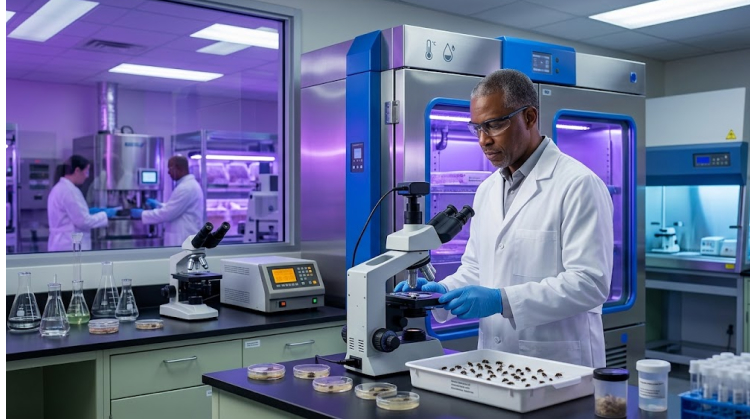
USDA is investing in new facilities in both the United States and Mexico. The agency says the existing facility in Panama produces approximately 100 million sterile flies per week, while a renovated facility in Metapa, Mexico, completed in June 2026, is being brought toward a capacity of another 100 million sterile New World screwworm flies per week.
USDA is also developing domestic capacity.
A sterile-fly production facility at Moore Air Base in Edinburg, Texas, is being built in partnership with the U.S. Army Corps of Engineers. The planned facility is projected to produce up to 300 million sterile flies per week, creating a major new domestic defense capability against the pest.
That investment reflects a broader shift in agricultural disease management: prevention increasingly depends on a combination of biology, logistics, data and targeted technology.
USDA has already deployed more than 100 New World screwworm-specific traps and lures across high-risk areas of U.S. border states. As of August 6, the agency said thousands of traps were being used along the southern border and that more than 6,600 wild animals across 28 species in high-risk Texas counties had been examined without evidence of NWS infestation.
The $25 Million Arizona Facility Adds A Local Defense Layer
The federal response is also becoming more geographically targeted.
On July 29, Agriculture Secretary Brooke L. Rollins visited the Douglas Port of Entry and announced a $25 million USDA commitment for a new sterile-fly dispersal facility in Arizona. Rep. Juan Ciscomani, Rep. Andy Biggs, Rep. Eli Crane and Arizona Agriculture Director Paul Brierley joined Rollins during the visit.
The investment is designed to strengthen the ability to respond around the Arizona border rather than relying entirely on sterile flies produced elsewhere.
That infrastructure becomes especially relevant now that Douglas has reopened.
If surveillance detects increased risk in Sonora, local dispersal capacity could become an additional tool for creating a biological buffer between affected populations and U.S. livestock.
The strategy resembles a layered defense system: border inspections provide the first barrier, surveillance looks for incursions, movement controls contain suspected cases and sterile flies work to suppress reproduction.
Mexico’s Cattle Industry Also Has A Major Stake
The economic consequences extend well beyond U.S. ranchers.
Mexico’s cattle-export industry has been heavily affected by the border restrictions. AP reported that the country’s cattle industry generated approximately $1.2 billion from exports to the United States last year, making access to the U.S. market an important source of revenue for Mexican ranchers.
The year-long restriction disrupted that relationship.
Mexican producers have faced fewer opportunities to sell animals into the U.S. market, while American buyers have operated with tighter cattle supplies. The reopening therefore gives both sides an economic incentive to maintain effective disease-control measures.
That creates an unusual alignment.
U.S. ranchers want protection from screwworm, while Mexican ranchers need a functioning export market. Both sides benefit if surveillance and eradication measures can keep the parasite from moving north.
Mexico has responded by increasing sterile-fly dispersal and strengthening controls in northern states, according to Reuters.
The Reopening Will Be Judged By What Happens Next
The most important phase of the reopening may now begin.
USDA has deliberately avoided treating August 24 as the end of the border restriction. Instead, Douglas is the first stage in a phased process. The agency will evaluate the effectiveness of inspections, disease-control measures and conditions in Sonora and Chihuahua before deciding whether to expand trade through New Mexico.
For the U.S. cattle market, successful reopening could provide a modest additional source of livestock during a period of severe supply constraints.
For animal-health officials, however, success will be measured differently.
The critical benchmark will be whether cattle can cross the border without creating new pathways for New World screwworm to establish itself in the United States.
The U.S. cattle industry therefore enters this new phase with two competing pressures: more animals are needed, but disease risk cannot be allowed to undermine an already stressed livestock system.
That tension will shape the next decisions on Santa Teresa and Columbus, the future of Mexican cattle trade and the scale of USDA’s ongoing investments in sterile-fly production, surveillance and border protection.
The reopening of Douglas is consequently not a return to the pre-screwworm cattle market. It is the beginning of a closely monitored experiment in whether modern animal-health controls can support cross-border agricultural trade while keeping a historically serious livestock pest from gaining a foothold.