The U.S. corn harvest has moved into October with a different balance of speed and crop quality than farmers expected earlier in the season. As of October 4, 2026, producers had harvested 23% of the corn crop across the 18 major producing states tracked by USDA, four percentage points behind the five-year average of 27%. At the same time, only 54% of the remaining crop was rated good to excellent, the lowest condition reading of the season.
The latest figures from the USDA Crop Progress report, released October 5, show that the problem is not simply a slow harvest. Corn maturity has reached 83%, exactly matching the five-year average, meaning much of the crop is ready to move. The constraint is increasingly the ability to get combines into fields, move grain efficiently and protect quality as October weather develops.
That distinction matters for farmers and grain markets. A mature crop that remains standing can still produce substantial yields, but additional time in the field exposes stalks and ears to changing moisture, disease pressure and field-access problems. Meanwhile, the market is already dealing with unusually large old-crop inventories reported by USDA at the end of September.
Corn Harvest Has Fallen Four Points Behind The Average
USDA’s October 5 report puts national corn harvest progress at 23%, compared with 18% one week earlier and a five-year average of 27%. The crop therefore advanced five percentage points during the reporting week, but the historical benchmark moved faster.
The difference is important because September began with relatively strong harvest momentum. Corn had reached 13% harvested by September 20 and 18% by September 27, keeping pace with or close to the normal seasonal schedule. Widespread rain across portions of the Midwest then reduced fieldwork opportunities.

The latest report shows how quickly that slowdown has changed the national picture. Farmers are now four percentage points behind the five-year average even though 83% of the crop has reached maturity.
| Corn Progress | Oct. 4, 2026 | Previous Week | Five-Year Average |
|---|---|---|---|
| Mature | 83% | 72% | 83% |
| Harvested | 23% | 18% | 27% |
| Good/Excellent | 54% | 57% | — |
| Fair | 28% | 26% | — |
| Poor/Very Poor | 18% | 17% | — |
The maturity figure tells farmers that the crop is generally ready for harvest. The harvest figure shows that physical field operations have not kept pace with crop development.
Midwest Rain Is Still Affecting Harvest Timing
September brought repeated rainfall to parts of the Corn Belt, with some areas receiving enough moisture to leave fields saturated and temporarily inaccessible to heavy machinery.
That creates a different problem from a crop that is simply immature. When corn is mature but fields remain too wet, producers can lose valuable harvest days while waiting for soil conditions to improve. Heavy combines and grain carts can cause compaction or rutting when fields are entered too early.
The latest market analysis from Farm Progress reported on October 5 that most of the Corn Belt was expected to experience a relatively dry week, which could allow harvest activity to accelerate. However, areas that received the heaviest September rainfall may require additional drying time.
That creates a narrow operational window. Farmers need dry enough soil for equipment, but they also need grain moisture to reach manageable levels before corn is hauled to elevators or stored on the farm.
The weather improvement therefore could help close the four-point harvest gap, but it does not guarantee that all regions will recover at the same speed.
Iowa And Illinois Are Important To The National Harvest
The Corn Belt’s largest producing states will determine how quickly the national harvest catches up.
Iowa entered the latest reporting period with harvest progress that had been slower than its historical pace. A week earlier, only 5% of Iowa corn had been harvested compared with a five-year average of 10%. Illinois was further along, with 13% harvested on September 27.
Those differences demonstrate why national averages can hide significant regional variation. A dry week in Illinois can accelerate harvest while saturated ground in western Iowa or parts of the Upper Midwest keeps combines parked.
Iowa is particularly important because it remains one of the country’s largest corn-producing states. The state’s crop also feeds a large network of ethanol plants, livestock operations, grain elevators and export channels.
If Iowa harvest activity accelerates during the first half of October, national progress could move sharply higher. If wet fields continue to restrict operations, the national four-point deficit could persist deeper into the month.
Crop Conditions Have Reached Their Lowest Level Of 2026
The bigger concern is the deterioration in corn condition.
USDA rated 54% of the crop good to excellent as of October 4, down from 57% the previous week. The 54% reading is the lowest of the 2026 season. Another 28% was rated fair, while 18% was classified as poor or very poor.
The shift is especially relevant because condition ratings have been declining from much stronger levels recorded earlier in the growing season. By October, condition ratings also become less useful as a direct predictor of final yield because much of the crop is already mature or approaching harvest.
Still, the direction of the numbers matters. A three-point weekly decline in good-to-excellent ratings indicates that weather and field conditions are continuing to affect standing corn.
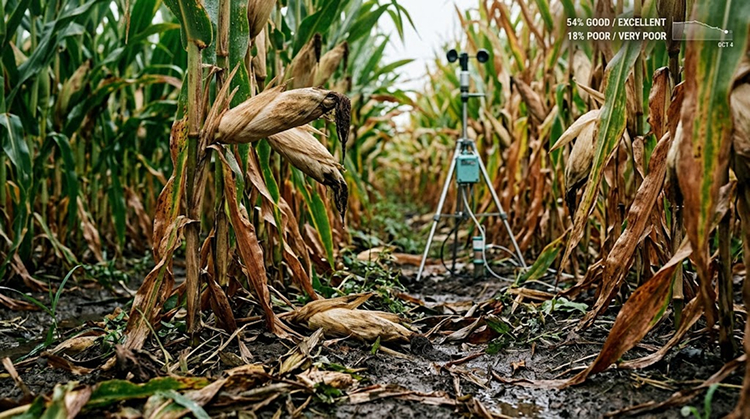
According to USDA crop statistics, the condition categories cover the major producing states rather than every acre of U.S. corn. The 18 states included in the latest corn assessment accounted for approximately 91% of the previous year’s U.S. corn acreage, making the figures a strong indicator of national conditions.
Mature Corn Is Ready But Not Necessarily Safe To Leave Standing
The 83% maturity figure is one of the most important numbers in the latest report.
Maturity has reached the five-year average, meaning the crop is not generally being held back by delayed physiological development. That changes the harvest decision for producers.
Once corn reaches maturity, farmers must balance the cost of running equipment against the risks of leaving grain in the field. Additional drying on the stalk can reduce artificial drying expenses in some circumstances, but extended field exposure can also increase the risk of stalk problems, ear losses and weather-related damage.
The calculation becomes more complicated when October weather is unsettled. A farmer with saturated soil may have mature corn but no practical opportunity to harvest it.
This is why the current harvest pace cannot be evaluated only by looking at maturity. The crop is ready; the fields are not necessarily ready.
Large Grain Inventories Are Changing The Market Pressure
The harvest slowdown is occurring at a difficult time for corn prices because USDA recently reported unusually large old-crop stocks.
The September 30 Grain Stocks report showed U.S. corn inventories of 2.095 billion bushels on September 1, up 35% from the previous year. Those stocks were the largest September 1 inventory in seven years.
That creates a major contrast for farmers. The 2026 crop is moving more slowly than average, but the market is not entering harvest with a shortage of old-crop corn.
The USDA Feed Grains Outlook also shows why supply expectations remain central to the corn market. USDA reduced its 2026 U.S. corn production outlook in September to roughly 15.8 billion bushels, but the crop remains historically large.
For farmers, this means a delayed harvest does not automatically create a bullish price response. Grain availability, storage capacity, export demand, ethanol consumption and basis levels all interact with the timing of harvest.
Corn Prices Are Facing Pressure From Both Supply And Demand
The futures market entered October under pressure. December corn closed at $4.9775 per bushel on October 2 after falling 30.5 cents during the previous week, according to Farm Progress market data.
The decline occurred despite the approaching harvest because traders were already focused on the large September stocks figure and the possibility that production could remain substantial.
There is another factor: export commitments have been slower than normal. As of September 24, U.S. corn export commitments were about 18.774 million metric tons, according to market data cited by the Illinois Farm Bureau, 31% below the same point a year earlier.
That leaves domestic demand particularly important. Corn used for ethanol and livestock feed continues to absorb large volumes, but those markets have to compete with a substantial amount of grain already in storage.
The result is an unusual harvest environment in which a slower physical harvest does not necessarily mean tighter supplies.
The October USDA Reports Could Change The Yield Debate
The timing of the latest Crop Progress report is significant because USDA is preparing its October production and supply-and-demand updates.
The September Crop Production report reduced the national corn yield estimate to 178.5 bushels per acre, down 1.2% from the previous forecast. USDA estimated production at approximately 15.8 billion bushels.
The October report will have greater importance because USDA’s production estimate will increasingly be tested against actual field results.
As combines move through Iowa, Illinois, Nebraska, Indiana and other major producing states, farmers are generating physical yield evidence that can either support or challenge the government’s previous assumptions.
Farm Progress reported that StoneX estimated the 2026 national corn yield at 182.1 bushels per acre, above USDA’s September projection, although StoneX also lowered its estimate from 182.9 bushels previously.
The gap between private estimates and USDA’s forecast makes actual harvest results increasingly important. A few weeks of strong or weak field yields could change the market’s perception of the 2026 crop.
Harvest Weather Could Become The Next Market Signal
Weather during the first half of October could determine whether the national harvest deficit disappears quickly.
The immediate forecast was relatively favorable. Farm Progress reported that much of the Corn Belt was expected to remain dry through the weekend, giving producers a chance to work through fields affected by September rainfall.
The longer-range picture was less certain. The NOAA temperature and precipitation outlook showed increasing moisture prospects for portions of the Corn Belt during the October 10–18 period.
That creates two competing possibilities.
A sustained dry period would allow combines to operate for longer hours, accelerate grain movement and potentially reduce the national harvest deficit. Another round of widespread rainfall would leave producers with mature corn still standing while shortening the number of suitable fieldwork days.
For farmers, the value of a favorable forecast is therefore practical rather than theoretical. Every additional dry day in October can represent thousands of acres harvested across the Corn Belt.
Basis Could Become More Important Than Futures
Local cash markets may provide a clearer signal of harvest pressure than futures prices alone.
University of Illinois researchers Austin Belman, Joe Janzen and Esteban Vizcarrondo recently examined the seasonal pattern of corn basis across 12 Corn Belt states. Their analysis found that basis typically weakens through September, reaches its seasonal low around mid-October and begins recovering later in the fall.
The University of Illinois farmdoc analysis estimates that the typical harvest-season basis low occurs around mid-October, with the average basis approximately 11 cents per bushel below the end-of-November baseline.
That timing matters this year because the physical harvest is already behind average while large stocks are sitting in the system.
If harvest accelerates sharply, local elevators could face a sudden influx of corn at exactly the point when basis traditionally reaches seasonal weakness. If wet conditions continue to delay deliveries, some areas could experience tighter nearby supplies despite the large national inventory.
Farmers therefore have another reason to track local cash bids rather than relying solely on futures.
Harvest Delays Could Increase Storage Decisions
The combination of mature corn, large inventories and a slower harvest puts additional pressure on storage decisions.
Farmers entering October with available bins have more flexibility than producers who must deliver grain immediately. However, existing stocks are already competing for space with new-crop corn.
The September 30 USDA report showed that farm stocks were 787 million bushels, while off-farm stocks were approximately 1.31 billion bushels. Off-farm inventories were up 44% from the previous year.
That means commercial storage facilities are already holding a substantial volume of corn before the 2026 crop reaches its seasonal peak.
The practical effect is that harvest logistics could become just as important as field conditions. Farmers may have grain ready for delivery but face weaker bids, longer truck queues or limited local storage options.
This makes harvest marketing planning increasingly important as October progresses. Producers need to evaluate storage capacity, local basis, transportation costs and cash-flow requirements together rather than treating harvest as a simple field operation.
The 2026 Crop Still Has Significant Yield Uncertainty
The latest condition report does not mean that U.S. corn production is collapsing.
Most of the crop remains rated fair, good or excellent, and 83% has reached maturity. USDA’s current production forecast remains close to 15.8 billion bushels, which would still represent a very large U.S. corn crop.
The more important question is whether actual harvested yields confirm the government’s current estimate.
If field results exceed expectations, the large September stocks figure becomes even more significant because additional production would increase available supplies. If yields fall below expectations, the market could begin reassessing the size of the 2026/27 balance sheet.
That is why the next several weeks are more important than the single four-point harvest deficit reported on October 5.
The October Harvest Will Test The Entire Corn Balance Sheet
The U.S. corn market is entering a period in which three different signals are moving at once.
Harvest progress is behind average. Crop conditions have reached a season low. Yet old-crop inventories are unusually large and futures prices have already absorbed significant supply pressure.
The immediate operational objective for farmers is to get mature corn out of the field during every suitable weather window. The market objective is different: determine whether actual yields justify USDA’s current production forecast and whether demand can absorb the resulting supply.
The next USDA production report will provide another national estimate, but field-level harvest results will increasingly carry more weight. Iowa, Illinois, Nebraska, Indiana and other major producing states will provide the evidence needed to determine whether the 2026 corn crop is merely arriving slowly or whether its final production potential is changing.
For now, the numbers point to a crop that is mature enough to harvest but moving four percentage points behind the historical pace, while its good-to-excellent rating has fallen to 54%. October’s weather, yield reports and local basis movements will determine whether that gap closes quickly or becomes one of the defining features of the 2026 corn market.