The 2026 U.S. corn harvest is moving forward at a faster-than-average pace just as global grain markets are becoming less comfortable about supplies. USDA reported that 8% of the U.S. corn crop had been harvested by September 14, compared with a five-year average of 6%. At the same time, 57% of the crop was rated good to excellent, while 86% had reached the dented stage. The numbers show a harvest that is already shifting from forecasts to measurable production results. USDA Crop Progress data provides the weekly national and state-level updates that will shape the market through the fall.
The timing matters because the United States is entering harvest with a large crop while the global corn balance sheet is moving in the opposite direction. USDA’s September supply estimates reduced expected U.S. production from the previous month, while analysts following global markets are increasingly focused on the gap between worldwide corn production and consumption.
Reuters reported on September 17 that USDA expects global corn consumption to exceed production by nearly 30 million metric tons in the 2026/27 marketing year, which would represent the largest production shortfall in more than three decades. That creates an unusual market environment: American farmers are harvesting a historically large crop, yet global buyers are facing a tighter supply cushion.
The U.S. Harvest Is Moving Faster Than Average
The pace of the U.S. harvest is one of the clearest indicators that the 2026 corn market has entered a new phase. Farmers are moving equipment into fields across the Corn Belt, grain is reaching elevators, and early yield information is beginning to replace the assumptions used in summer forecasts.
USDA’s September 14 report showed 8% of the nation’s corn crop harvested, two percentage points ahead of the five-year average. Progress varied considerably among states, reflecting differences in planting dates, summer weather and crop maturity.
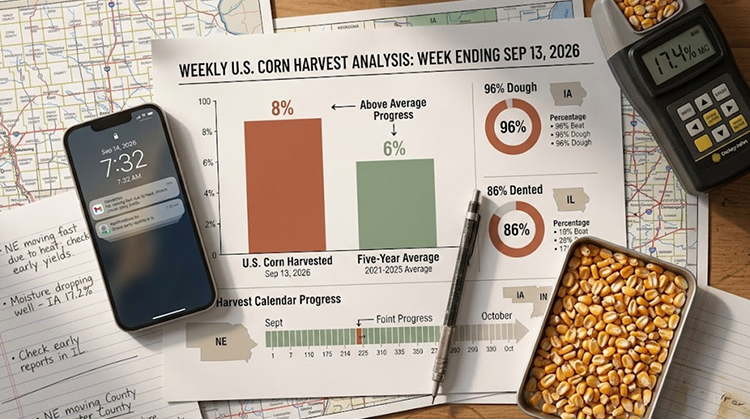
Earlier USDA data also showed that the crop had advanced quickly through the reproductive stages. By September 8, 96% of corn in the 18 major reporting states had reached the dough stage, 76% had dented and 25% had reached maturity. That progression gave producers more opportunity to begin fieldwork before the traditional peak of the U.S. harvest season.
The speed of harvest does not automatically mean that yields will exceed expectations. A crop can mature quickly because of favorable conditions, but late-season heat and moisture stress can also accelerate development while limiting final kernel weight.
That distinction is particularly important in states such as Iowa and Illinois, where the size of the crop has major consequences for the national production estimate.
A Large U.S. Crop Does Not Mean A Loose Global Market
The most important development in the current corn market is the contrast between U.S. production and global availability.
The United States remains one of the world’s largest corn producers and exporters. A large American harvest normally gives international buyers a substantial supply source, particularly during the fall when new-crop corn enters the market.
But the global balance sheet is broader than the United States.
Reuters reported September 17 that global corn consumption is projected to exceed production by almost 30 million metric tons during 2026/27. The publication described the projected gap as the largest in more than 30 years. Global grain supplies are also being affected by weaker production expectations among major exporting countries.
That creates an important distinction between total production and exportable supply. A country can produce more corn without necessarily increasing the amount available to international buyers if domestic consumption rises at the same time.
Brazil provides a useful example. Reuters reported that Brazil is expected to produce another record corn crop, but stronger domestic ethanol demand is increasing domestic consumption. More corn used inside Brazil means less of the crop is necessarily available for export.
The latest USDA corn market outlook similarly points to lower global coarse-grain production estimates for 2026/27. USDA reduced projected global coarse-grain production by 5.1 million metric tons in its latest outlook, including a 5.4-million-metric-ton reduction in U.S. corn production.
Corn Prices Are Responding To A Different Supply Story
The price response shows that commodity markets are already looking beyond the size of the American harvest.
Reuters reported that Chicago corn futures posted a 16% rally during August, an unusually strong move for a period when corn markets often face seasonal pressure from expectations of the incoming U.S. crop.
The rally does not mean that the market expects an immediate physical shortage in American elevators. Instead, it reflects increasing attention to the global relationship between production, consumption and inventories.
A large U.S. crop can therefore coexist with higher prices if international demand remains strong and other exporters experience production or logistical constraints.
The distinction matters for American farmers. If global supplies remain tight while the U.S. harvest produces fewer bushels than previously expected, export demand can provide stronger competition for domestic supplies.
That competition can affect basis levels and the relationship between futures prices and local cash bids.
It also changes the importance of storage. Farmers who have adequate on-farm or commercial storage may have more flexibility over when they sell their grain, particularly if harvest pressure temporarily weighs on local cash prices.
Iowa And Illinois Will Help Define The National Crop
Iowa and Illinois remain central to the 2026 U.S. corn market because of their enormous production base. Their field conditions also illustrate why national averages can conceal significant differences between regions.
USDA’s September 8 crop report showed 77% of Iowa corn rated good to excellent, compared with 55% in Illinois. Iowa’s crop was also 96% in the dough stage and 79% dented at that point. Illinois was 96% dough and 76% dented.
The differences are significant because the national yield estimate depends on millions of acres that experienced very different weather patterns during the growing season.
The September 11 USDA Crop Production report placed the national corn yield forecast at 178.5 bushels per harvested acre, down 2.2 bushels from the August estimate of 180.7. Production was projected at roughly 15.8 billion bushels, about 213 million bushels below the previous month’s forecast.
For farmers and grain buyers, actual harvest results will now become increasingly important. USDA’s agricultural statistics database will continue to provide the state and national production information needed to compare field results with the agency’s forecasts.
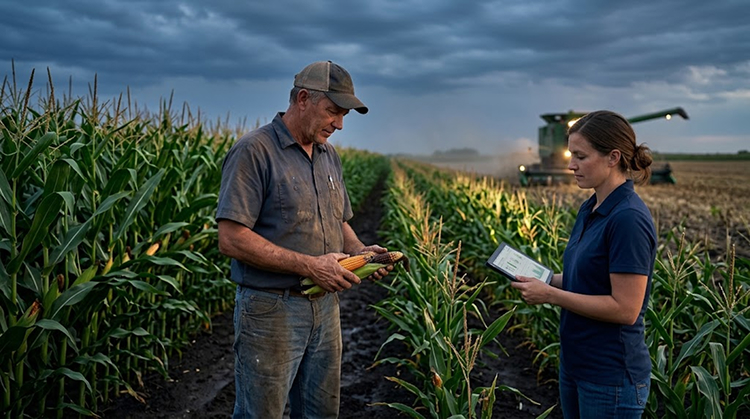
The difference between estimated and realized yields can quickly change local basis levels, storage decisions and marketing strategies.
The U.S. Balance Sheet Is Smaller Than Earlier Forecasts
The September USDA estimates also changed the domestic outlook.
The agency reduced expected 2026/27 corn ending stocks to approximately 1.567 billion bushels, down from the August estimate of 1.653 billion bushels. The reduction reflects the smaller production forecast and changes in projected supply and use.
USDA also raised its projected season-average farm price for corn from $4.50 to $4.80 per bushel.
Those numbers show why the yield reduction matters even though the United States is still producing a very large crop.
Production is forecast at approximately 15.8 billion bushels, compared with about 17.02 billion bushels in 2025. That represents a decline of roughly 7% from last year’s exceptionally large harvest.
The 2026 crop therefore does not need to be small in absolute terms to create a tighter domestic market. It only needs to be smaller relative to consumption and exports.
USDA’s September 2026 WASDE report provides the broader supply-and-demand framework behind these estimates.
Ethanol And Feed Demand Keep Corn Consumption High
Domestic corn demand remains another reason the production number deserves close attention.
Corn is used extensively for livestock feed and ethanol production, while food, seed and industrial users account for another substantial portion of demand.
USDA’s September projections put 2026/27 domestic corn use at roughly 12.9 billion bushels, including approximately 5.95 billion bushels for feed and residual use and about 5.6 billion bushels for ethanol and related products.
This creates a floor under domestic demand even when export conditions change.
Ethanol is particularly important because the U.S. corn market has become closely linked to the energy sector. Changes in fuel demand, ethanol margins and renewable fuel production can influence how much corn moves through processing plants.
For livestock producers, corn prices also affect feed costs. A tighter balance sheet can therefore extend beyond grain elevators and affect cattle, hog and poultry operations.
That interconnected demand structure means that the 2026 harvest will be evaluated through several different markets rather than through farm-gate corn prices alone.
Global Grain Stocks Are Becoming More Important
The global deficit projected for corn is part of a broader grain-market story.
Reuters reported that combined corn and wheat production among major exporting countries is expected to decline substantially from the previous year. The projected year-over-year reduction is significant by historical standards, increasing the importance of every major exporting region.
The market is also dealing with longer-term acreage trends.
Over the past quarter-century, major agricultural exporters have expanded oilseed acreage much faster than grain acreage. Reuters reported that harvested area among major oilseed and oilseed-product exporters in 2026/27 is more than twice its 2000/01 level, while acreage among major grain exporters has increased only about 5%.
That does not mean the world is running out of grain-producing land. It means yield improvements have carried more of the burden of satisfying rising demand.
For corn, that leaves less room for weather-related production losses.
A single poor growing season in a major exporting country can have a larger effect when inventories are already less comfortable.
Brazil Could Become More Important To The Corn Market
Brazil remains one of the most important variables for the global corn balance sheet.
The country is expected to produce another large corn crop, but domestic demand is changing the export equation. According to Reuters, Brazil’s stronger ethanol demand is increasing domestic corn consumption.
That trend matters because Brazil has become an increasingly important supplier to international buyers.
The U.S. and Brazil therefore compete for export demand while operating under different seasonal calendars. Brazil’s second-crop corn has become particularly important to global trade, while U.S. new-crop corn arrives in the international market during the Northern Hemisphere harvest.
If Brazil’s domestic ethanol sector continues consuming more corn, the country may have less surplus available for export even when total production remains high.
For U.S. farmers, that could create additional export opportunities during periods when global buyers need replacement supplies.
The 2027 Acreage Battle Has Already Started
The 2026 harvest is also influencing the next planting decision.
Farmers do not make 2027 acreage decisions in isolation. Expected corn prices, soybean returns, fertilizer costs, land rents, weather conditions and crop insurance economics will all influence how many acres move into corn next spring.
The current global balance sheet adds another variable.
If corn consumption continues to exceed production, the market may need additional acreage or higher yields in the following marketing year. But expanding corn acreage requires farmers to move land away from another crop, and that decision depends heavily on relative returns.
Wheat is already part of that competition. Reuters noted that weak wheat prices encouraged U.S. farmers to favor corn and soybeans in 2026, pushing all-wheat planted acreage to a record low. Wheat prices have since recovered, increasing competition for 2027 acres.
That could make next spring’s planting decisions more consequential for the global grain market.
Harvest Data Will Matter More Than Forecasts
The next stage of the 2026 corn market will be driven increasingly by what farmers actually find in their fields.
USDA forecasts provide the framework, but harvested acres, realized yields, grain moisture, test weight and regional basis levels will provide evidence that can either reinforce or challenge those forecasts.
This is where precision crop planning can become increasingly relevant at the farm level. Better field-level information can help producers compare expected yields with actual harvest results and make more informed decisions about storage, transportation and marketing.
The September reports have already established that the national crop is smaller than USDA expected one month earlier. The question now is whether field results confirm the reduction or create another round of revisions.
The answer will develop as combines move through Iowa, Illinois, Nebraska, Minnesota, Indiana and the other major producing states.
Harvest Pressure Could Temporarily Hide Global Tightness
There is another market dynamic worth watching: harvest pressure.
When large quantities of corn reach elevators at the same time, local supplies can temporarily increase even when the broader global market is tightening. Farmers need somewhere to put the crop, elevators need to manage incoming grain, and transportation systems face a seasonal surge.
That can put pressure on local basis levels.
The effect can be particularly pronounced in areas where storage capacity is limited or transportation costs are high.
But the seasonal harvest effect does not necessarily last. Once the initial wave of new-crop grain moves through the system, the market begins focusing again on remaining stocks, export demand and the next production cycle.
That is why the current price movement cannot be judged only by what happens during the first weeks of harvest.
U.S. Corn Has Become The Key Global Buffer
The United States enters the fall with an important role in the global grain market.
Its 2026 corn crop is still expected to be the second-largest U.S. corn crop on record, according to Reuters, despite the September reduction in the yield forecast. That scale gives international buyers a substantial supply source.
But the size of the crop should not be confused with unlimited availability.
A production estimate of roughly 15.8 billion bushels is large. Yet projected domestic consumption, exports and ending stocks show that a substantial portion of those bushels will already have a destination.
The global market is therefore watching two numbers at the same time: how many bushels U.S. farmers produce and how many bushels the rest of the world needs.
That relationship will determine whether the U.S. crop functions as a comfortable surplus or as an essential buffer against a global supply deficit.
The 2026 Harvest Is Becoming A Global Supply Test
The U.S. corn harvest is accelerating, but the central agricultural story is no longer simply whether American farmers produced another large crop.
The more important question is how that crop fits into a global market where consumption is projected to exceed production by nearly 30 million metric tons.
USDA’s September estimates already reduced the U.S. yield forecast to 178.5 bushels per acre and production to about 15.8 billion bushels. Ending stocks were also reduced to approximately 1.567 billion bushels, while the projected farm price increased to $4.80 per bushel.
At the same time, global corn demand continues to expand, Brazil’s domestic ethanol industry is consuming more corn, major grain exporters face lower combined production, and the competition for 2027 acreage is beginning earlier.
The coming weeks will provide the market with something forecasts cannot fully provide: physical evidence from the fields.
If harvested yields hold near USDA’s September estimate, the U.S. will still have a very large crop, but the global market may have fewer spare bushels than the headline production number suggests. If yields fall further, the pressure on stocks and export supplies could become more pronounced.
For American farmers, grain buyers and livestock producers, the 2026 harvest is therefore becoming a test of how much security a large U.S. corn crop can actually provide when global consumption is running ahead of production.