The 2026 U.S. soybean harvest is moving faster than normal just as international buyers are showing renewed interest in American supplies. USDA reported on September 21 that 12% of the U.S. soybean crop had been harvested as of September 20, compared with 8% at the same point in the five-year average and 8% a year earlier. The pace is four percentage points ahead of both benchmarks, putting farmers further into harvest than they normally would be at this stage of September.
The timing is significant because the soybean market is entering harvest with a very different demand backdrop from earlier in the year. China has recently purchased approximately 1 million metric tons of U.S. soybeans, while Brazilian supplies have tightened ahead of the country’s next major crop. The purchases do not eliminate uncertainty surrounding international trade, but they have returned export demand to the center of the U.S. soybean market.
For American soybean farmers, the combination creates an unusual situation. Harvest is arriving quickly, but the market is also receiving evidence that overseas buyers may need more U.S. beans during the months when American supplies dominate global trade.
Soybean Harvest Is Four Points Ahead Of Average
The latest USDA Crop Progress report provides the clearest evidence that the 2026 soybean harvest has accelerated.
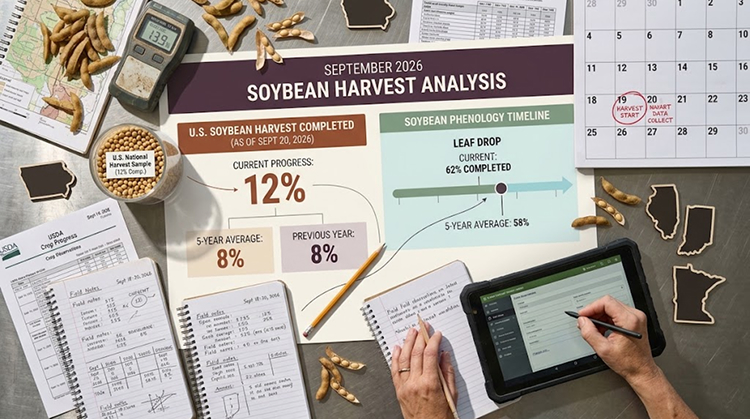
As of September 20, 12% of U.S. soybeans had been harvested, compared with 8% for both the five-year average and the same period last year. Soybeans were also at 62% leaf drop, four points ahead of the five-year average of 58%.
That difference matters because harvest progress influences the timing of physical soybean availability. The earlier combines enter fields, the sooner elevators, processors, exporters and transportation networks begin receiving new-crop supplies.
The faster pace also gives farmers an earlier opportunity to evaluate actual yields.
Throughout the summer, soybean production estimates depended on crop condition reports, pod development, weather patterns and USDA projections. Harvest changes the information available to the market. Farmers begin reporting actual yields, moisture levels and field performance rather than relying entirely on projected production.
The September 21 numbers therefore represent more than a calendar milestone. They mark a transition from crop expectations toward measurable supply.
Midwest Fields Are Moving Quickly Into Harvest
The national average conceals substantial differences between states, but the overall direction is clear: soybean fields are advancing toward harvest across the Midwest.
The September 21 USDA report showed soybean development continuing ahead of historical averages, although weather conditions varied considerably across producing regions. USDA’s weekly reports track crop development across major states, providing a running picture of leaf drop, maturity and harvest activity. The agency’s Crop Progress reports are updated weekly throughout the growing season.
The speed of harvest can be beneficial for farmers facing a long list of operational pressures. Earlier field access can reduce the risk of harvest congestion later in the season and gives producers more time to manage grain movement before winter weather creates additional transportation problems.
But early harvest also exposes the crop to market conditions sooner.
If farmers are harvesting significant volumes while futures prices or local basis levels are unfavorable, they face decisions about whether to sell immediately, store the crop or use forward marketing strategies.
Those choices become more complicated when export demand is changing at the same time.
Soybean Conditions Remain Mixed
A faster harvest does not automatically mean the national crop is performing better than expected.
USDA reported that 58% of U.S. soybeans were rated good to excellent as of September 20, unchanged from the previous week and three percentage points below the 61% rating recorded a year earlier.
That difference illustrates why harvest speed and crop quality need to be considered separately.
Soybeans can progress rapidly toward maturity without producing uniformly strong yields across every production region. Weather during pod development, moisture availability, disease pressure and late-season heat can influence the final number of bushels harvested per acre.
The 2026 crop therefore still has regional differences that will become more visible as combines move through fields.
For farmers, actual yield data is ultimately more important than the national percentage harvested. A field that reaches harvest early but produces fewer bushels than expected can affect local supply just as significantly as a delayed field with a strong yield.
China Has Returned To The U.S. Soybean Market
The demand story has changed significantly during September.
Reuters reported on September 10 that China had purchased approximately 1 million metric tons of U.S. soybeans during that week, according to four traders. The purchases brought China’s total U.S. soybean commitments close to half of the 25 million metric tons per year it had committed to purchase through 2028 under the trade agreement.
USDA separately confirmed sales of 340,000 metric tons to China and another 100,000 metric tons to unknown destinations during the period covered by the report. Traders identified China’s state-owned Sinograin and COFCO as likely buyers, although the companies did not publicly confirm the purchases.
The significance goes beyond the size of one week’s transactions.

China is the world’s largest soybean importer, and its purchasing decisions have an enormous influence on global oilseed markets. When Chinese demand shifts toward U.S. beans, the effect can quickly appear in export sales, futures prices, basis levels and shipping demand.
For U.S. farmers entering harvest, that demand is arriving at a particularly important point in the marketing calendar.
Brazil’s Tightening Supply Is Creating An Opening
The renewed interest in U.S. soybeans is also connected to conditions in Brazil.
Brazil has become the world’s largest soybean exporter and a dominant supplier to China. But Brazilian soybean inventories are tightening as the country moves through its marketing season and waits for the next crop.
Reuters reported September 7 that Chinese private soybean processors were dealing with tight supplies and high import costs, while Brazilian inventories were declining. Strong Brazilian exports and domestic crushing have reduced available supplies before the next crop arrives in early 2027.
That creates a seasonal opportunity for U.S. exporters.
American soybeans become particularly important to global buyers during the months immediately following the U.S. harvest because the United States has large quantities available while South America’s next harvest is still developing.
The seasonal window can therefore give American farmers greater access to international demand even when Brazil remains the dominant exporter over the full marketing year.
The U.S. soybean market does not need to replace Brazil to benefit. It simply needs to capture a larger share of global purchases during periods when Brazilian supply is less available.
U.S. Soybean Prices Have Already Responded
The market has already incorporated part of the changing supply and demand picture.
Reuters reported September 7 that U.S. soybean prices had risen approximately 12% since June, reflecting weather concerns and Chinese state buying.
That price movement is important because it demonstrates how quickly international demand can affect U.S. agricultural markets.
Soybeans are traded globally, but farmers experience that global market through local cash bids. Futures prices establish the broader benchmark, while basis levels reflect local supply, transportation costs, processor demand and export competition.
A stronger futures market can improve the revenue outlook for farmers, but the final price they receive depends on local conditions.
That distinction is especially important during harvest because elevators can face heavy deliveries at the same time that farmers are trying to sell grain.
Harvest Pressure Could Limit Local Price Gains
The arrival of new-crop soybeans creates a seasonal supply surge.
Even when export demand is strong, elevators and processors suddenly have more physical beans to handle. Storage capacity, transportation availability and local processing demand can determine how aggressively buyers compete for grain.
The result can be a temporary separation between futures prices and local cash prices.
Farmers with limited storage may have fewer options because they need to move grain quickly. Producers with adequate storage can potentially spread sales over a longer period, giving them more flexibility to wait for changes in basis or futures markets.
This is where crop marketing planning becomes particularly relevant. The value of a strong harvest is determined by more than yield alone; timing, storage, transportation and market access all influence the final return.
The current soybean market makes that calculation more complicated because export demand is strengthening at the same time that new-crop supplies are arriving.
China’s Demand Is Still Subject To Trade Costs
The recent purchases should not be interpreted as a complete removal of trade risk.
Reuters reported that a 10% tariff on U.S. goods remains in place, which has discouraged some private Chinese soybean buyers because imported U.S. beans can be less competitive economically.
Chinese state-owned buyers have nevertheless continued purchasing U.S. soybeans.
That difference between state and private demand is important for American producers. Large government-linked purchases can create significant short-term demand, but private crushers ultimately make buying decisions based on margins, replacement costs and domestic demand.
Reuters reported that Chinese private soybean processors were already facing weak margins, with some October-to-January U.S. shipments potentially remaining unprofitable even if tariffs are reduced.
The market therefore has two separate questions to answer.
The first is whether China continues making large purchases of U.S. soybeans.
The second is whether those purchases eventually translate into broader private-sector demand.
The second question will determine how durable the current improvement in export demand becomes.
Soybean Crushers Are Watching Their Margins
Soybean demand is not simply about whole beans moving from American farms to Chinese ports.
Soybeans are crushed to produce soybean meal and soybean oil, making the economics of processing an important part of the global market.
Chinese crushers have been facing high import costs and weak processing margins, according to Reuters. Brazil’s tightening supplies have made the situation more complicated, while China’s domestic livestock sector has also created uncertainty around feed demand.
Soybean meal demand is heavily influenced by livestock production, particularly hogs and poultry.
If China’s hog herd contracts or feed demand weakens, crushers may have less incentive to purchase beans even when supplies are available.
That means American farmers are watching several interconnected markets at once: soybean futures, Chinese import demand, soybean meal, soybean oil, Brazilian inventories and domestic U.S. crushing.
U.S. Crush Demand Provides Another Market
Exports are only one part of the U.S. soybean balance sheet.
Domestic soybean crushing has become increasingly important as the United States expands renewable diesel and other biofuel production. More soybean oil demand can increase the value of domestic processing and encourage crushers to compete for locally produced soybeans.
That gives farmers another potential source of demand beyond exports.
It also changes the geography of the market.
Soybeans grown far from an export terminal may be more economically attractive to a nearby crushing plant if processors are offering competitive basis levels. Conversely, regions with strong river or rail access can benefit when export demand increases.
The soybean market is therefore becoming increasingly connected to both food and fuel demand.
That diversification can provide support during periods when one source of demand weakens, but it also means that changes in biofuel policy, livestock production or international trade can quickly alter regional prices.
Transportation Costs Could Limit The Benefit Of Higher Demand
Strong soybean demand does not automatically translate into higher farm income.
Transportation is becoming a significant variable during the 2026 harvest.
Reuters reported September 14 that U.S. rail fuel surcharges for grain shipments had increased 153% year over year to 48 cents per mile per railcar, according to USDA data. Fuel surcharges represented about 11% of grain rail transportation costs, compared with 5% a year earlier.
That matters for soybeans because transportation connects interior farms with processors, river terminals, ports and export markets.
Higher freight costs can reduce the value of a stronger futures market once the grain reaches the local cash market.
Farmers therefore need to consider the full marketing chain rather than looking only at the Chicago futures price.
The cost of moving a bushel can determine how much of the international demand signal ultimately reaches the producer.
Brazil Will Remain The Long-Term Benchmark
Even with stronger U.S. export demand, Brazil will remain central to the soybean market.
Brazil’s enormous production base gives Chinese buyers an alternative source, and South America’s next crop will eventually return to the export market.
The current opportunity for U.S. farmers is therefore seasonal rather than permanent.
American exporters can benefit while Brazilian supplies are tighter, but the competitive landscape will change once Brazil begins harvesting its next soybean crop.
Weather will also matter.
Brazil’s planting and growing season will determine whether the country produces another large crop. Any significant weather disruption could extend the period during which global buyers rely more heavily on U.S. supplies.
That makes South American planting progress one of the most important developments to watch after the U.S. harvest accelerates.
The 2027 Acreage Decision Is Already Taking Shape
The market signals from the 2026 harvest will influence decisions about 2027 acreage.
Farmers compare expected soybean returns with corn, wheat and other crops when deciding how to allocate land. Strong soybean export demand can encourage additional soybean acreage, but high input costs, fertilizer prices, land rents and expected basis levels also affect the calculation.
The global market is providing another variable.
If China continues purchasing U.S. soybeans while Brazilian supplies remain tight, farmers may see stronger incentives to maintain or expand soybean acreage.
However, acreage decisions cannot be based on one month of export activity.
A large South American crop could shift the competitive balance again. A change in Chinese livestock demand could reduce imports. Tariffs could alter the relative price of U.S. and Brazilian soybeans. Domestic crush demand could also continue growing independently of exports.
The 2027 planting decision will therefore reflect a combination of these forces rather than a single price signal.
The September Harvest Is Giving The Market Better Evidence
The most important change in the soybean market is that the 2026 crop is now moving from estimates into physical grain.
With 12% of soybeans already harvested by September 20, the market will receive increasingly detailed information about yields, moisture and regional production.
That information will be compared with USDA’s production forecasts and with private estimates.
If actual yields confirm expectations, attention will shift toward exports, domestic crush and ending stocks.
If yields disappoint, stronger Chinese buying could become even more important because the United States would have fewer bushels available for competing domestic and international demand.
The speed of harvest makes that information arrive sooner.
U.S. Soybeans Are Entering A More Important Export Window
The 2026 U.S. soybean harvest is running ahead of schedule, but the larger market story is about what happens to those beans after they leave the field.
USDA’s September 21 data shows harvest at 12%, four percentage points ahead of both last year and the five-year average. At the same time, only 58% of the crop was rated good to excellent, leaving regional yield questions as combines move through the Midwest.
International demand is providing a second major development.
China has purchased approximately 1 million metric tons of U.S. soybeans in September, bringing its purchases closer to half of its annual 25-million-ton commitment through 2028. Brazil’s available supplies are tightening, while Chinese crushers are dealing with high costs and weak margins.
Those factors give U.S. soybeans a stronger position during the fall export window, but they do not remove the risks surrounding tariffs, Chinese feed demand, Brazilian production and transportation costs.
The next several weeks will provide a much clearer picture.
As more U.S. soybeans move from fields in Iowa, Illinois, Indiana, Minnesota and other major producing states into elevators, processors and export channels, the market will learn whether faster harvest progress is simply a seasonal development or the beginning of a more important shift in global oilseed trade.
For American farmers, the combination of an early harvest and renewed export demand makes the 2026 soybean marketing season particularly sensitive to what happens next in China, Brazil and the U.S. fields themselves.