The U.S. Department of Agriculture is preparing to send approximately $13.8 billion in gross Agriculture Risk Coverage (ARC) and Price Loss Coverage (PLC) payments to eligible producers for the 2025 crop year, creating one of the largest direct infusions of government support into American agriculture in the history of the programs.
USDA Secretary Brooke Rollins announced the payments on October 7, 2026, describing the total as the largest annual ARC and PLC payout since the programs were established through the 2014 Farm Bill. The payments arrive at a particularly consequential point for producers because many farms are simultaneously dealing with elevated financing costs, expensive inputs and weaker inflation-adjusted farm income.
The timing means the money could have a much broader effect than simply improving year-end farm income. For many operations, the payments can influence how quickly operating loans are reduced, whether suppliers are paid down, how much fertilizer is purchased for the next crop and whether equipment or conservation investments move forward.
Farm Payments Have Reached An Unusual Scale
The $13.8 billion ARC and PLC figure stands out because it is far above the annual payment levels seen during most of the programs’ history.
ARC and PLC are designed to provide commodity producers with protection when market prices or farm revenue fall below established benchmarks. PLC focuses primarily on commodity prices, while ARC can respond to revenue conditions at the county or individual-farm level.
For the 2025 crop year, USDA said 16 commodities triggered PLC payments, including corn, soybeans, wheat, canola, chickpeas, dry peas, lentils, peanuts, rice, safflower, seed cotton, grain sorghum and flaxseed. ARC-County payments can also be triggered based on county-level revenue conditions, meaning payment exposure varies considerably across regions and commodities.
The scale of the payments reflects changes made by the Working Families Tax Cuts Act, which strengthened the commodity safety net beginning with the 2025 crop year. The legislation increased statutory reference prices and changed the effective reference-price calculation.
It also raised the ARC and PLC payment limit. For the 2025 crop year, the payment limit is $160,000, compared with the previous $125,000 limit, subject to program requirements and eligibility rules.
That change matters because the distribution of the $13.8 billion will not be uniform. Farms with eligible base acres and qualifying commodities will receive different amounts depending on program participation, historical yields, commodity prices and county-level revenue.
The Money Is Arriving During A Weaker Farm-Income Environment
The timing of the payments is particularly significant because USDA’s broader farm-income outlook has weakened.
USDA’s Economic Research Service forecasts 2026 net farm income at $158.4 billion, down $4.3 billion, or 2.6%, from 2025 in nominal terms. After adjusting for inflation, the decline is larger: $9.1 billion, or 5.5%. Net cash farm income is forecast at $176.4 billion, only slightly above the 2025 level in nominal terms and down 2.5% after inflation.
That makes government payments more important to the financial picture.
The distinction between net farm income and cash flow is critical. A farm can have machinery depreciation, inventory changes and other noncash factors affecting its reported income while still needing substantial cash to pay fertilizer suppliers, fuel companies, lenders, employees and landlords.
ARC and PLC payments are direct cash support. Their arrival can therefore have an immediate effect on the liquidity position of qualifying farms.
The broader USDA forecast also shows production expenses remaining elevated. Inflation-adjusted farm production expenses are projected to increase by approximately $7.1 billion, or 1.5%, in 2026.
That combination creates an important financial contrast: farms are receiving a historic safety-net payment at a time when underlying operating economics remain under pressure.
Producers Could Use The Payments To Reduce Operating Debt
One of the most immediate uses for the money could be reducing short-term agricultural debt.
Farm operators often rely on operating lines of credit to finance seed, fertilizer, chemicals, fuel, repairs, labor and other expenses before crops are sold. When commodity revenue is weaker or harvest timing is delayed, those lines can remain outstanding for longer.

The latest USDA lending rates show how expensive that working capital can be. For October 2026, the FSA direct farm operating loan rate is 5.375%, while the direct farm ownership rate is 6.250%.
Paying down an operating balance can therefore create a measurable financial benefit beyond the initial government payment. A producer who uses part of an ARC or PLC payment to reduce borrowing can lower interest expenses and create more available credit for the following production cycle.
That may become particularly valuable for farms carrying balances from the 2026 crop year.
The Federal Reserve Bank of Kansas City reported in September that farm debt growth remained strong during the first half of 2026. Farm loan demand supported agricultural-bank profitability, while liquidity at agricultural lenders tightened gradually. At the same time, farm loan delinquency rates remained relatively low.
The payments could therefore function as a financial pressure-release mechanism without necessarily signaling that the underlying farm economy has returned to strong profitability.
Suppliers Could See A Wave Of Farm Cash
The effects of the payments will extend beyond farm balance sheets.
When producers receive government payments, some of the money can move directly to agricultural suppliers. Farmers with outstanding balances for fertilizer, seed, crop chemicals, fuel or equipment may use the funds to settle accounts accumulated during the previous production cycle.
That creates a secondary economic effect across rural communities.
A farm that receives a payment and immediately pays down a fertilizer bill is effectively transferring part of the government support to an input supplier. The supplier can then use that cash to pay employees, distributors, transportation companies or manufacturers.
This makes the $13.8 billion figure more significant than the amount deposited into producer accounts alone.
The timing also matters because producers are beginning to make decisions for the next crop year. Fertilizer purchases, seed commitments, equipment repairs, land rent and operating credit requirements can all compete for the same pool of available cash.
For farms with strong liquidity, the payments could create an opportunity to purchase inputs earlier or lock in some costs. For more financially constrained operations, the priority may simply be reducing outstanding obligations.
The Payments Could Change 2026–27 Farm Investment Decisions
The strongest potential impact may come from farms that have enough financial flexibility to invest after receiving their payments.
That could include grain storage improvements, irrigation equipment, precision-agriculture technology, machinery repairs, conservation practices or upgrades that reduce long-term operating costs.
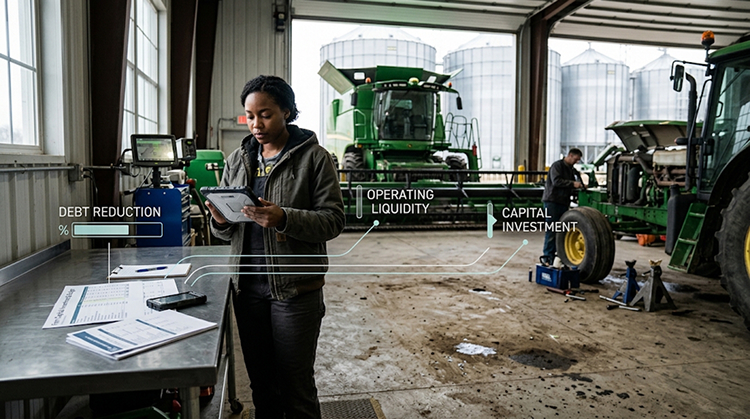
This is where farm financial planning becomes more important. Government payments are temporary cash inflows, while machinery, storage and land improvements can create financial obligations lasting for years.
Using the entire payment for consumption or short-term expenses can improve immediate liquidity without necessarily improving the farm’s long-term position. Using all of it to make a large capital purchase can create the opposite problem if working capital remains tight.
The most financially significant question is therefore how producers divide the payment between debt reduction, operating liquidity and productive investment.
That decision will vary sharply between farms.
Credit Conditions Make Liquidity More Valuable
The financial environment makes cash particularly valuable for smaller and more highly leveraged producers.
The Kansas City Fed reported in August that agricultural credit conditions continued to deteriorate gradually during the second quarter of 2026. Farm incomes remained subdued, while credit conditions tightened steadily. Lenders reported weaker financial conditions among smaller farms and operations that were majority renters.
A separate Kansas City Fed analysis found that loan performance had shown some improvement in the pace of deterioration, but lenders were still gradually increasing collateral requirements as crop-sector challenges persisted. Strong farmland values continued to support borrower balance sheets.
In that environment, a large government payment can improve a farm’s financial position in several ways at once.
It can reduce debt, improve liquidity, lower interest expenses and potentially strengthen the producer’s position with lenders before the next operating cycle.
For farms that are already financially healthy, the payment may be an investment opportunity. For farms operating with thin margins, it may be primarily a balance-sheet repair mechanism.
Not All Of The $13.8 Billion Will Reach Farmers As Cash
The headline figure also requires an important qualification.
USDA describes the $13.8 billion as gross payments. The agency states that the amount does not account for payment limitations or the statutory 5.7% sequestration rate that applies to ARC and PLC payments.
A simple calculation illustrates the difference. If the entire $13.8 billion were subject only to the 5.7% sequestration reduction, the resulting amount would be approximately $13.01 billion before considering payment limitations or individual eligibility differences.
Actual producer receipts will vary.
That distinction matters for farm budgeting because producers should not treat the national $13.8 billion headline as an amount that will be distributed evenly across eligible operations.
The calculation process also varies by program. PLC payments are tied to program yields and payment rates, while ARC-County payments depend on county-level revenue calculations.
As a result, two farms producing the same commodity can receive very different payments based on their program circumstances.
The 2026 Crop Year Is Already Creating Another Financial Question
The current payments also arrive while farmers are making decisions about the 2026 crop year ARC and PLC programs.
USDA has opened the election and enrollment period for the 2026 crop year. The Working Families Tax Cuts Act also added approximately 30 million new base acres nationwide, expanding the potential reach of the commodity safety net.
That creates an unusual overlap.
Farmers are receiving large payments tied to the 2025 crop year while simultaneously deciding how to manage risk for the 2026 crop year.
The distinction is important because the current $13.8 billion payment does not mean the same level of support will automatically occur again next year. ARC and PLC payments depend on commodity prices, benchmark revenues, yields, program participation and other variables.
Producers therefore have to treat the current payment as a response to a specific market environment rather than as a guaranteed annual revenue stream.
Corn And Soybean Producers Could See Important Differences
Commodity differences will be particularly important.
Corn and soybeans are among the largest U.S. crops by acreage and revenue, but their ARC and PLC exposure depends on program-specific calculations rather than simply national market prices.
A producer growing corn in one county may have a different ARC-County outcome from a producer growing the same crop elsewhere. Likewise, PLC payments depend on program yields and the relationship between the effective reference price and the relevant market price.
USDA’s ARC/PLC data system provides commodity- and program-year-specific payment rates, benchmark revenues and yields, allowing producers and analysts to examine the mechanics behind the national payment total.
That makes the $13.8 billion announcement more than a single farm-income statistic. It represents thousands of individual calculations occurring across the country’s agricultural regions.
Government Payments Are Becoming A Larger Part Of Farm Economics
The current payment surge also fits into a broader increase in the importance of federal support.
USDA ERS projected in February that direct government payments to U.S. farm producers could reach $44.3 billion in 2026, up $13.8 billion, or 45.2%, from $30.5 billion in 2025. That broader figure includes multiple federal programs and is separate from the $13.8 billion ARC/PLC announcement for the 2025 crop year.
This distinction is essential.
The $13.8 billion ARC/PLC figure is a specific program-year payment estimate. The $44.3 billion forecast represents a much broader estimate of direct federal government payments during calendar year 2026.
Together, however, the figures show how important government programs have become to the financial structure of U.S. agriculture.
For policymakers, that raises questions about the long-term role of commodity safety nets. For farmers, it creates a practical financial reality: federal payments can materially affect annual liquidity when commodity margins weaken.
The Cash-Flow Effect Could Extend Into 2027
The most important consequence of the payments may occur after the checks arrive.
A producer who uses the money to reduce an operating line could enter the next growing season with lower interest costs and more borrowing capacity. Another producer could use the funds to purchase fertilizer or seed before prices move higher.
A third could use the money for equipment maintenance, storage or precision-agriculture improvements that reduce costs over several seasons.
Those choices determine whether the payment primarily solves a short-term cash problem or changes the farm’s financial position.
The timing is particularly relevant because USDA’s latest farm-income forecast shows that inflation-adjusted net farm income is expected to remain below 2025 levels even though it remains above its long-term average.
That means producers still face an operating environment where liquidity matters.
The $13.8 billion therefore should not be viewed simply as a windfall. It is a large financial transfer arriving during a period of elevated expenses, expensive credit and uneven commodity profitability.
The Record Payment Changes The Financial Starting Point For Farmers
USDA’s October 7 announcement gives American agriculture an unusually large injection of commodity safety-net funding at a time when farm finances remain under pressure.
The $13.8 billion in gross ARC and PLC payments is historically large, but its ultimate economic impact will depend on what producers do with the money.
Debt reduction could lower interest expenses. Supplier payments could strengthen rural businesses. New input purchases could support the next production cycle. Capital investments could improve productivity. Stronger liquidity could also give farmers more flexibility when negotiating with lenders.
The payments cannot eliminate weaker commodity margins or higher production costs, but they can change the financial position from which producers enter the next crop cycle.
For an industry carrying record levels of debt while inflation-adjusted farm income declines, that difference in liquidity may become one of the most important financial effects of the 2026 farm economy.