The USDA AI Challenge is a planned federal effort to apply artificial intelligence to crop-trait discovery, with an emphasis on using germplasm data, field images, laboratory results and related records to identify plant and seed traits more quickly. USDA announced on July 22, 2026, that it was seeking university and stakeholder partners for this work, with the challenge expected to launch later in 2026. The stated target is practical: help researchers find traits tied to resilience, disease resistance and productivity without overstating what AI can deliver before field validation is complete.
Why The USDA AI Challenge Targets Trait Discovery
Crop-trait discovery is slow because useful traits are often hidden across large collections of genetic material, field observations and laboratory measurements. Plant breeders and public researchers need to compare many potential signals: seed traits, disease response, root structure, drought response, canopy development and yield-related measurements. AI may help sort these records, but the value depends on data quality, biological interpretation and repeated testing.
The Data Problem Behind Faster Breeding
USDA’s July 22, 2026 notice described AI-based solutions that would integrate germplasm data, including field images and lab results. That emphasis matters because no single dataset usually explains crop performance. A line that looks promising in one environment may perform differently under another weather pattern, soil type or disease pressure. AI systems can screen for patterns, but they do not remove the need for agronomic judgment.
The broader policy setting is the Genesis Mission, launched in November 2025, which directed federal agencies to build AI tools to accelerate scientific discovery, including in agriculture. For agriculture, the challenge is not simply making faster predictions. It is connecting predictions to traits that can be measured, tested and transferred into breeding programs.
USDA AI Challenge And Germplasm Signals
The USDA AI Challenge is expected to give participating teams access to the American Science & Security Platform, a Department of Energy-designed system that connects datasets, scientific instruments and AI tools. That platform could matter for crop science because germplasm collections are valuable only when researchers can search, compare and interpret them efficiently.
USDA’s Agricultural Research Service budget materials for fiscal year 2026 also point in this direction. The ARS request included more than $2.1 million under “Germplasm and Genomics” to use AI and imaging with crop wild relatives in the National Plant Germplasm System, with the goal of finding trait genes tied to drought tolerance and insect resistance, according to the ARS budget notes.
Funding And Computing Capacity Behind The Work
AI crop research depends on more than algorithms. It requires curated datasets, computing access, imaging pipelines, data governance and staff who understand both plant science and machine learning. That makes the funding structure important for assessing how quickly useful tools may move from research teams into breeding decisions.
ARS Budget Signals
The ARS budget request does not prove that the planned challenge will produce new commercial varieties by a certain date. It does show that USDA is placing AI and imaging within germplasm and genomics work rather than treating AI as a stand-alone technology. That distinction is useful. In sustainable farming, technology is most valuable when it improves decisions about stress tolerance, pest pressure, input efficiency or resilience under variable field conditions.
USDA is also developing PlantCAD, described in the research record as a plant “DNA language model” that can scan large numbers of genomic sequences. Its stated uses include detecting yield-limiting mutations, identifying useful genes in crop wild relatives and supporting trait discovery for heat, drought and pathogen stress. These are research applications, not guaranteed farm outcomes. The practical test will be whether candidate traits move through breeding and field evaluation with enough reliability to change management or variety selection.
AI Innovation Fund Structure
For fiscal year 2026, USDA’s AI Innovation Fund under ARS’ Scientific Computing Initiative planned to fund 4 to 6 proposals, each receiving up to $100,000. The proposal deadline was February 6, 2026, with funds to be obligated in fiscal year 2026, according to USDA’s AI Innovation Fund information. This is a modest scale compared with the full cost of crop development, but it can support targeted methods, data pipelines and early AI tools.
The USDA AI Challenge also sits alongside wider data modernization in agriculture. USDA’s Artificial Intelligence Strategy for fiscal years 2025 and 2026 emphasized data readiness, access and stewardship, including work on the department’s Data Catalog, metadata and data quality standards. That is a practical concern for farmers because weak data standards can limit trust in model outputs. Related federal data work is already affecting crop measurement, as seen in Agheiro’s coverage of USDA AI and satellite crop estimates.
What Farmers Should Watch Before Results
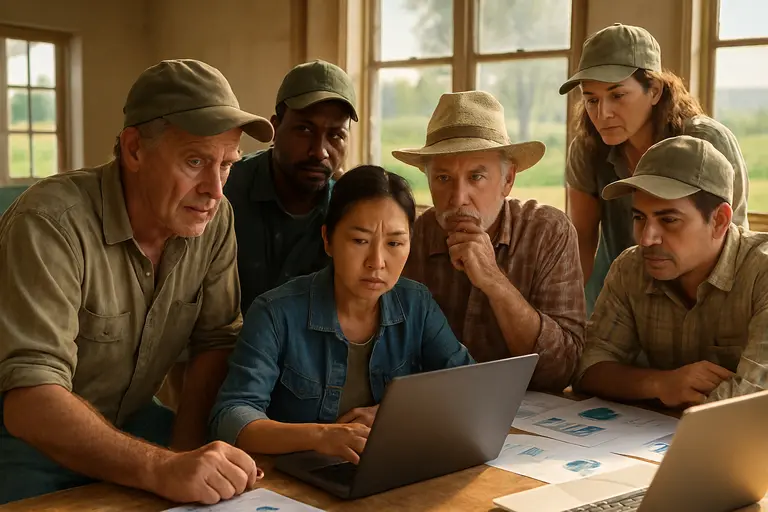
Farmers should treat AI-driven trait discovery as a research acceleration tool, not an immediate replacement for local trial data. A drought-tolerance signal found in a database still needs testing across locations, planting dates and management systems. Disease resistance must also be checked against local pathogen populations, which can shift over time.
Practical Value Depends On Validation
Recent USDA-ARS examples in the research record suggest why AI is attractive. ARS reported digital image analysis of 15,000 alfalfa root systems in St. Paul, Minnesota, reducing root-type identification time from about 22 weeks to about 2 weeks. ARS also reported imaging 1,000 turfgrass variants in Beltsville, Maryland, with 345,600 images captured in a month and 93% accuracy for drought-tolerance traits. These examples show time savings in defined research settings. They should not be read as proof that every crop, trait or breeding program will see the same result.
For the USDA AI Challenge, the key question is whether methods built on image analysis, genomic records and laboratory data can produce candidate traits that remain useful after field testing. Farmers have good reason to ask how models were trained, where test data came from and whether results were checked across different environments.
Sustainability Gains Need Proof
Trait discovery can support sustainable farming if it helps breeders identify crops that tolerate drought, resist insects or maintain productivity with fewer losses. Still, sustainability claims need evidence. A model may identify a gene linked to stress response, but the resulting crop line must still meet yield, quality and market requirements. It must also fit real production systems, including equipment, planting windows and pest management plans.
Imaging is likely to be central because field and laboratory images can turn plant features into measurable data. For readers interested in exploring agricultural communications and visual documentation, Finest Image offers a perspective within the same publishing network.
What The USDA AI Challenge Means For Crop Science
The USDA AI Challenge should be viewed as a structured attempt to shorten the search phase of crop-trait discovery. It does not eliminate plant breeding timelines, environmental testing or seed production requirements. Its likely value is earlier in the research pipeline: narrowing large pools of germplasm, flagging promising genetic signals and helping scientists decide which materials deserve closer study.
That could have community-level value if public breeding programs can identify useful traits for crops and regions that receive less private investment. It could also help researchers work more efficiently with crop wild relatives in the National Plant Germplasm System, which may contain genes relevant to drought, insects and disease. The risk is overconfidence. AI can find correlations, but crop improvement requires repeatable biological performance.
If the USDA AI Challenge launches later in 2026 as USDA described, the first results should be assessed with caution: What datasets were used? Were the models tested outside their training data? Did the findings lead to measurable trait improvement? Those questions will determine whether the initiative becomes a useful research tool for sustainable crop science or remains an early experiment in agricultural AI.