The U.S. Department of Agriculture (USDA) has expanded its Climate-Smart Agriculture funding programs across major production regions in the United States, including the Midwest Corn Belt and California’s Central Valley. The updated 2026 allocation cycle focuses on farm-level adoption of carbon tracking systems, soil health measurement tools, and data-driven fertilizer optimization across large-scale agricultural operations.
The expansion reflects a continued federal shift toward linking agricultural subsidies with measurable environmental performance. Farming regions such as Iowa, Illinois, Nebraska, and California’s Fresno and Kern counties are now receiving increased program access tied to emissions reporting, soil carbon retention practices, and water-use efficiency improvements.
Early implementation data indicates that farms participating in earlier funding rounds have already begun integrating satellite soil monitoring, regenerative crop rotation planning, and digital nutrient application systems.
Federal Climate-Smart Funding Structure and Allocation Zones
The USDA Climate-Smart Agriculture framework operates through a mix of direct producer payments, technical assistance grants, and partnership programs with agricultural organizations and private-sector technology providers. In the 2026 expansion cycle, priority has been placed on scaling participation in high-output agricultural regions where emissions intensity per acre is closely monitored.

Midwestern corn and soybean producers remain central to the program due to their high fertilizer usage and measurable soil carbon variability. In California, funding is more concentrated in irrigation-dependent systems where water efficiency intersects with emissions reduction strategies.
The program also integrates third-party verification systems USDA Climate-Smart Commodities program overview, requiring participating farms to document soil management practices and input usage through standardized reporting platforms.
Midwest Corn Belt Adoption and Soil Management Systems
Across the Midwest, climate-smart funding is reshaping operational decisions at the farm level. States such as Iowa and Illinois are seeing increased adoption of precision fertilizer application systems designed to reduce nitrogen runoff while maintaining yield stability.
Large-scale corn producers are integrating sensor-based soil monitoring systems that track moisture retention and nutrient density in real time. These systems feed into variable-rate application equipment that adjusts fertilizer distribution across uneven field zones.
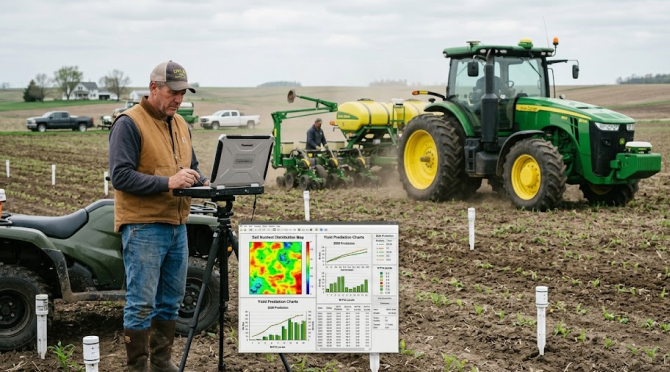
Agricultural extension programs in Nebraska report that early adopters of USDA Natural Resources Conservation Service soil health resources-funded climate programs are reducing input waste while maintaining consistent yield performance across multi-year planting cycles. However, the transition requires significant investment in data infrastructure and equipment calibration.
California Farming Systems and Irrigation Efficiency Integration
In California, Climate-Smart Agriculture funding is being integrated into existing irrigation efficiency programs across the Central Valley. Counties such as Fresno, Tulare, and Kern are using federal support to accelerate adoption of soil moisture sensors, drip irrigation systems, and satellite-based evapotranspiration modeling.
Water-intensive crops including almonds, grapes, and processing tomatoes are central to program deployment due to their sensitivity to irrigation timing and soil water retention variability. Funding is being directed toward systems that align water delivery with carbon reduction targets, particularly in regions under continued pressure from groundwater regulation frameworks.
Farm operators are increasingly combining USDA funding mechanisms with state-level water efficiency mandates under California’s Sustainable Groundwater Management Act (SGMA). This creates a dual compliance structure where water use efficiency and carbon tracking operate in parallel.
Technology Providers and Agricultural Data Infrastructure Growth
The expansion of climate-smart funding has accelerated demand for agricultural data platforms capable of integrating soil, weather, and input usage datasets into unified reporting systems. Technology providers working with USDA-funded programs are developing platforms that connect field sensors, precision agriculture and technology integration resources, satellite imagery, and farm management software into centralized dashboards.
These systems are particularly relevant for large-scale operations managing thousands of acres across variable soil conditions. Data aggregation allows farm operators to identify carbon reduction opportunities while optimizing yield performance under regulatory reporting requirements.
In practice, farms participating in the program are transitioning from reactive input management to predictive agricultural planning models, where fertilizer application, irrigation timing, and crop rotation decisions are informed by multi-year environmental datasets.
Economic Implications for Large-Scale Crop Production
The financial structure of Climate-Smart Agriculture funding introduces new revenue streams for producers, but also increases administrative and compliance requirements. Payments are tied to verified environmental outcomes, requiring farms to document measurable improvements in soil carbon levels and input efficiency.
Midwestern grain producers benefit from large acreage scaling, where small per-acre efficiency gains translate into significant total funding eligibility. In California, higher input costs and water constraints make efficiency improvements more financially impactful per unit of production.
Commodity markets are beginning to reflect climate-linked production models, particularly in export-oriented crops where sustainability reporting influences buyer contracts. Agricultural lenders are also incorporating climate-smart participation into credit risk assessments, linking funding eligibility to long-term operational stability.
| Region | Primary Crop Systems | Climate-Smart Focus Area | Expected Operational Impact |
|---|---|---|---|
| Iowa / Illinois | Corn, Soybeans | Fertilizer optimization | Reduced nitrogen runoff |
| Nebraska | Corn, Wheat | Soil carbon tracking | Improved yield stability |
| California Central Valley | Almonds, Grapes, Tomatoes | Irrigation + carbon integration | Water-use efficiency gains |
Regional Adoption Patterns and Farm-Level Adjustments
Adoption rates vary significantly across farm sizes and production types. Large commercial operations are integrating climate-smart systems faster due to capital availability and existing digital infrastructure. Smaller farms face higher barriers related to equipment cost and data management complexity.
Extension services across participating states are providing technical assistance programs to support onboarding, particularly in data reporting and sensor calibration. These services play a key role in reducing entry friction for mid-sized farms that fall between large industrial operations and small family-owned systems.
Field-level adjustments are increasingly centered on aligning planting decisions with environmental reporting cycles, creating new planning constraints that extend beyond traditional yield-based strategies.
Operators in both regions are also evaluating long-term return on investment from participation, balancing federal funding benefits against compliance overhead and infrastructure upgrades.