The U.S. corn market entered the 2026 harvest with far more old-crop grain in storage than traders expected.
The U.S. Department of Agriculture reported September 30 that corn stocks in all positions totaled 2.095 billion bushels on September 1, 2026, up 35% from a year earlier. The figure was roughly 170 million bushels above the average trade estimate and represented the highest September 1 inventory level in seven years.
The report immediately changed the market conversation.
December corn futures fell more than 20 cents after the report, trading near $5.01 per bushel, as traders absorbed evidence that the U.S. had carried substantially more corn into the new marketing year than expected.
The significance extends beyond one day’s futures move.
Farmers are already harvesting another large crop. USDA’s September production forecast called for approximately 15.8 billion bushels of 2026 corn, while the previous crop was revised to approximately 16.96 billion bushels.
That combination creates a difficult supply equation: a huge amount of old-crop corn remains available while another large harvest is entering elevators, feedlots, ethanol plants and export channels.
Corn Stocks Rose Far More Than The Market Expected
The most important number from the September 30 report is the 2.095 billion bushels of corn stored on September 1.
USDA had reported 1.549 billion bushels in the same positions one year earlier. The increase of approximately 546 million bushels represents a 35% jump.

The market had been prepared for a much smaller number.
Analysts surveyed ahead of the report expected stocks around 1.918 billion bushels. The actual figure exceeded that estimate by roughly 177 million bushels.
That difference matters because September 1 stocks are the bridge between two marketing years.
The number represents grain left over from the 2025 crop after an entire year of exports, ethanol production, livestock feeding and other domestic uses.
If stocks are higher than expected, it means the previous year’s demand did not remove as much corn from the system as traders had anticipated.
The market must then carry that additional grain into the next crop year.
The USDA Grain Stocks report also provides a detailed breakdown between farm and commercial storage, showing where that surplus is physically located.
The 2025 Crop Was Larger Than The Revised Estimate
USDA also revised the previous year’s corn production estimate.
The agency reduced 2025 planted acreage by approximately 75,000 acres to 98.713 million acres, while leaving the record national yield estimate unchanged at 186.5 bushels per acre. The resulting 2025 production estimate was reduced by about 57 million bushels to 16.964 billion bushels.
Even after the revision, the 2025 crop remains enormous.
It was the combination of historically high acreage, record yield and strong production that created the supply base now visible in the September 1 stocks report.
The fact that 2.095 billion bushels remained after a year of heavy usage shows that production was large enough to outrun the pace at which the market could absorb it.
This is important because the 2026 crop does not have to be exceptionally large to keep total supply elevated.
A substantial carry-in already exists.
Commercial Elevators Are Holding A Much Larger Share
The distribution of the corn is just as important as the national total.
USDA reported that 787 million bushels were stored on farms, up 22% from September 2025.
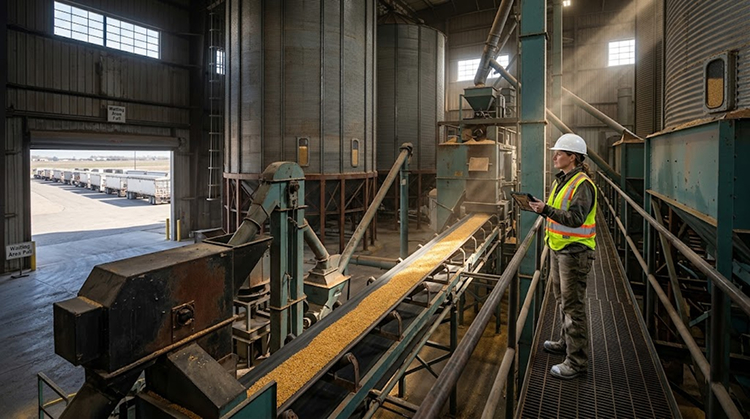
Off-farm stocks were considerably larger at 1.31 billion bushels, up 44% from a year earlier.
That 44% increase in commercial stocks deserves close attention.
Off-farm inventories include grain held in elevators and other commercial storage facilities. When these stocks rise sharply, the market can face greater pressure at the local level because elevators have to make room for the incoming harvest.
The timing is particularly difficult.
The 2026 corn harvest was already underway when USDA released the report. National harvest progress stood at 18% as of September 27, two percentage points ahead of the five-year average, according to the previous week’s Crop Progress report.
That means the supply represented by the September 1 stocks number is being joined by new-crop deliveries.
Elevators across the Midwest therefore have to manage two supply streams simultaneously: old-crop grain that has not yet moved and new-crop corn arriving from fields.
For farmers without adequate on-farm storage, that can make local basis levels increasingly important.
Corn Disappearance Is Strong But Still Not Fast Enough
The stocks report does not indicate that corn demand has collapsed.
USDA estimated June-August 2026 corn disappearance at 3.20 billion bushels, compared with 3.09 billion bushels during the same period in 2025. That represents an increase of approximately 110 million bushels.
This is one of the most important details in the report.
Corn consumption increased during the summer, yet inventories still finished the marketing year at a seven-year high.
The implication is that the supply increase was large enough to overwhelm the additional demand.
Corn has multiple major demand channels. Livestock producers use it for feed, ethanol plants consume it for fuel production, food and industrial manufacturers use it in processed products, and exporters ship millions of bushels overseas.
When all of those channels increase usage and inventories still climb 35%, the market is dealing with a substantial supply cushion.
The USDA corn market outlook continues to show strong U.S. corn demand, but the agency’s September outlook also reduced projected U.S. production and highlighted changes in domestic and global supply conditions.
Ethanol Demand Is Carrying A Major Share Of The Crop
The ethanol industry remains one of the largest structural buyers of U.S. corn.
USDA’s earlier feed-grain outlook projected roughly 5.6 billion bushels of corn use for ethanol and related products in 2026/27. That level demonstrates how deeply ethanol is embedded in the U.S. corn balance sheet.
Ethanol demand has therefore provided a substantial floor for corn consumption.
But even strong ethanol demand cannot automatically eliminate a large surplus.
The 2025 crop was close to 17 billion bushels, and the 2026 crop is also projected at approximately 15.8 billion bushels.
That creates a supply base large enough to keep storage levels elevated even when ethanol plants operate at high utilization.
The relationship between ethanol production and corn prices will become more important if the market begins to anticipate larger carryout stocks for 2026/27.
A strong ethanol sector can absorb billions of bushels, but it cannot consume unlimited additional production.
Export Demand Will Have To Absorb More Corn
Exports provide another major outlet.
USDA’s Feed Outlook has projected 2026/27 U.S. corn exports at approximately 3.15 billion bushels, which would still rank among the largest annual totals on record. Mexico has been particularly important, accounting for a substantial share of U.S. corn exports.
Global demand therefore remains a critical part of the corn balance sheet.
The United States is the world’s leading corn producer, consumer and exporter, making domestic inventories sensitive to international buying patterns. USDA’s corn backgrounder describes corn as the leading U.S. field crop by planted area, production and cash receipts.
But exporters also face competition.
Brazil has become a major corn supplier, and other countries can compete for buyers in Latin America, Asia and other feed markets.
For U.S. farmers, this means export demand has to be strong enough to move both the old-crop surplus and the new crop.
If international buyers slow their purchases, more grain remains in domestic storage.
That increases pressure on elevators and can weaken local basis levels during the harvest.
The New Crop Is Arriving Before The Old Supply Is Gone
This is where the September 30 report becomes especially important for farmers.
The U.S. corn harvest is already moving.
At the same time, the September 1 stocks number shows that the country started the new marketing year with 2.095 billion bushels in storage.
That is a very different situation from entering harvest with depleted inventories.
The market therefore has less urgency to bid aggressively for new-crop corn.
If an elevator already has substantial grain in storage and expects another large volume of corn to arrive, it has a strong incentive to manage space carefully.
Farmers who harvest early can face a different set of marketing conditions from those who have sufficient on-farm storage and can wait.
The value of storage becomes more visible in a high-inventory environment.
Farm Storage And Commercial Storage Are Moving In Different Directions
The 22% increase in on-farm corn stocks and 44% increase in off-farm stocks also reveal a change in how the crop is moving through the system.
Farmers are holding more grain themselves, but commercial inventories have risen much faster.
That suggests a substantial amount of the old crop had already moved into elevators and commercial facilities before September.
The distinction matters because commercial storage has physical limits.
Elevators need space for new-crop deliveries, and they must balance incoming grain against shipments to ethanol plants, feed mills, rail terminals, river elevators and export facilities.
When commercial stocks rise quickly, logistics can become a market factor in their own right.
Farmers near crowded elevators can see weaker bids even when futures prices remain relatively stable.
The reverse can happen if a processor, ethanol plant or exporter suddenly needs additional grain.
Local basis therefore becomes an increasingly important indicator of how the national surplus is affecting individual farms.
The Corn Market Is Carrying A Larger Starting Inventory Into 2026/27
The September stocks report effectively changes the starting point for the new marketing year.
Before the report, traders had been working with an estimate of roughly 1.9 billion bushels of old-crop stocks.
The actual figure was approximately 2.095 billion.
That difference adds more supply to the balance sheet.
Even if USDA’s 2026 production estimate remains near 15.8 billion bushels, the total quantity available to the U.S. market becomes larger because the carry-in is larger.
This is why the report produced such an immediate reaction.
December corn futures fell more than 20 cents after the data was released, reaching approximately $5.0025 per bushel, the lowest intraday level for that contract since August 21.
The futures reaction is a direct reflection of the market reassessing available supply.
The 2026 Crop Does Not Need To Break Records To Add Pressure
The current situation also changes the way farmers should interpret this year’s production forecast.
The 2026 U.S. corn crop is forecast at approximately 15.8 billion bushels, well below the revised 2025 production of 16.964 billion bushels.
On its own, that decline might appear supportive.
But the market does not evaluate the new crop in isolation.
It evaluates total available supply.
A smaller crop combined with unusually large carry-in stocks can still produce a substantial total supply.
This is why the September 1 inventory figure may prove more important to near-term price formation than the year-over-year decline in production.
The crop entering fields and elevators now is arriving into a market that already has a large amount of corn available.
Farmers Face A Different Harvest-Market Equation
The report changes the economic environment for farmers making harvest decisions.
When old-crop stocks are tight, buyers often have a stronger incentive to secure new supplies.
When stocks are abundant, the buyer can be more selective.
That does not mean every farmer will see the same price.
Regional basis remains dependent on transportation, storage capacity, ethanol demand, feed demand and local crop conditions.
But the national inventory number establishes the broader market pressure.
Farmers with adequate storage may have more flexibility to avoid selling immediately into the largest harvest-delivery window.
Those without storage may have fewer options if local elevators become crowded.
This makes harvest marketing planning particularly relevant during a year when old-crop inventories and new-crop deliveries are arriving together.
The Corn Surplus Could Keep Basis Under Pressure
Futures prices receive most of the immediate attention after a USDA report, but basis may become more important for individual producers.
Basis reflects the difference between a local cash price and the relevant futures contract.
When elevators have plenty of corn and limited storage space, they may lower bids relative to futures.
If an ethanol plant needs additional corn, the local basis can strengthen.
The same principle applies to exporters and livestock feeders.
The national 2.095-billion-bushel inventory therefore does not guarantee that every U.S. farm will experience the same cash-market pressure.
Instead, it increases the probability that regional storage and demand conditions will become more important.
Farmers in areas with strong ethanol demand may have a different marketing environment from producers farther from processing facilities.
The physical location of the corn remains critical.
Demand Has To Keep Growing To Absorb The Supply
The U.S. corn market has already demonstrated that demand can increase without eliminating a large supply surplus.
June-August disappearance reached 3.20 billion bushels, up from 3.09 billion a year earlier.
The question is whether that pace can continue through 2026/27.
Several areas will matter:
- Ethanol and other industrial corn use.
- Livestock feed demand.
- U.S. corn exports.
- Mexican imports and other international buyers.
- Domestic food and industrial consumption.
The market needs these demand channels to remain strong because another substantial U.S. crop is arriving.
USDA’s September outlook still projected total 2026/27 corn use at one of the highest levels on record, demonstrating that the issue is not an absence of demand. The challenge is that supply remains unusually large relative to that demand.
Global Corn Markets Could Determine How Quickly The Surplus Shrinks
U.S. inventories cannot be analyzed entirely within the domestic market.
Global corn production and consumption determine how attractive American exports are.
USDA’s September outlook reduced projected global coarse-grain production by 5.1 million metric tons, primarily because of lower U.S. corn and sorghum production forecasts. Global coarse-grain ending stocks were also reduced by 1.6 million metric tons.
That provides some counterweight to the large U.S. inventory.
If global supplies outside the United States tighten, international buyers could purchase more American corn.
If foreign production remains abundant, U.S. exporters may have to compete more aggressively on price.
The domestic surplus therefore creates a stronger incentive for exporters to move grain abroad.
The Corn Market Is Starting 2026/27 With More Grain Than Expected
The September 30 Grain Stocks report has fundamentally changed the starting point for the U.S. corn market.
There were 2.095 billion bushels of corn in storage on September 1, up 35% from a year earlier. Commercial inventories reached 1.31 billion bushels, up 44%, while farm stocks rose 22%. At the same time, June-August disappearance increased to 3.20 billion bushels.
Those figures describe a market with strong consumption but an even larger supply base.
The problem becomes more pronounced because another 15.8-billion-bushel 2026 crop is moving through the production system.
The result is not simply a story about low corn prices.
It is a story about storage, basis, transportation, ethanol demand, exports and the ability of the U.S. market to absorb an unusually large volume of grain.
The next few months will show how quickly domestic and international buyers can reduce the surplus.
For farmers, the September 30 report has made one fact especially clear: the 2026 corn harvest is arriving on top of a much larger old-crop inventory than the market expected. That starting point will influence local cash bids, storage economics and marketing decisions well beyond the first weeks of harvest.