The U.S. Department of Agriculture (USDA) has expanded its soil carbon monitoring pilot programs across key agricultural states, with new implementation phases rolling out in Iowa and Illinois during the 2026 growing season. The expansion is part of a broader federal effort to quantify soil carbon storage at the field level while integrating digital agriculture systems into mainstream crop production workflows.
The updated pilot framework focuses on corn and soybean production zones across the Midwest Corn Belt, where soil management practices have a measurable impact on greenhouse gas balance, fertilizer efficiency, and long-term yield stability. Participating farms are now using satellite imagery, ground-based sensors, and machine-learning models to track soil carbon fluctuations across seasonal cycles.
The USDA Natural Resources Conservation Service (NRCS) continues to lead program coordination, working alongside state universities, private ag-tech firms, and regional conservation districts.
Soil Carbon Measurement Systems and Midwest Farm Integration
Soil carbon monitoring in Iowa and Illinois has moved beyond experimental trials into structured field deployment. The USDA program uses a combination of remote sensing data, soil sampling protocols, and predictive modeling systems that estimate carbon sequestration across varying soil types and crop rotations.
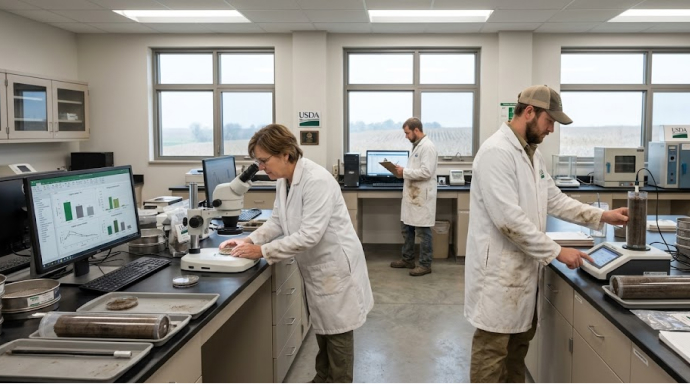
Corn Belt farms participating in the pilot are typically large-scale operations with high fertilizer input systems, making them ideal for evaluating how nutrient management strategies influence soil carbon retention. Early findings indicate that fields using reduced tillage and cover cropping systems demonstrate higher carbon stability over multi-season cycles.
Agricultural operators are also integrating these measurements into broader farm management software platforms, allowing soil carbon metrics to influence fertilizer application timing and crop rotation planning.
Expansion of USDA Pilot Zones Across the Corn Belt
The 2026 expansion introduces additional monitoring sites across central Iowa counties such as Story, Boone, and Polk, alongside Illinois agricultural regions including McLean, Champaign, and Livingston counties. These areas represent high-yield corn and soybean production corridors where soil management practices significantly affect national commodity output.
The pilot program now includes expanded participation requirements, where farms must document soil management practices, fertilizer usage, and yield outcomes alongside carbon measurement data. This creates a dual reporting structure that links environmental performance with agricultural productivity.
Field technicians and extension specialists are conducting periodic soil sampling to calibrate digital models against physical soil carbon measurements. This calibration process is critical for improving the accuracy of predictive algorithms used in carbon estimation systems.
A growing number of producers are integrating these datasets into broader sustainability reporting systems supported by climate-smart agriculture verification frameworks.
Precision Agriculture Systems Driving Soil Carbon Tracking
Modern soil carbon monitoring relies heavily on precision agriculture infrastructure already present in many Midwest farming operations. GPS-guided equipment, variable-rate application systems, and satellite-driven field segmentation allow soil carbon data to be mapped with high spatial resolution.
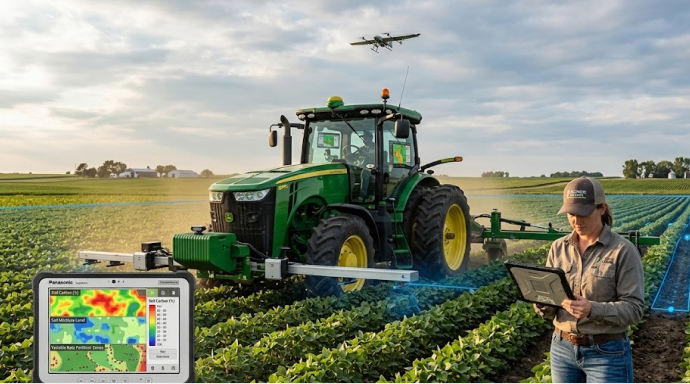
These systems identify micro-variations within fields that influence carbon retention, such as drainage differences, soil texture shifts, and crop residue distribution. Farmers use this information to adjust planting density, fertilizer placement, and residue management strategies.
The integration of carbon tracking into existing precision agriculture workflows reduces the operational burden on producers while increasing the accuracy of environmental reporting.
Data Infrastructure and Agricultural Technology Partnerships
The USDA soil carbon program depends heavily on collaboration with agricultural technology providers that supply data infrastructure, cloud processing systems, and sensor networks. These partnerships allow continuous monitoring of soil conditions throughout the growing season rather than relying solely on periodic sampling.
In Iowa and Illinois, participating farms use a mix of in-field probes, drone imagery, and satellite data feeds to build continuous soil condition profiles. These datasets are processed using machine learning models that estimate carbon flux based on temperature, moisture, crop growth stage, and residue decomposition rates.
This level of integration reflects a broader shift in U.S. agriculture toward data-driven environmental management systems, where soil health becomes a quantifiable and trackable performance metric rather than a static field condition.
Economic Implications for Corn and Soybean Producers
The introduction of soil carbon monitoring has direct economic implications for Midwest producers, particularly those engaged in corn and soybean production. Participation in USDA pilot programs can influence eligibility for future incentive payments tied to verified carbon sequestration outcomes.
Large-scale operations benefit from economies of scale, as carbon measurement costs are distributed across thousands of acres. Smaller farms face higher per-acre implementation costs but may gain access to technical assistance programs provided through state extension services.
Commodity markets are also beginning to reflect sustainability-linked production models, where buyers consider environmental metrics alongside yield and quality. This shift is particularly relevant for export-oriented grain supply chains that increasingly require sustainability documentation.
| Farm Category | Monitoring Adoption Level | Primary Benefit | Operational Challenge |
|---|---|---|---|
| Large Corn Operations | High | Carbon credit eligibility | Data integration complexity |
| Mid-size Farms | Moderate | Fertilizer optimization | Equipment upgrade costs |
| Small Farms | Low to Moderate | Access to USDA incentives | Technical onboarding |
Regional Agricultural Research and Soil Science Collaboration
University-led research programs in Iowa State University and the University of Illinois continue supporting USDA soil carbon initiatives through field trials and long-term soil health studies. These institutions provide independent validation of carbon measurement methodologies and contribute to improving model accuracy.
Research findings are also influencing regional extension services, which provide guidance to farmers on how to integrate soil carbon practices into existing crop production systems. These services play a key role in translating complex environmental data into practical field-level decisions.
The collaboration between federal agencies, academic institutions, and private-sector technology providers represents a structured approach to scaling soil carbon monitoring across the Midwest agricultural landscape.
Long-Term Soil Carbon Tracking and Agricultural Transition
Soil carbon monitoring in Iowa and Illinois reflects a broader transformation in U.S. agriculture, where environmental metrics are increasingly integrated into production systems. Rather than operating as separate sustainability initiatives, carbon tracking is becoming embedded in daily farm management workflows.
This transition affects how farmers evaluate input efficiency, soil fertility, and long-term land productivity. Fields are now assessed not only by yield but also by their ability to retain carbon and maintain soil structure over time.
As USDA pilot programs expand, soil carbon monitoring is expected to become a standard component of agricultural reporting systems across major U.S. production regions, particularly where federal funding and private market incentives intersect.