Wheat resistance traits are becoming easier to identify as genome-wide association studies connect field disease ratings with DNA markers in U.S. wheat germplasm. The recent research record does not point to one simple resistance answer. Instead, it shows many small and moderate genetic signals across hard winter, soft winter, and spring wheat materials, with some loci already known and others reported as novel.
That distinction matters for growers and breeders. Wheat diseases such as stripe rust, leaf rust, Septoria tritici blotch, and Fusarium head blight are influenced by pathogen races, weather, variety choice, and management. A marker linked to resistance can help breeding programs screen lines more efficiently, but it does not replace field testing across locations and years.
Why Genome-Wide Studies Matter In U.S. Wheat
From Field Scores To DNA Markers
Genome-wide association studies, often shortened to GWAS, look for statistical links between genetic markers and measured traits. In wheat disease work, those traits may include infection type at the seedling stage, adult-plant field severity, damaged kernels, or toxin levels. The method is useful because breeding populations often contain many past recombination events, giving researchers a way to narrow the region associated with resistance.
The value is practical but not absolute. A significant single nucleotide polymorphism, or SNP, is not always the causal gene. It may be close to the causal variant, or it may tag a larger chromosome segment. That is why follow-up validation remains necessary before a marker becomes routine in a breeding pipeline.
Wheat Resistance Traits Across Disease Targets
Wheat resistance traits now being reported in U.S. studies cover several important disease groups. Stripe rust has received substantial attention because it can cause serious yield losses when susceptible varieties meet favorable conditions for the pathogen. Fusarium head blight is equally serious from a grain-quality standpoint because it is tied to Fusarium-damaged kernels and DON mycotoxin. Septoria tritici blotch and leaf rust also remain active breeding targets in regional wheat programs.
The studies supplied in the research record show a broad pattern: resistance is often quantitative, split across multiple loci, and unevenly distributed across germplasm. That is a familiar outcome in crop genetics. It also supports a cautious reading of GWAS results. A marker-trait association is a lead, not a finished variety.
What Wheat Resistance Traits Mean For Breeding
All-Stage And Adult-Plant Resistance
One of the clearest findings from the recent hard winter wheat work is the difference between all-stage resistance and adult-plant resistance. In a panel of 459 contemporary hard winter wheat genotypes from the U.S. Great Plains, researchers reported 113 SNP markers representing 112 loci linked to stripe rust resistance, including 40 novel loci. The same study found that only 7% to 14% of genotypes were resistant at the seedling stage to five U.S. races, while 32% to 78% were resistant at the adult-plant stage in field environments across Oklahoma, Kansas, and Washington stripe rust GWAS.
That gap is important. Seedling resistance can be race-specific and strong, but it may fail when pathogen populations change. Adult-plant resistance is often partial, but it can add durability when combined with other resistance genes or quantitative loci. Breeders usually prefer to stack useful genes and QTLs rather than depend on a single source of protection.
Known Genes Still Matter
The hard winter wheat panel also showed diagnostic evidence for resistance types Yr15, Yr17, Yr18, Yr29, and the quantitative stripe rust resistance locus QYr.tamu-2B. These findings do not mean every variety carries those factors, and they do not mean stripe rust risk disappears. They do show that U.S. germplasm already contains genetic material that breeders can track and combine.
For growers, Wheat resistance traits identified through markers may eventually show up as better variety ratings or more stable field performance. The timing depends on breeding cycles, validation, seed increase, and regional testing. Even when a marker is useful, it usually takes years for a new line to move from selection to commercial acreage.
Stripe Rust Signals From Hard Winter Wheat
Novel Loci Expand The Breeding Map
The 40 novel loci reported in the March 10, 2025 hard winter wheat study are meaningful because they broaden the set of possible resistance sources. Novel does not automatically mean superior. It means the loci were not previously reported in the same way, based on the study’s analysis and available comparisons. Breeders still need to test whether these loci perform consistently in other populations and environments.
Several other research results in the notes point in the same direction. A broader U.S. winter wheat panel phenotyped in 2018 and 2019 identified 51 loci for stripe rust resistance. A spring wheat study with 616 lines evaluated in 2017 and 2018 identified 37 genes or QTLs, including 10 potentially new QTLs. A later U.S. winter wheat rust study reported novel QTLs for both leaf rust and stripe rust, while also confirming known resistance genes in U.S. winter wheat germplasm.
Regional Deployment Remains Uneven
Resistance allele frequencies varied among spring wheat nurseries in the research record, indicating regional differences in deployment. That is not surprising. Wheat classes, pathogen pressure, maturity targets, end-use quality, and local adaptation all influence which parent lines breeders use. A resistance source that looks promising in one region may still need careful testing before it fits another region’s agronomic and quality requirements.
For that reason, Wheat resistance traits should be evaluated as part of a regional decision system. Variety trials, disease nurseries, and local extension data remain necessary because marker results alone cannot measure all weather, pathogen, and management interactions.
Fusarium Head Blight Findings Need Caution
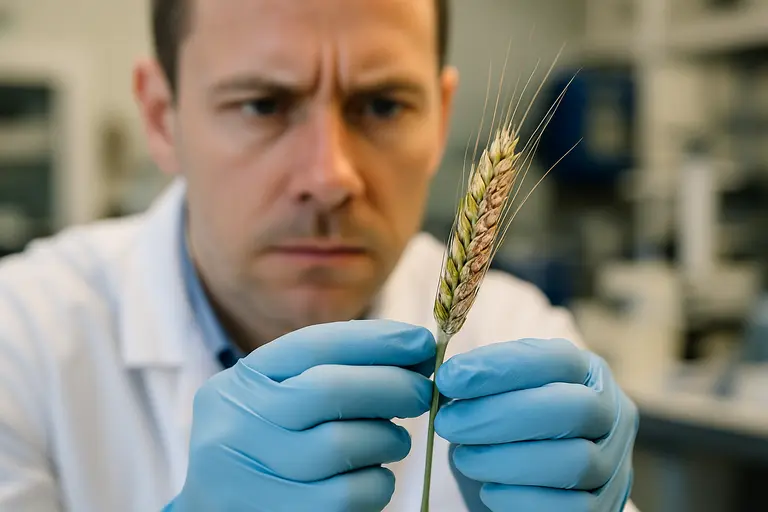
QTLs Across Symptoms, Kernels, And DON
The Fusarium head blight study published on March 11, 2026 identified nine QTLs and 38 SNPs significantly associated with resistance traits across greenhouse and field experiments. The reported traits included percentage of symptomatic spikelets, Fusarium-damaged kernels, and DON mycotoxin. Six of the nine QTLs were described as putatively novel: three tied to reduced symptomatic spikelets, two tied to low Fusarium-damaged kernels and DON, and one linked to all three measured traits Fusarium head blight QTL study.
This is useful because Fusarium head blight is not a single-trait problem. A line may reduce visual symptoms but still need evaluation for kernel damage or toxin risk. That makes multi-trait screening especially important. A marker tied to lower DON is valuable only if the association holds in other genetic backgrounds and disease environments.
Why Field Validation Still Carries Weight
Greenhouse tests can provide controlled inoculation and repeatable pressure, while field nurseries expose lines to more realistic variation. The best evidence usually comes when signals are consistent across both types of testing. The FHB findings in the research notes came from multiple greenhouse and field experiments, which strengthens the case for follow-up work, but the word “putatively” signals that caution remains appropriate.
Fusarium resistance breeding also has to account for yield, maturity, plant height, lodging, and end-use quality. A QTL with disease value may not move forward if the surrounding chromosome segment carries negative agronomic effects. Marker-assisted selection can help reduce that risk, but it cannot remove the need for agronomic selection.
How Breeders Can Use Marker Results
Marker-Assisted Selection Is A Filter
In practical breeding, markers often serve as a filter. They help identify lines worth keeping, crossing, or testing more heavily. They can also help breeders stack several resistance factors in one background. This is especially relevant for diseases where single-gene resistance can be overcome by pathogen change.
- Use GWAS markers to identify promising parents and breeding lines.
- Validate markers in the target wheat class and region before large-scale use.
- Combine marker data with field disease ratings, grain quality, and yield testing.
- Track both known genes and novel QTLs to reduce dependence on one resistance source.
For those interested in understanding how technical agricultural content is shared across the industry, Interline Publishing is part of a related network and provides insights on how these topics are communicated to a broader audience.
Septoria And Leaf Rust Add To The Picture
The 2026 Septoria tritici blotch study in a U.S. soft winter wheat population from Indiana reported 12 significant marker-trait associations on chromosomes 1A, 1D, 3B, 4A, 5B, 6A, and 7A. Some appeared to align with known Stb genes, while others were considered novel. A soft red winter wheat study in Georgia reported 26 significant QTLs for leaf rust and stripe rust severity and response, with one top QTL explaining up to 30.8% of phenotypic variance and 16 loci considered likely novel.
These results show why Wheat resistance traits are best viewed as a portfolio. Different diseases require different resistance sources, and no single GWAS result covers all production risks. Breeding programs must balance disease resistance with yield stability, milling and baking quality, and regional adaptation.
Wheat Resistance Traits And Practical Breeding Choices
What Farmers Can Take From The Research
Farmers do not need to read every SNP table to benefit from this work. The farm-level effect should come through stronger variety development, clearer disease ratings, and better regional recommendations. Still, growers should be careful about assuming that a variety with one named resistance factor will perform well against every local disease population.
Wheat resistance traits identified through GWAS are most useful when they are validated, stacked, and tested under realistic field pressure. The recent U.S. research record is encouraging because it has expanded the list of known and novel loci for stripe rust, Fusarium head blight, leaf rust, and Septoria tritici blotch. It is also a reminder that genetic resistance is usually gradual progress rather than a single breakthrough.
As of September 7, 2026, the strongest practical message is measured optimism. Genome-wide studies are giving breeders more markers and more candidate loci. The next step is turning those signals into varieties that hold up across years, regions, and pathogen pressure without sacrificing the agronomic traits farmers need.