Every American producer wants to make more money each season. Many now use crop price tracking to stay ahead. This helps them understand where prices start and how they change over time.
Measuring how much you harvest is key to making a profit. By using yield data carefully, you can choose the best time to sell. Experts say this approach also improves soil health and farm performance.
Success on the farm is not just about hard work. It also involves understanding financial trends and global changes. Knowing where numbers come from helps you manage risks and plan for growth.
What happens at your local elevator is influenced by global supply and demand. Weather and trade deals can change numbers every day. Understanding these origins helps you make smarter business decisions and achieve long-term success.
- Selling Smarter: Knowing where market values start helps you sell at the right time.
- Farm Health: Tracking your output leads to better soil and higher income.
Global commodity exchanges
It’s key to know how global commodity exchanges work to understand crop prices. These places are where many commodities, like farm products, are bought and sold.
These exchanges are big in setting crop prices. They help shape global market trends. They’re where buyers and sellers meet to set prices based on what’s available and what’s needed.
Understanding global commodity exchanges
These exchanges help trade futures contracts and other financial items tied to commodities. This helps find the price through the talks between buyers and sellers.
Many people are involved, like farmers, traders, and investors. Farmers can use this info to plan their pricing. For example, they can see when to sell their crops by watching price trends.
Getting accurate forecasts of agricultural prices is key for planning and making policies. These exchanges give valuable data for this.
- They offer real-time price info.
- They help protect against price risks.
- They make the commodity market more efficient.
Knowing how global commodity exchanges affect crop prices helps farmers and policymakers. This knowledge is important for dealing with the global agricultural market’s complexities.
Regional price differences
It’s key for farmers to know about regional price differences. This knowledge helps them make smart choices about selling their crops. It can really affect how much money they make.
Many things cause these price differences. These include local market conditions, how much it costs to transport goods, and how much supply and demand vary in each area.
Factors influencing regional price differences
Several important factors affect crop prices in different areas. One big one is local market conditions. These can change a lot from one place to another.
Local market conditions
Local market conditions include things like soil quality, weather, and pests. For example, areas with good soil and weather can grow more crops. This can make prices go down because there’s more to sell.

Precision agriculture is a big help in dealing with these local conditions. It uses new digital tech to help farmers grow better crops. This way, they can handle the challenges of different areas better.
For instance, precision agriculture lets farmers check soil moisture, watch the weather, and fight pests in a smart way. This boosts crop yields and helps farmers decide the best time and place to sell their crops.
- Soil quality assessment
- Weather pattern analysis
- Pest and disease management
By getting to know and adjusting to local market conditions, farmers can do better in the market. This helps them make more money.
Tools farmers use to track prices
Farmers are now using advanced tools for crop yield tracking and price monitoring. These tools help farmers make smart choices about their crops and sales.
Tracking crop yields and prices is key for farmers to boost their production and profits. By knowing how much each crop yields, farmers can plan better for the future.
Crop yield tracking and price monitoring tools
Farmers use different tools and methods to track yields and prices. Some old ways include:
- Maintaining paper records of crop yields and sales
- Using spreadsheet software to track and analyze data
But, new tech offers better ways to track yields and prices. Some modern tools include:
- Farm management software that provides detailed data analysis
- Crop yield trackers that use sensors and GPS to monitor crops
- Precision agriculture tools that help optimize crop production and reduce waste
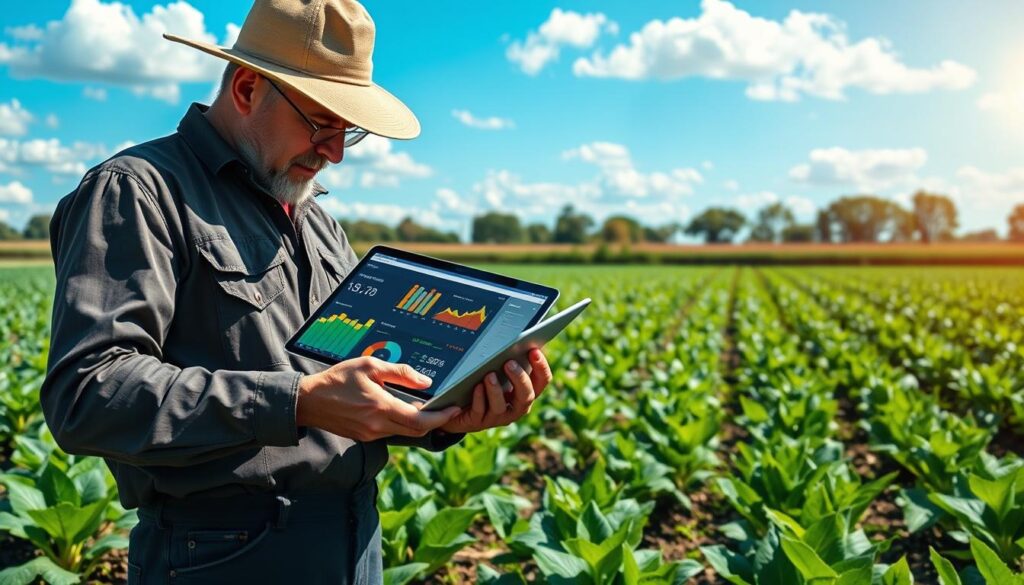
Modern tools let farmers access data in real-time. This helps them make quick decisions. For example, they can use price monitoring tools to keep up with market trends and adjust their sales plans.
| Feature | Description | Benefit |
|---|---|---|
| Crop Yield Tracking | Records and analyzes crop yields | Helps in identifying areas for improvement |
| Price Monitoring | Tracks market prices in real-time | Enables farmers to make informed sales decisions |
| Data Analysis | Provides insights into crop performance and market trends | Helps in strategic decision-making |
By using these tools and technologies, farmers can track yields and prices better. This leads to smarter decisions and higher profits.
Using price data to plan sales
Farmers can greatly benefit from looking at past price trends and using advanced forecasting. By studying crop market prices, they can spot patterns and guess future changes. This helps them set better prices.
Enhancing profitability through data-driven decisions
Deep learning models like LSTM and GRU are great at finding patterns in price data. They help farmers make smart choices to boost their profits. By using price data, farmers can handle the market’s ups and downs better.
Using price data wisely lets farmers adjust their sales plans based on market trends. This leads to more informed and profitable choices. It’s a key strategy for farmers to improve their market standing.