The U.S. Department of Agriculture announced approximately $1.8 billion in Conservation Reserve Program (CRP) payments for 2026 on October 8, providing annual rental income to eligible farmers, ranchers, and private landowners who participate in conservation programs. The announcement arrives as agricultural producers weigh land-use decisions, operating expenses, commodity-market uncertainty, and the cost of preparing for another production season.
The funding comes through the USDA’s Farm Service Agency (FSA), which administers the Conservation Reserve Program and its Grassland CRP component. These programs compensate eligible participants for maintaining resource-conserving vegetation on enrolled land. Depending on the contract and land type, participants can receive a predictable rental payment while protecting soil, improving water quality, and maintaining wildlife habitat.
The announcement also carries a significant working-land component. USDA reported that it accepted offers covering nearly 1 million new acres through Grassland CRP in 2026. Following enrollment, Grassland CRP acreage is expected to represent more than 40% of all acres enrolled in the broader program. That shift highlights how conservation payments can support land stewardship while leaving many grazing and haying activities in place.
For agricultural businesses, the central question is how this income fits into a wider financial plan. CRP payments can help stabilize revenue for participating operations, but eligibility rules, contract obligations, local land economics, and the productive potential of each parcel determine whether enrollment makes financial sense.
USDA’s $1.8 Billion Payment Announcement Signals The Scale Of Conservation Income
In its October 8 news release, the USDA confirmed that approximately $1.8 billion in annual rental payments would go to agricultural producers and private landowners participating in CRP and Grassland CRP during 2026. Agriculture Secretary Brooke L. Rollins said the enrollment supports efforts to protect grazing land and strengthen the cattle industry while preserving natural resources.
The department also identified Iowa, Illinois, Minnesota, South Dakota, and Missouri as the five states with the highest CRP payment totals for 2026. These states contain extensive agricultural landscapes where landowners must balance crop production, livestock operations, soil conditions, and conservation priorities.
The scale of the payments matters because agricultural income can fluctuate sharply with commodity prices, weather, input costs, and yields. Rental payments tied to qualifying conservation contracts create a different source of revenue from selling corn, soybeans, wheat, hay, or livestock. For participants, that distinction can help make a portion of annual income more predictable.
The USDA’s official announcement of 2026 conservation payments provides the national figures and outlines the program’s conservation goals.
The $1.8 billion figure represents program-wide payments, not an equal distribution among participants. Individual payments depend on enrolled acreage, contract terms, applicable rental rates, and program requirements. A farm with a small parcel enrolled in a conservation practice will have a different payment profile from a large landholding with multiple qualifying tracts.
The announcement also should not be confused with the separate $13.8 billion in gross Agriculture Risk Coverage and Price Loss Coverage payments announced by USDA on October 7 for the 2025 crop year. Those programs address commodity revenue and price risks, while CRP payments compensate eligible participants for maintaining land under conservation contracts. The distinction matters when farmers build budgets that combine federal support with crop sales, livestock revenue, and other income.
Grassland CRP Is Becoming A Larger Part Of The Conservation Program
One of the most consequential details in the October announcement is the growth of Grassland CRP. USDA accepted offers on nearly 1 million new acres during the 2026 enrollment cycle and expects grassland acreage to account for more than 40% of total CRP enrollment after those offers are included.
Grassland CRP differs from the traditional approach of removing environmentally sensitive cropland from production. It is a working-lands program that allows participants to conserve grasslands while continuing most grazing and haying practices, subject to contract terms and program rules.
That structure can be particularly relevant for ranchers who rely on pasture and rangeland to sustain livestock operations. Grassland conservation can protect vulnerable acreage while maintaining its role in forage production. For some operators, the payment adds a revenue stream without requiring the same shift away from agricultural use that may occur under other CRP contracts.
The USDA also reported that 26.8 million acres are expected to be enrolled in CRP for fiscal year 2027, following the acceptance of 2.2 million acres through Grassland, General, and Continuous CRP enrollment opportunities during 2026.
The earlier July 7 announcement provides additional context. USDA said producers and landowners had submitted offers covering nearly 2.5 million acres, while approximately 2.2 million acres were available for enrollment under the program’s acreage limits. Nearly 1.5 million acres were approaching contract expiration at the time, and participants submitted re-enrollment offers for just over 982,000 acres. They also submitted offers to enroll 1.5 million acres of new land.
These figures demonstrate the level of interest in conservation agreements, but they also show that enrollment is competitive. Submitting an offer does not guarantee acceptance. Producers need to evaluate their land’s eligibility, the offered rental terms, and the economic consequences of committing acreage for the required period.
Conservation Payments Can Help Stabilize Farm Cash Flow
Farm financial planning often centers on revenue from harvested crops and livestock sales. Those sources remain essential, but they can be exposed to price swings, weather damage, changing input costs, and unpredictable market conditions. Conservation rental payments introduce another component into the financial picture for operations with eligible enrolled land.
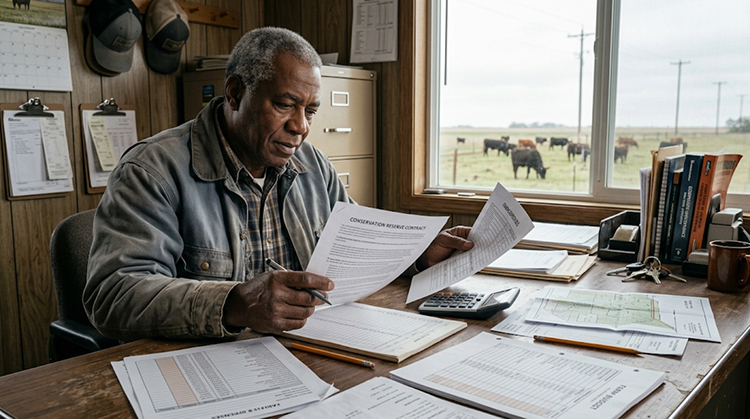
A CRP payment can help a participant plan for recurring expenses such as property taxes, insurance, equipment maintenance, or debt service. For ranchers enrolled in Grassland CRP, payments may supplement income from permitted grazing and haying activities, depending on the contract. The degree of financial benefit will vary by operation.
Consider a hypothetical farm that receives $18,000 in annual conservation rental payments. That amount should not automatically be treated as profit. The owner may still face costs associated with establishing and maintaining the required vegetative cover, managing the property, meeting contract requirements, and giving up alternative uses for the enrolled acreage.
A useful budget separates the gross payment from the expenses and opportunity costs connected to the contract. It should also distinguish predictable annual income from payments that are one-time, conditional, or dependent on completing approved work. This gives farm managers a clearer picture of how much money is available for operating needs.
Producers can improve their farm cash-flow planning by reviewing expected conservation payments alongside crop-sale schedules, livestock receipts, loan installments, seed and fertilizer purchases, and equipment costs. The goal is to avoid committing the same expected revenue to multiple financial obligations.
Conservation income may also help some farms manage periods when crop revenue arrives later than expected. However, participants should review payment timing and contract terms before relying on a deposit to meet a specific bill. A sound plan leaves room for delays, unexpected costs, and changes in the broader business.
The Financial Trade-Off Depends On The Land And Contract
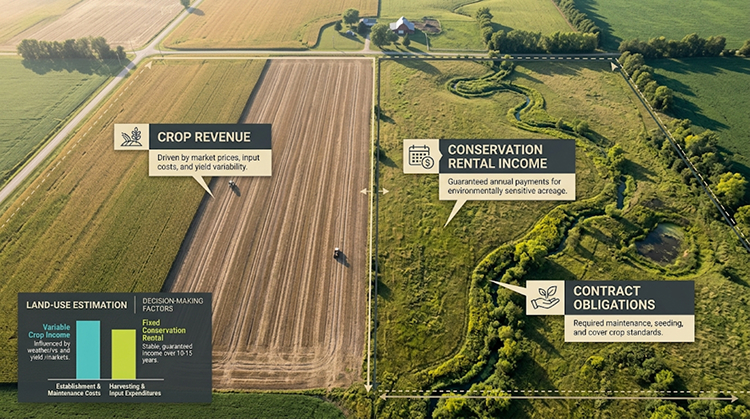
CRP participation is not a universal solution for improving farm revenue. Its financial value depends on the land’s production potential, local rental conditions, the conservation practice required, and the terms offered by the program.
For highly erodible fields, marginal cropland, or parcels that consistently produce weak yields, conservation enrollment may offer an attractive alternative to annual cultivation. Reducing erosion can also protect soil resources and limit the movement of sediment and nutrients into nearby waterways. These environmental benefits may support the long-term condition of the surrounding farm.
By contrast, productive cropland in a strong commodity market may generate more revenue from crop production than from a conservation contract. Farmers evaluating such acreage must compare expected crop income against input costs, machinery expenses, land rent or ownership costs, and the risks of producing a crop. The right decision requires parcel-level calculations rather than a broad assumption that federal rental payments always improve profitability.
Contract duration is another critical factor. The USDA’s Natural Resources Conservation Service explains that CRP contracts generally run from 10 to 15 years. A long commitment can offer income stability, but it also limits flexibility in how the enrolled acreage can be used. That restriction matters if commodity prices improve, a farm changes ownership, a livestock operation expands, or a family plans to reorganize its land base.
The official Conservation Reserve Program overview describes the program’s role in establishing long-term vegetative cover, reducing soil erosion, improving water quality, and protecting wildlife habitat.
Before enrolling, landowners should compare projected rental income with realistic alternatives for the parcel. They should also account for establishment costs, maintenance obligations, potential effects on adjoining fields, and any restrictions on grazing, haying, or other uses. A conservation planner or Farm Service Agency representative can help clarify program requirements before a participant makes a long-term commitment.
Iowa, Illinois, Minnesota, South Dakota, And Missouri Lead The Payment Rankings
The USDA’s five leading states for 2026 CRP payments—Iowa, Illinois, Minnesota, South Dakota, and Missouri—illustrate the program’s importance across the central United States. Each state has a mix of crop-producing land, grasslands, and areas where conservation practices can support soil and water protection.
In Iowa and Illinois, where corn and soybeans play major roles in agricultural production, the economics of taking eligible land out of intensive cultivation can be especially important. The value of a conservation contract must be compared with potential crop revenue and the cost of planting, fertilizing, harvesting, and marketing a crop.
Minnesota and South Dakota also include substantial grassland and livestock interests. For qualifying landowners, Grassland CRP may provide an opportunity to maintain pasture and rangeland while receiving rental income under program rules. Missouri’s mix of row-crop agriculture, pasture, and varied terrain creates a different set of parcel-level decisions.
The national payment ranking does not establish the average payment received by an individual farmer in any of these states. Nor does it show that all producers within a leading state are eligible. Total payments reflect participation and enrolled land across the state, while an individual contract depends on the acreage and terms involved.
For that reason, local figures are more useful when farmers are comparing enrollment options. County-level rental information, field characteristics, conservation needs, and the farm’s current production plan can reveal whether a specific offer is financially attractive. Producers should consult their local FSA office for details that apply to their land rather than assuming that a statewide ranking predicts their own payment.
Conservation Benefits Can Protect The Farm’s Long-Term Productive Capacity
Although annual rental income is a central financial incentive, CRP is also intended to address environmental pressures that can affect agricultural productivity. Establishing long-term vegetative cover can reduce soil erosion, improve water quality, and provide habitat for wildlife. These outcomes can benefit the broader landscape surrounding enrolled acreage.
Soil erosion can remove valuable topsoil, while sediment and nutrient runoff can affect streams, lakes, and downstream water systems. Vegetative cover helps keep soil in place and can slow runoff. The benefits vary with soil type, slope, vegetation, weather, and the conservation practice used.
The program’s value therefore extends beyond the immediate payment. A landowner may receive income while maintaining acreage that would otherwise face erosion risks or require costly management. At the same time, conservation outcomes should be evaluated against the actual conditions of the parcel and the practices specified in the agreement.
Grassland CRP adds another dimension because it can preserve grass-based agricultural landscapes while allowing most grazing and haying practices to continue. For ranchers, this can connect environmental stewardship with the ongoing use of land for livestock production. The precise activities allowed, however, depend on program rules and the participant’s contract.
Conservation planning should account for both the immediate financial return and the land’s longer-term condition. Farmers who assess these factors together can make more informed choices about which parcels to enroll, which to keep in production, and how to structure their operations for future seasons.
What Farmers Should Review Before Making Revenue Decisions
The $1.8 billion national payment announcement provides context, but farmers need contract-specific information before changing their budgets. The first step is to confirm whether the land is eligible, whether the relevant enrollment opportunity is open, and whether an offer has been accepted. Producers should also verify payment terms with the Farm Service Agency rather than using the national total to estimate individual proceeds.
A practical review should include the following:
- Calculate the net financial effect. Compare the expected rental payment with establishment and maintenance costs, foregone production revenue, and any other expenses tied to the contract.
- Check contract obligations. Confirm the contract duration, required vegetative cover, permitted uses, and any restrictions affecting grazing, haying, or future land management.
- Coordinate payments with the farm budget. Incorporate the expected timing of conservation income into loan payments, input purchases, property costs, and other financial commitments.
- Evaluate environmental and operational benefits. Consider erosion risks, water-quality goals, pasture management, and the role of the parcel in the farm’s broader production system.
The October announcement shows that conservation payments remain a substantial source of income for participating landowners and agricultural producers. With 26.8 million acres expected to be enrolled in CRP for fiscal year 2027, the program will continue to influence how eligible land is managed across the United States.
For some farms, CRP payments can provide valuable stability and support conservation goals. For others, crop production or alternative land uses may offer a stronger return. The decision rests on the economics of each parcel, the contract’s requirements, and the farm’s longer-term plans—not simply the size of the national payment total.