U.S. drought conditions in 2026 did not create one national farming problem. They created several regional problems at the same time. The Southwest faced deep water-supply stress tied to weak snowpack. Parts of the Plains and sorghum-growing areas carried direct crop exposure. Some regions had short-term rainfall relief while still dealing with longer-term hydrologic deficits. For farmers, that distinction matters because drought affects a dryland grain field, an irrigated vegetable farm, and a grazing operation in different ways.
Why U.S. drought conditions Differ By Region
The most useful drought question for farm planning is not whether the country is dry. It is where the dryness sits, how long it has lasted, and which crops or water systems depend on the affected moisture source. A rain-fed field responds first to topsoil and subsoil moisture. An irrigated farm may be more exposed to snowpack, reservoir storage, groundwater rules, or canal deliveries. Livestock operations feel drought through forage growth, hay availability, and water access.
That regional separation was clear in the Southwest. As of June 18, 2026, about 90.9% of Arizona, New Mexico, Utah, Colorado, and Nevada was in drought, while forecasts leaned toward above-average monsoon rainfall that could reduce short-term drought in some areas. The same update reported that long-term drought impacts would persist, especially because April 1 snow water equivalence across the Western U.S. was 32% to 53% below the previous record low Drought.gov Southwest update.
Southwest Snowpack And Irrigation Timing
In the Southwest, drought risk is not limited to whether summer thunderstorms arrive. Monsoon rain can improve surface conditions, support rangeland response, and reduce immediate crop stress in some locations. It does not fully replace mountain snowpack that normally feeds streams, reservoirs, and irrigation systems over a longer period.
This is why producers in snowmelt-dependent basins often face a delayed form of drought. A field may receive summer rain, but a water district can still face allocation pressure if reservoir storage is low or if runoff was weak earlier in the season. Orchard, forage, and vegetable farms with fixed irrigation demand may have less flexibility than annual crop farms that can adjust acreage before planting.
Why U.S. drought conditions Hit Sorghum Areas
Sorghum is often discussed as a more drought-tolerant grain than corn, but tolerance does not mean immunity. For sorghum, U.S. drought conditions were still severe in several production areas during mid-2026. USDA Economic Research Service data reported that, as of June 9, about 60% of U.S. sorghum production area was in drought. Oklahoma and New Mexico each had 99% of sorghum area under at least moderate drought, and Oklahoma had 48% of its sorghum area in extreme drought and 6% in exceptional drought USDA feed outlook.
Those figures matter because sorghum is often part of risk management in drier regions. If drought expands into the very areas where a drought-tolerant crop is concentrated, the crop can still face yield pressure. The implication is not that sorghum loses its value in dryland rotations. Rather, it shows that crop choice reduces some exposure but cannot remove weather risk.
Farming Implications By Crop And Water Source
Drought changes farm decisions through several channels. The first is yield potential. Moisture deficits during sensitive crop stages can reduce stand development, grain fill, or forage regrowth. The second is input efficiency. Fertilizer, seed, and chemical costs may be harder to recover when moisture limits plant growth. The third is operational timing. Irrigation turns, hay cuttings, grazing rotations, and planting windows can all shift when water supply is uncertain.
Irrigated Farms Face Allocation And Delivery Risk
For irrigated farms, the central issue is not only crop water demand. It is whether water arrives when the crop needs it. A reduced snowpack year can tighten supplies before peak summer demand. A wet monsoon period may reduce some irrigation need, but it can arrive unevenly and may not refill the storage systems that support later deliveries.
Crop science helps frame the tradeoff. High-value perennial crops can justify water priority because losing trees or vines affects more than one season. Annual field crops may offer more room to adjust acreage, planting date, or intended use. Forage producers may cut fewer acres, change harvest timing, or shift some ground away from water-intensive stands if water reliability is weak.
Dryland Feed Grains Carry Different Exposure
Dryland farms are more directly tied to precipitation and stored soil moisture. In sorghum regions, the June 2026 drought footprint showed that large portions of production area were exposed to moisture stress. That does not predict the exact yield on any single farm, but it signals a higher probability of uneven stands, lower biomass, or reduced grain fill where rain did not arrive in time.
Farmers comparing dryland crop options should be cautious about simple labels such as drought-tolerant or low-water. A crop may use less water than another crop and still fail under prolonged stress. Local soil depth, residue cover, planting date, hybrid selection, and weed control all affect how far limited moisture can carry a crop.
Practical Responses With Limits
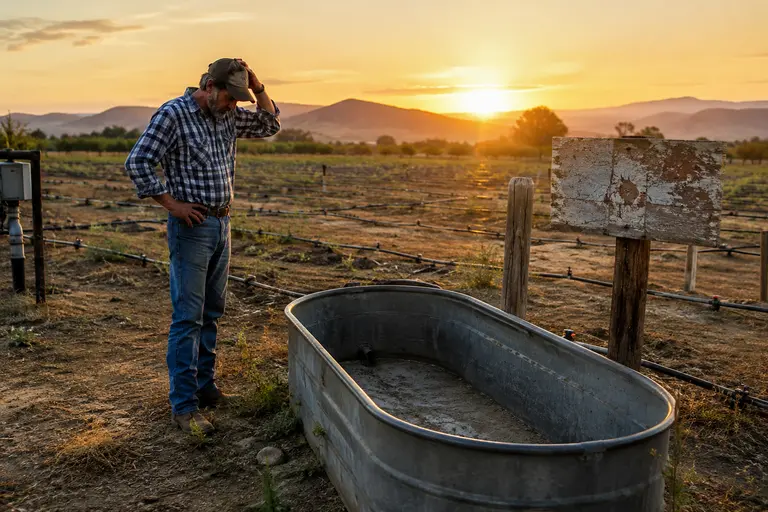
Practical drought response starts with separating short-term moisture stress from long-term water supply risk. Short-term stress may be managed through planting adjustments, irrigation scheduling, grazing changes, or harvest-use decisions. Long-term risk may require changes to rotation, infrastructure, water contracts, or enterprise mix. Those choices are farm-specific and depend on cost, labor, water rights, and market access.
For related farm-level planning ideas, Agheiro’s discussion of drought strategies for water shortages connects soil moisture monitoring, irrigation choices and pasture protection with cautious decision-making. The common thread is that drought planning works best when it is based on local measurements rather than national averages alone.
Measure Before Making Large Changes
U.S. drought conditions also change the value of information. Soil probes, irrigation records, field scouting, and yield history can help farmers decide whether a crop still has economic potential or whether inputs should be reduced. For livestock operations, forage inventories and realistic regrowth estimates are more useful than hoping late rain will restore production.
Evidence quality matters in agriculture as much as in other risk fields. Readers interested in how evidence is used across different industries may find relevant content at Polygraphianz, though crop decisions still require agronomic data from fields, weather records and water managers.
Match Decisions To The Water Source
A farm drawing from groundwater faces a different drought calculation than a farm tied to snowmelt-fed surface water. A dryland operation faces a different calculation again. This is why a single drought map cannot answer every management question. The map can identify exposure, but the response depends on crop stage, soil water storage, irrigation access, and financial capacity.
For annual crops, flexible acreage and hybrid selection may reduce risk before planting. During the season, the options narrow. Farmers may shift harvest use, reduce optional inputs, or protect the strongest fields first. For perennial crops and livestock systems, early planning is often more valuable because the cost of waiting can be high.
Crop Planning Under U.S. drought conditions
Crop planning under U.S. drought conditions should start with the regional water signal. In the Southwest, the June 2026 evidence pointed to severe drought coverage and record-low snowpack indicators, even with possible monsoon improvement. In sorghum areas, USDA data showed that drought was concentrated in important production states, including severe categories in Oklahoma.
The farming implication is clear but not simple: drought risk is uneven, and management should be uneven too. A producer with reliable irrigation and strong soil moisture may make different choices than a neighbor with weaker water access. A sorghum grower in moderate drought may still have reasonable prospects after timely rain, while a field in extreme or exceptional drought may need a much more conservative budget.
The cautious approach is to treat drought data as a planning signal rather than a final yield forecast. Regional drought percentages show exposure. Field measurements show condition. Marketing plans, input decisions, and livestock feed plans should account for both. That combination gives farmers the best chance to respond to dry conditions without assuming more certainty than the data can support.