Drought Strategies for 2026 should begin with a clear reading of water limits at the field, pasture, and farm finance level. Severe drought does not create one uniform problem. A dryland corn field, an irrigated vegetable block, and a cow-calf pasture can each face different risks from the same rainfall shortage. For that reason, the best response is usually a sequence of practical decisions: protect soil moisture, ration irrigation where available, adjust crop and livestock plans, and document losses early if disaster assistance may be needed.
The research available for 2026 supports a cautious approach. Several tools can reduce drought stress, but none can remove the risk created by a sustained water shortage. Farmers should treat each practice as part of a farm-specific plan rather than as a guaranteed yield saver. Soil type, crop stage, irrigation access, forage reserves, and local program eligibility all affect the result.
Drought Strategies Begin With Field Assessment
Reading Water Risk Before Acting
A field assessment should start with the water already present in the system. That means checking soil moisture, crop growth stage, root depth, residue cover, and whether the crop is approaching a sensitive period. In many crops, water stress during reproductive development can cause more damage than the same stress during some earlier vegetative stages. The research notes do not provide crop-specific yield loss figures, so the safer recommendation is to rank fields by crop stage and likely return from any limited irrigation.
Monitoring drought severity also matters. USDA Farm Service Agency guidance points producers to the U.S. Drought Monitor and identifies disaster assistance options for producers affected by drought, including the Livestock Forage Disaster Program and the Emergency Assistance for Livestock, Honeybees, and Farm-Raised Fish Program in its June 10, 2026 Kansas drought notice USDA drought assistance notice. Producers outside Kansas still need to verify county-level eligibility and program rules with their local FSA office.
Drought Strategies For Soil Moisture Decisions
Soil moisture decisions are often the lowest-cost place to start because they affect every later choice. Reduced tillage, no-till systems, cover crops, mulching, and residue management are all identified in the research notes as practices that can help retain moisture and build drought resilience. The effect will vary. A no-till field with stable residue cover may conserve surface moisture better than a tilled field, but compaction, weed pressure, and planting equipment limits can change the outcome.
Soil amendments are also listed in the research as a way to improve soil structure and water-holding capacity. That claim is plausible, but the notes do not provide enough site-specific detail to say which amendment, rate, or timing is best. Farmers should base amendment decisions on soil tests, local agronomic advice, and realistic expectations. During a drought year, the main goal is often to avoid making soil structure worse while preserving as much plant-available water as possible.
Water Conservation Starts With Soil Management
Residue, Mulch, And Reduced Disturbance
Residue management deserves careful attention during a dry season. Crop residue and mulch can reduce direct evaporation from the soil surface, moderate soil temperature, and slow runoff during scattered rainfall events. These benefits are most useful when residue does not interfere with planting, emergence, or pest control. In dry conditions, aggressive tillage can increase moisture loss and leave the surface more exposed. That does not mean every farm can switch systems quickly, but it does support restraint before making tillage passes that are not essential.
Cover crops require a more careful reading. They can support soil health and residue cover, but they also use water while growing. In areas already short of moisture, termination timing becomes a management decision rather than a fixed calendar task. The most practical Drought Strategies are those that balance future soil benefits with current water availability. If soil moisture is critically short before planting a cash crop, a growing cover crop may need earlier termination than it would receive in a normal year.
Crop Selection And Planting Changes
The research notes also identify drought-tolerant crop varieties and changes in crop choice or planting schedules as potential responses. This is reasonable, but farmers should be careful about assuming that a drought-tolerant label removes production risk. Variety selection can improve the odds under water-limited conditions, yet performance still depends on planting date, soil fertility, disease pressure, and the timing of rainfall.
Adjusting cropping patterns can be a practical response where water supplies are known before planting. A farm may reduce acreage in high water-demand crops, change planting windows, or shift toward crops better suited to limited water. These decisions can affect marketing plans, input purchases, labor timing, and crop insurance questions, so they should be made early when possible. Related regional analysis of Corn Belt drought risk shows why local soil moisture can matter as much as national weather headlines.
Irrigation And Crop Choices Under Short Supply
Using Sensors To Avoid Guesswork
Where irrigation is available, efficiency becomes a central management issue. The research notes list micro-irrigation, subsurface drip irrigation, and soil moisture sensors as ways to improve water use. Sensors are especially useful because they can help distinguish between a crop that looks stressed in afternoon heat and a crop that has depleted moisture in the active root zone. That distinction can prevent both under-watering and wasteful watering.
Subsurface drip and other targeted systems can reduce losses compared with less precise delivery methods, but installation cost, water quality, filtration, and maintenance needs must be considered. For some farms, short-term drought response may focus less on new infrastructure and more on scheduling, nozzle checks, leak repair, and prioritizing the most valuable or most vulnerable acres. For producers considering longer-term investments, Agheiro has also covered precision irrigation funding and why water efficiency remains a major issue in dry regions.
Prioritizing Acres When Water Is Limited
Limited water forces ranking decisions. A farmer may choose to irrigate fields with the strongest yield potential, crops at the most water-sensitive stage, or fields tied to contracts. In specialty crops, quality losses may be as damaging as yield losses. In grain crops, the decision may depend on whether a field has enough potential left to justify the water. The research notes do not provide a universal threshold, so local economics and crop condition should guide the final call.
Water sharing or water trading is also listed in the research as an option. That may be relevant in places where water rights systems and local rules allow it. Farmers should be cautious here because water rights, permitting, and withdrawal limits are highly location-specific. A neighbor-to-neighbor arrangement that works in one region may not be lawful or practical in another. Any formal transfer should be checked against local rules before water is moved.
Livestock And Pasture Decisions During Drought
Protecting Forage Base Before It Is Lost
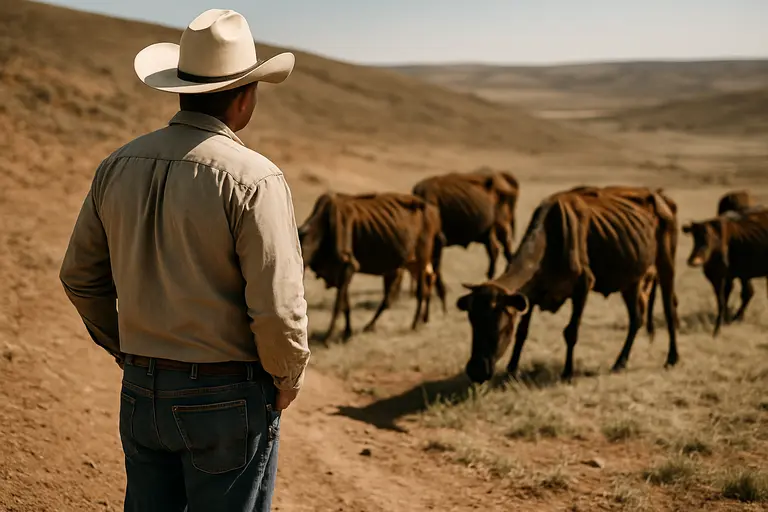
Livestock producers face a different version of the same water shortage. Pasture stress can reduce forage growth, weaken root reserves, and lengthen recovery after rain returns. North Carolina Cooperative Extension advises rotating cattle off pastures when forage is reduced to a 3-to-4 inch height, which helps protect plant health and supports faster recovery after drought conditions ease pasture drought guidance.
That recommendation is practical because overgrazing can turn a short-term forage shortage into a longer recovery problem. If cattle remain too long on stressed pasture, desirable forage plants may lose vigor while bare ground increases. In severe drought, producers may need to use sacrifice areas, feed stored forage, reduce stocking pressure, or move animals to protect the pasture base. The right choice depends on feed inventory, livestock numbers, water access, and market conditions.
Linking Forage Plans With Assistance Programs
For livestock operations, drought planning should include documentation. Producers may need records of grazing losses, feed purchases, water hauling, livestock numbers, and dates when pastures became unusable. USDA programs such as LFP and ELAP are not automatic payments for every drought-related expense. Eligibility depends on program rules, location, qualifying conditions, and documentation. Early contact with the local FSA office can reduce confusion later.
Pasture management also connects to soil management. Maintaining cover protects the soil surface, reduces erosion risk if intense rain follows drought, and helps the stand recover. A drought plan that focuses only on getting through the next week may miss the cost of pasture damage that affects the next season.
Financial Assistance And Community Coordination
Using Public Programs Without Assuming Coverage
USDA disaster assistance can help some producers manage drought-related losses, but it should not be treated as a substitute for farm-level risk planning. The research notes identify LFP and ELAP as relevant programs. Farmers should confirm deadlines, eligible losses, county status, and required records directly with FSA. Program rules can vary by commodity and disaster category, and a general announcement does not prove that every farm will qualify.
Conservation planning is another medium-term step. The research notes identify work with NRCS conservation planning as a way to improve soil health and water conservation. A conservation plan may include practices that build water retention or reduce erosion risk. Still, the timing matters. Some practices need years to show their full value, so they are better viewed as drought preparation and recovery tools rather than instant relief.
Local Coordination During Water Shortages
Drought affects rural communities as well as individual farms. Shared concerns may include water access, forage movement, equipment availability, and communication with local agencies. Producer groups, extension offices, irrigation districts, and conservation staff can help coordinate information. For those interested in connecting with community resources, Bethel NC UMC serves as an associated community reference within this publishing network.
Community coordination should remain practical and evidence-based. Farmers can compare rainfall records, pasture condition, and irrigation limits, but each operation still needs its own budget and agronomic review. Drought plans are stronger when they combine local observation with official drought data and clear records.
Drought Strategies For Farm Decision Making
Building A Short-Term And Long-Term Plan
Drought Strategies work best when divided into short-term actions and longer-term investments. Short-term actions include checking soil moisture, limiting unnecessary tillage, adjusting irrigation schedules, protecting pasture height, and documenting losses. Longer-term actions include adopting residue-focused systems, improving irrigation efficiency, reviewing crop choices, and building conservation plans that support water retention.
The key is to avoid overconfidence. No single practice can fully offset severe water shortages, and research notes for 2026 do not provide enough detail to rank every option by return on investment. Farmers should choose practices that fit their soils, crops, livestock, labor, and water rules. Drought Strategies are most useful when they help producers make timely, documented, and flexible decisions under pressure.
For crop farms, that may mean prioritizing water for fields with the strongest remaining yield potential. For livestock farms, it may mean protecting forage stands before grazing damage becomes severe. For mixed operations, it may mean coordinating crop residue, feed supply, and pasture recovery as one system. The practical goal is not to eliminate drought risk. It is to reduce avoidable losses, protect the farm resource base, and keep enough flexibility to respond as weather and program information change.