The U.S. Department of Agriculture is preparing to use artificial intelligence to strengthen the accuracy of its national crop production reports after a processing error distorted September 2026 corn estimates for Kansas, Nebraska, and the wider United States. The new system is expected to make its first appearance in the November 10 Crop Production report, marking a significant step in the agency’s effort to modernize agricultural statistics and rebuild confidence among farmers, grain traders, and commodity analysts.
USDA Under Secretary for Research, Education, and Economics Scott Hutchins told Reuters on November 6 that the department developed an AI tool capable of identifying anomalies that existing validation procedures might miss. Officials determined that the system would have flagged the September corn data problem before publication.
The decision follows a correction issued by the USDA’s National Agricultural Statistics Service (NASS) on October 23. Investigators found that a computer processing error had incorrectly combined irrigated and non-irrigated corn acreage observations, affecting yield forecasts and other measurements. Although the agency said the original field data was accurate, the error raised questions about how information moves from field surveys into national agricultural estimates.
For American producers, the issue extends beyond a technical reporting problem. USDA crop forecasts influence grain marketing, farm financing, commodity contracts, storage decisions, and expectations for the next growing season. Introducing AI into the validation process could help prevent similar mistakes, but the agency will still need transparent methods, reliable field information, and human oversight to maintain confidence in its reports.
USDA Plans First AI Validation Test for November 10 Crop Report
The USDA’s new artificial intelligence tool is scheduled to check information prepared for the monthly Crop Production report due November 10, 2026. According to Reuters, officials concluded that the system would have detected the inconsistencies behind September’s corn estimates.
Hutchins described the technology as an additional safeguard rather than a replacement for the agency’s established review procedures. The tool will look for unusual patterns and anomalies that may not be apparent during normal validation.
That distinction is important because USDA crop statistics depend on multiple stages of data collection and processing. Field observations, producer surveys, acreage calculations, yield estimates, and statistical reviews all contribute to the final published figures. An error introduced during data processing can affect results even when the original observations are accurate.
The AI system is intended to strengthen the checks performed before publication. It does not mean that artificial intelligence will independently determine how much corn American farmers produce, nor does it eliminate the need for agricultural statisticians to evaluate questionable results.
Hutchins said he was optimistic about the department’s ability to use these tools to avoid similar problems in the future. The November report will provide an early opportunity to assess whether the additional review process can identify unusual data before it reaches the public.
For the USDA, the test is also a measure of whether technology can improve confidence in an institution whose statistics influence agricultural decisions across the country.
How a Processing Error Changed Kansas and Nebraska Corn Estimates
The September reporting problem originated in the way NASS combined observations from irrigated and non-irrigated corn fields.
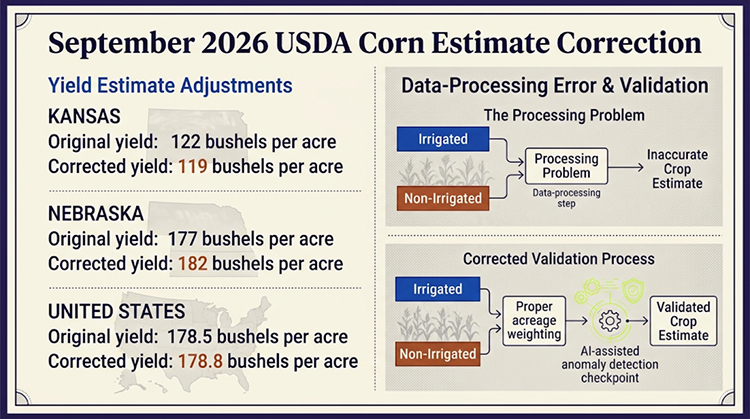
According to Lance Honig, chair of the USDA’s Agricultural Statistics Board, a computer file incorrectly combined acreage weights associated with the two production categories. The problem affected September plant population measurements, ear counts, yield estimates, and production forecasts.
Kansas and Nebraska were particularly affected because both states have substantial irrigated corn acreage. Irrigated fields can produce different yields from non-irrigated fields, meaning the proportions assigned to each category matter when calculating representative state estimates.
The corrected figures showed meaningful changes:
| September 2026 corn estimate | Original figure | Corrected figure |
|---|---|---|
| Kansas yield | 122 bushels per acre | 119 bushels per acre |
| Nebraska yield | 177 bushels per acre | 182 bushels per acre |
| U.S. average yield | 178.5 bushels per acre | 178.8 bushels per acre |
| U.S. corn production | 15.800 billion bushels | 15.828 billion bushels |
The revisions changed the direction of the state-level estimates. Nebraska’s projected yield increased by five bushels per acre, while Kansas’s declined by three. The national yield forecast increased by just 0.3 bushels per acre.
Although the national adjustment was relatively small, the state-level revisions were significant for producers and market participants who depend on regional estimates.
NASS published its correction on October 23 and provided additional details the following day. The agency said the affected September figures had been corrected in its Crop Production reports and Quick Stats database.
Importantly, the October 9 forecasts were reviewed and validated separately. NASS confirmed that its October corn yield and production projections remained unchanged after the review.
The corrected figures illustrate why data validation needs to account for the structure of agricultural production rather than simply checking whether numbers appear reasonable at a national level.
Why Accurate USDA Crop Estimates Matter to Farmers and Grain Markets
USDA crop production reports are among the most closely watched sources of agricultural information in the United States. They provide estimates that farmers, grain elevators, processors, exporters, lenders, and commodity traders use to evaluate supply conditions.
When the agency raises or lowers expected production, the market may reassess how much grain will be available during the marketing year. Even a relatively small revision can influence expectations about inventories, transportation demand, and prices.
For a farmer in Nebraska, a revised yield estimate can affect comparisons between expected local production and the national outlook. A grain buyer may use the same information to evaluate procurement needs, while an agricultural lender may consider broader production trends when reviewing farm financial conditions.
The relationship between production estimates and prices is not automatic. Grain markets also respond to export demand, weather, currency movements, global harvests, ethanol production, livestock feed requirements, and inventory levels. However, USDA statistics provide a common reference point for many of those decisions.
This makes the credibility of the reporting process particularly important.
A producer who believes national estimates are unreliable may become more cautious about using them to time grain sales or evaluate storage options. Traders may also place greater emphasis on private forecasts, satellite observations, and independent crop assessments when official numbers appear inconsistent.
The National Corn Growers Association, which represents approximately 35,000 farmers, criticized the September errors in October. The organization said the mistakes further weakened confidence in the government’s ability to provide accurate crop information.
The concern is especially relevant during periods of tight farm finances. Producers facing high diesel, fertilizer, machinery, and operating costs need dependable market information when deciding how to manage the value of their harvest.
USDA’s Data Modernization Plan Goes Beyond Artificial Intelligence
The new validation tool is part of a broader effort to modernize agricultural data collection and reporting.
On September 1, 2026, Agriculture Secretary Brooke Rollins announced the USDA Data Modernization Plan at the Farm Progress Show in Boone, Iowa. The initiative aims to improve the timeliness, accuracy, and usefulness of federal agricultural information while reducing the amount of time producers spend responding to government surveys.
The plan includes several technology priorities that extend beyond AI-assisted validation.
USDA intends to evaluate improved satellite imagery, geospatial tools, crop models, and other emerging technologies for acreage and yield estimation. The agency also plans to improve digital reporting systems, coordinate information across departments, and assess how artificial intelligence and machine learning can support its statistical operations.
Kip Tom, the USDA’s Special Advisor for Data Modernization, said the initiative is intended to reduce outdated information silos and provide farmers and rural communities with better service.
The department also emphasized producer privacy and transparency. Farmers need to know why information is collected, how it is used, and what safeguards protect confidential business information.
This is particularly important because many USDA estimates depend on voluntary participation. If producers become less willing to answer surveys, the agency could face additional challenges in collecting representative information.
A modern reporting system must therefore improve efficiency without weakening the quality of the underlying data.
The September corn correction demonstrates that technological improvements need to address the entire reporting process, from field observations to statistical calculations and final publication.
Satellite Data and AI Could Strengthen Crop Estimation
Artificial intelligence is only one component of the USDA’s modernization strategy. Satellite imagery and geospatial analysis could also help the agency evaluate crop conditions and improve estimates of planted acreage and production.
Satellite observations can provide information about vegetation development, field boundaries, crop health, and changes in land use. When combined with producer surveys and field-level observations, these tools can help statisticians evaluate whether reported acreage and yield estimates align with conditions observed across agricultural regions.
For example, satellite-based monitoring may help identify areas where crop development differs from historical patterns. Statistical models can then flag locations that deserve additional examination.
However, satellite imagery does not automatically reveal final crop yields. Cloud cover, crop varieties, planting dates, irrigation practices, soil conditions, and local weather can affect how satellite measurements should be interpreted.
Field-level information remains important because remote sensing cannot capture every factor that determines harvested production.
The USDA’s September 1 modernization announcement specifically described a pilot involving improved satellite imagery, geospatial tools, crop models, and essential producer-reported information. The agency also plans to work with agricultural partners and land-grant universities to strengthen yield research.
Combining these sources could provide a more complete picture of American crop production. AI-assisted validation could then help identify inconsistencies between different data streams before estimates are released.
The long-term objective is not simply to collect more information. It is to make the information more useful, consistent, and reliable for the people who depend on it.
USDA Faces Wider Questions About Agricultural Data Reliability
The September corn error did not occur in isolation. USDA has faced criticism over other statistical revisions and reporting problems that have affected confidence in its agricultural information.
Reuters reported that the agency previously received criticism after making substantial upward revisions to earlier corn acreage estimates. It also reported inaccurate beef export sales data during the summer of 2026.
More recently, market analysts questioned figures in a USDA monthly soybean-processing report that showed a significant difference between soybean crushing volumes and soybean meal production in Iowa. The agency said it was reviewing the report through its normal process and would make any necessary revisions in the following month.
These developments have increased scrutiny of how the USDA collects, processes, and verifies information.
The department has also faced questions about staffing reductions and their potential effect on federal data collection. Thousands of employees have left USDA agencies since the administration’s workforce changes, raising concerns among agricultural observers about the resources available for statistical operations.
Hutchins told Reuters that staffing losses were not responsible for the September corn processing error. Lance Honig also emphasized that the original field information was sound and that the problem should have been caught through proper validation.
That distinction matters. The September incident was a processing failure, not evidence that field surveyors collected incorrect information.
Nevertheless, the broader challenge remains: the agency must ensure that its statistical infrastructure can handle increasingly complex agricultural information while maintaining the accuracy expected by producers and markets.
AI may provide another layer of protection, but it cannot independently resolve problems involving incomplete surveys, inconsistent definitions, weak source data, or unclear reporting procedures.
What the November 10 Report Will Reveal About USDA’s New System
The November 10 Crop Production report will be the first major opportunity to evaluate the new AI validation process in a live reporting cycle.
Farmers and commodity analysts will be watching both the published production figures and the USDA’s explanation of how the new review system fits into its existing procedures.
One important question is whether the agency will explain how anomalies are identified and reviewed. Transparency about the tool’s role would help producers understand whether it functions as an additional statistical check, how potential problems are escalated, and whether human reviewers retain final responsibility for the figures.
Another question concerns consistency. A validation system must work across different crops, states, reporting periods, and production methods. The irrigated and non-irrigated acreage error in Kansas and Nebraska provides a clear example of why statistical relationships need to be checked at both regional and national levels.
The agency will also need to demonstrate that the technology improves reporting without creating unnecessary delays. Agricultural markets operate on strict schedules, and producers often make decisions around the publication dates of USDA reports.
If the November test identifies unusual patterns before release, it could demonstrate the practical value of AI-assisted quality control. If the system produces too many false alerts or fails to identify meaningful inconsistencies, the agency may need to refine its approach.
The outcome will be relevant beyond corn production. USDA statistics cover soybeans, wheat, cotton, livestock, dairy, inventories, exports, and other agricultural sectors. Improvements in data validation could eventually support a wider range of reports.
Reliable Agricultural Data Remains the Priority
USDA’s decision to introduce artificial intelligence into crop report validation represents a practical response to a problem that affected important corn estimates in Kansas and Nebraska. The September error changed state yield forecasts, required corrections to national production figures, and renewed concerns about the reliability of official agricultural statistics.
The November 10 report will provide an early test of whether the new system can identify anomalies before publication. Its success will depend on more than the technology itself. Accurate source information, sound statistical methods, experienced reviewers, transparent procedures, and continued participation from farmers will remain essential.
The USDA’s broader modernization plan offers an opportunity to improve how agricultural information is collected and evaluated. Satellite imagery, geospatial analysis, machine learning, and better reporting systems could help the agency produce more useful estimates while reducing unnecessary administrative work for producers.
For American agriculture, the real measure of progress will be whether these improvements result in statistics that farmers, lenders, processors, and commodity markets can trust. Artificial intelligence may strengthen the process, but reliable agricultural data must remain the final objective.