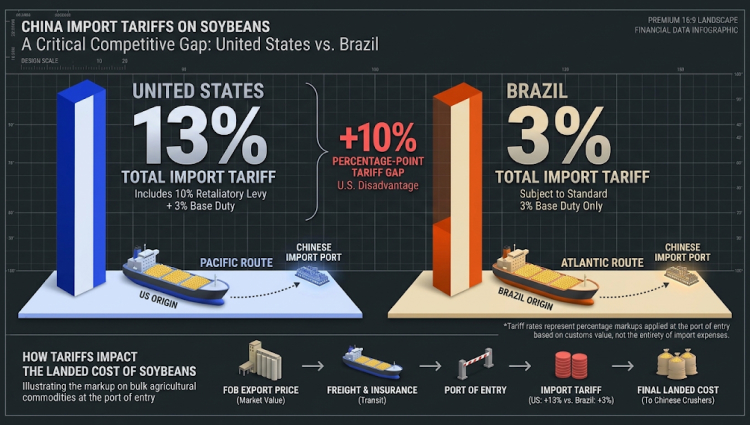
China’s decision to extend its tariff pause with the United States offers American agricultural exporters another two months of trade stability, but it does little to resolve one of the biggest problems facing U.S. soybean farmers. Beijing will continue suspending a 24% additional tariff on American imports while retaining a separate 10% additional duty. As a result, U.S. soybeans continue facing an estimated total Chinese import tariff of 13%, compared with just 3% for competing Brazilian supplies.
The decision, announced by China’s Customs Tariff Commission of the State Council on November 9, 2026, took effect at 1:01 p.m. Beijing time on November 10. The extension moves the current trade-truce deadline to January 10, 2027, giving Washington and Beijing additional time to negotiate broader agricultural and commercial arrangements.
For American soybean producers, however, the announcement delivers only partial relief. China has committed to purchasing at least 25 million metric tons of U.S. soybeans annually from 2026 through 2028, but the remaining tariff makes American shipments less attractive to private Chinese importers. State-owned enterprises have continued purchasing U.S. crops, yet the competitive gap with Brazil remains a concern for farmers across the Midwest and Mississippi River agricultural corridor.
The central question is whether the two governments can convert temporary tariff relief and purchasing commitments into a more durable trading arrangement before the January deadline.
China Extends the Trade Truce Until January 10, 2027
The latest extension follows months of negotiations between the United States and China over tariffs, agricultural purchases, and broader economic cooperation.
On November 9, China’s Customs Tariff Commission announced that it would continue suspending the additional 24% tariff imposed on U.S.-origin goods for another two months. The separate 10% additional tariff will remain in place.
The decision implements the latest understanding reached between U.S. President Donald Trump and Chinese President Xi Jinping. It also prevents the higher tariff rate from returning immediately as the previous suspension approached expiration on November 10.
The United States took a corresponding step. The Office of the U.S. Trade Representative extended 178 tariff exclusions covering Chinese imports through January 9, 2027. The two measures provide a temporary framework for continued trade while officials work toward a broader agreement.
Reuters reported on November 9 that the two governments had also discussed a reciprocal tariff-reduction package involving approximately $60 billion in trade. The proposed arrangement includes roughly $17 billion in American agricultural goods that China imported in 2024, although the broader package had not been finalized at the time of reporting.
U.S. Treasury Secretary Scott Bessent previously indicated that an additional two months would give the countries more time to explore economic cooperation.
For agricultural exporters, the extension reduces the immediate risk of another tariff escalation during an important part of the soybean marketing season. However, it does not eliminate the duties that continue to affect American agricultural products.
U.S. Soybeans Still Face a 10-Percentage-Point Tariff Disadvantage
The most important issue for American soybean producers is the difference between the tariffs applied to U.S. and Brazilian shipments.
According to tariff information reported by S&P Global and USDA Foreign Agricultural Service analysis, U.S. soybeans face an estimated total Chinese import duty of 13%, while Brazilian soybeans face the standard 3% most-favored-nation rate.
| Import origin | Estimated Chinese import tariff |
|---|---|
| United States | 13% |
| Brazil | 3% |
| Tariff difference | 10 percentage points |
The remaining 10% retaliatory duty is particularly important because it affects the commercial decisions of private Chinese importers.
Soybean purchases are highly sensitive to delivered prices. Importers compare the cost of the beans themselves, ocean freight, insurance, tariffs, handling, and processing margins. A higher import duty can make American supplies less competitive even when U.S. farmers offer attractive prices at export terminals.
Brazil benefits from its lower tariff treatment and its established position in China’s soybean supply network. Its production calendar also creates a seasonal advantage. Brazilian harvests generally enter international markets during the first half of the year, while U.S. producers supply a substantial portion of global export demand during the fall and winter.
That seasonal overlap matters because Chinese buyers can shift purchases between origins depending on price, availability, and trade policy.
The American Soybean Association has criticized the continued exclusion of soybeans from additional tariff relief. In a September 28 statement, ASA President Scott Metzger, an Ohio soybean farmer, said China’s annual purchase commitment provides important demand stability but argued that removing the remaining tariff would improve access for private Chinese buyers.
The distinction is significant: a purchase commitment from a government does not automatically make every American shipment commercially competitive.
China’s 25-Million-Ton Purchase Commitment Offers Support
Despite the tariff disadvantage, China remains one of the most important destinations for U.S. soybean exports.
Under the agreement associated with the October 30, 2025 meeting between Trump and Xi in Busan, South Korea, China committed to purchasing at least 25 million metric tons of American soybeans annually in 2026, 2027, and 2028.
The commitment provides a potential source of demand for U.S. producers during a period of uncertainty in international agricultural trade.
However, the purchasing arrangement should be evaluated alongside actual export activity.
USDA Foreign Agricultural Service data covering the marketing year through October 29, 2026, showed that China accounted for approximately 15.95 million metric tons in total U.S. soybean commitments. That figure combines accumulated exports and outstanding sales, rather than representing shipments already delivered.
The same data showed approximately 7.57 million metric tons in accumulated exports to China, with another 8.38 million metric tons in outstanding sales.
These figures indicate substantial Chinese buying activity during the opening months of the 2026/27 marketing year. Nevertheless, the marketing-year figures should not be treated as a direct measurement of fulfillment of the separate annual purchase commitment, which is expressed on a calendar-year basis.
The USDA data also demonstrate how important China has become to the current U.S. export program. Through October 29, China represented approximately 63% of accumulated U.S. soybean exports recorded in the United Soybean Export Council’s country breakdown.
The purchasing commitment therefore provides an important demand signal, but its long-term value will depend on actual shipments, delivery schedules, and whether Chinese buyers continue purchasing after the current trade arrangements expire.
Previous Trade Disputes Already Hurt U.S. Soybean Exports
The latest tariff extension comes after a difficult period for American soybean exporters.
During the 2025/26 marketing year, U.S. soybean exports declined 18.2% year over year, according to USDA data cited by S&P Global. Sales to China fell 45% to approximately 12.8 million metric tons.
The decline reflected the consequences of trade tensions and increased competition from South American suppliers.
China is the world’s largest soybean importer, purchasing the crop primarily for crushing into soybean meal and soybean oil. Soybean meal supports the country’s livestock and poultry feed industries, while soybean oil is used in food production and other applications.
Because of this demand structure, even relatively small changes in China’s purchasing patterns can influence global soybean prices.
When Chinese buyers reduce purchases from the United States, American exporters must find alternative destinations or compete more aggressively on price. That can increase pressure on Gulf export terminals, river transportation networks, and grain elevators that depend on strong international demand.
The consequences reach producers in states such as Iowa, Illinois, Minnesota, Indiana, and Ohio, where soybean production contributes significantly to farm revenue.
For these farmers, access to China is about more than diplomatic relations. It influences the number of potential buyers competing for their harvest and the prices exporters can offer at local elevators.
Brazilian Competition Remains a Major Challenge
Brazil’s growing role in China’s soybean market creates a structural challenge for American exporters.
Brazil has expanded its soybean production capacity over several years, supported by agricultural investment, improved logistics, and increasing planted acreage. Its exports benefit from a strong relationship with Chinese crushers and a lower tariff burden.
USDA’s October 2026 Oil Crops Outlook estimated U.S. soybean production for the 2026/27 marketing year at approximately 4.56 billion bushels, with an average yield forecast of 53.1 bushels per acre.
Meanwhile, the November 10 WASDE release was scheduled for noon Eastern Time, making it the next major official checkpoint for U.S. production, exports, and ending-stock estimates. Its figures should be assessed separately from the October projections.
For Brazil, the November market estimates available ahead of the report placed its 2025/26 soybean crop near 185.9 million metric tons. That production scale gives Brazilian exporters substantial flexibility when responding to Chinese demand.
The competitive difference is therefore not limited to tariffs. Freight rates, harvest timing, port capacity, currency movements, crop quality, and availability all influence which origin offers the most attractive delivered price.
Still, the 10-percentage-point tariff difference creates an additional obstacle for American sellers. Even when U.S. soybean prices are competitive at origin, the extra duty can reduce their attractiveness after arrival in China.
What the Tariff Extension Means for Midwest Farmers
The immediate benefit of the November decision is greater short-term certainty.
Without the extension, American exporters could have faced the return of the suspended 24% additional tariff, potentially making shipments significantly more expensive for Chinese buyers.

Maintaining the suspension gives exporters and importers additional time to arrange contracts, schedule vessels, and negotiate deliveries.
However, the remaining 10% duty means producers cannot assume that the trade relationship has returned to normal.
For farmers selling soybeans during the fall harvest period, the difference can influence local basis levels, export demand, and the availability of competing buyers.
The Mississippi River system is especially important to the U.S. soybean export network. Grain moves from producing states through river terminals toward Gulf export facilities, where shipments are loaded for international markets.
When China purchases large volumes of U.S. soybeans, exporters may compete more aggressively for supplies, supporting demand at inland elevators and river terminals.
When Chinese purchases weaken, exporters must redirect shipments toward other markets or adjust prices to remain competitive.
The situation also affects farm planning. Producers deciding how much acreage to allocate to soybeans in 2027 will consider input costs, crop rotation, expected prices, domestic crushing demand, and the reliability of international buyers.
A temporary trade extension helps reduce immediate uncertainty, but it does not provide the same confidence as a permanent agreement that removes the remaining tariff disadvantage.
Domestic Soybean Demand Could Reduce Export Dependence
The dispute with China also highlights the importance of expanding domestic markets for American soybeans.
Soybean crushing capacity has attracted substantial investment in the United States as companies respond to demand for soybean meal and vegetable oil. Renewable diesel and other biomass-based fuels have become important sources of potential demand for soybean oil.
The American Soybean Association has specifically emphasized the importance of maintaining and expanding domestic biofuel markets while pursuing improved access to China.
A stronger domestic crushing industry can provide another outlet for farmers when export demand weakens. It can also support regional investment in processing facilities, transportation infrastructure, and agricultural employment.
However, domestic demand cannot necessarily replace the volume of international trade represented by China. The country remains a major buyer, and changes in its purchasing patterns can influence global prices even when U.S. processors expand capacity.
For American producers, a diversified market strategy is therefore important. Maintaining access to China, expanding sales to other international destinations, and developing domestic processing demand can reduce dependence on any single market.
January 2027 Will Be the Next Major Trade Test
The November 9 extension has postponed another potential tariff confrontation, but the underlying disagreements remain unresolved.
The next important deadline is January 10, 2027, when China’s extended suspension is scheduled to expire. The United States and China will need to determine whether they can reach a broader arrangement before then or require another extension.
Agricultural organizations will be watching whether Beijing maintains its 25-million-metric-ton annual soybean purchase commitment and whether private Chinese importers receive better access to American supplies.
The USDA’s weekly export sales reports will provide an important measure of progress. Producers and traders should monitor new Chinese bookings, accumulated exports, outstanding sales, and changes in purchases from competing origins.
The American Soybean Association is also likely to remain involved in discussions over the remaining tariff. Its position is that purchasing commitments provide demand stability, but removing the additional duty would give American farmers a stronger commercial position.
For the U.S. soybean industry, the difference between a temporary pause and a lasting trade agreement is substantial. The extension protects existing opportunities for now, but it does not eliminate the cost advantage available to Brazilian competitors.
American Soybean Farmers Still Need a More Durable Trade Agreement
China’s decision to extend the tariff pause provides welcome breathing room for U.S. agricultural exporters during the 2026/27 soybean marketing year. The continuation of the 24% suspension reduces the risk of an immediate tariff escalation and gives both governments more time to negotiate.
However, the remaining 10% additional duty continues to place American soybeans at a disadvantage against Brazilian supplies. With estimated Chinese import tariffs of 13% on U.S. beans and 3% on Brazilian beans, American producers still face a meaningful obstacle in one of their most important export markets.
China’s commitment to purchase at least 25 million metric tons of U.S. soybeans annually through 2028 offers a significant source of potential demand. The latest USDA export figures show that Chinese buying has already become a major component of the current marketing year’s export program.
The next challenge is turning those commitments into sustained commercial shipments under conditions that allow American farmers to compete on more equal terms.
For producers across the Midwest, the January 2027 deadline will be more than another diplomatic milestone. It will help determine whether the current trade truce becomes a stronger agricultural partnership or another temporary pause in a continuing struggle over market access.