Sunlight is the main fuel for a good harvest. This natural power, called photosynthesis in crops, turns sunlight into energy for plants. Plants use this energy to grow.
- Solar energy conversion creates glucose for plant structure development.
- Efficient metabolic processes directly boost final harvest weights.
Plants make glucose from sunlight, carbon dioxide, and water. This sugar is key for building roots, stems, and leaves.
Understanding plant growth science helps farmers get more from their fields. Modern farming focuses on improving these natural processes.
Technology, like the digital revolution, helps track these processes. It makes farming more precise, increasing food security and harvests.
Plants also release oxygen, storing energy that affects the harvest weight. Making this energy conversion more efficient is key. Using advanced techniques helps plants grow their best.
Factors that limit efficiency
Knowing what limits photosynthetic efficiency is key to boosting crop yields. Photosynthesis is a complex process. It’s influenced by many environmental and internal factors.
The efficiency of photosynthesis is vital for crop development. It’s affected by several key elements. These include environmental factors that directly impact plant growth science and production.
Environmental Factors Affecting Photosynthesis
Environmental elements like light intensity, temperature, carbon dioxide concentration, and water availability are very important. They play a big role in determining photosynthetic efficiency.
Light Intensity and Temperature
Light intensity and temperature are critical. For example, high temperatures can lead to the formation of toxic compounds through photorespiration. This reduces photosynthetic efficiency.
The impact of these factors can be summarized as follows:
- Light intensity affects the rate of photosynthesis, with both too little and too much light being detrimental.
- Temperature influences the rate of chemical reactions in photosynthesis, with optimal temperatures varying by crop.
- Carbon dioxide concentration is a limiting factor, as increased CO2 can enhance photosynthesis up to a point.
- Water availability is critical, as drought stress can significantly reduce photosynthetic efficiency.
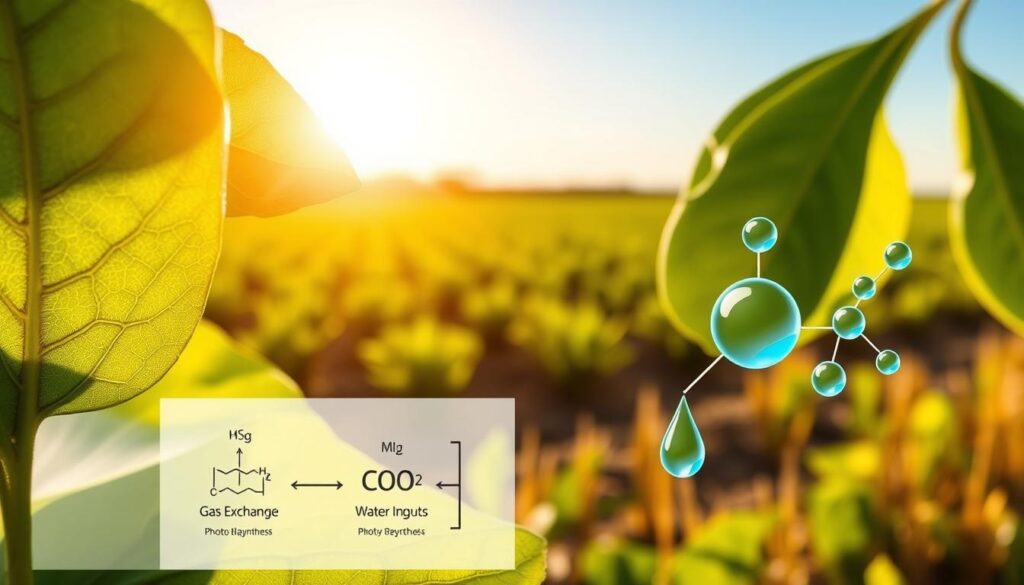
By understanding these factors, farmers and researchers can develop strategies to optimize photosynthetic efficiency. This can help improve crop yields.
Canopy management and sunlight capture
Effective canopy management is key to better sunlight capture and photosynthesis. By adjusting the leaf structure and arrangement, farmers can improve light distribution. This reduces shading and boosts photosynthetic performance.
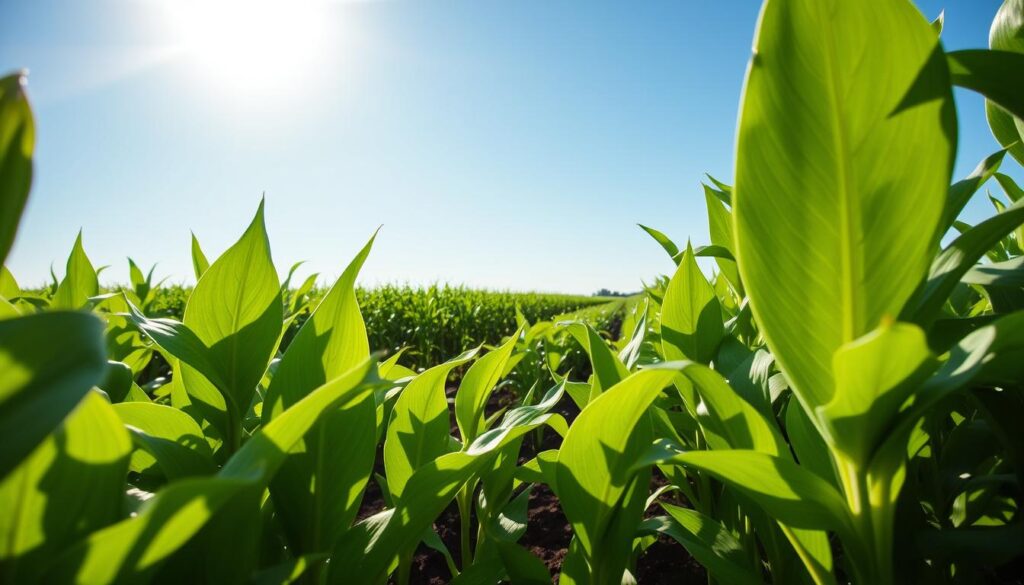
Optimizing light capture for improved photosynthesis
Research has led to new ways to capture light better. Scientists are looking into changing chlorophyll concentration and chloroplast arrangement in leaves. This aims to increase light absorption.
Pruning and training plants can create a more efficient canopy. This allows more light to reach the leaves. As a result, photosynthesis in crops improves, leading to better crop development.
- Improving leaf arrangement to reduce shading
- Enhancing chlorophyll concentration for better light absorption
- Optimizing chloroplast arrangement within leaf cells
These strategies can help farmers increase crop yields and improve agricultural productivity. Effective canopy management is essential in modern farming. It helps maximize photosynthetic efficiency and supports healthy crop development.
Water and nutrient interactions
Water and nutrients are key to understanding photosynthesis in farms. Photosynthesis turns light into chemical energy. It depends on water and nutrient levels.
Enough water is vital for photosynthetic rates. Drought harms photosynthesis, slowing plant growth. Nutrients like nitrogen, phosphorus, and potassium also affect photosynthesis in crops.
Impact on Photosynthetic Efficiency
Water and nutrients greatly affect photosynthesis. For example, soil water limits photosynthesis when it’s warm enough for plants to grow. Photosynthesis makes carbohydrates, essential for plant cells, using chlorophyll and sunlight.
- Nutrient deficiencies can limit photosynthetic capacity.
- Adequate water supply is critical for optimal photosynthetic rates.
- The balance between water and nutrients impacts plant health and productivity.
Knowing how water and nutrients interact helps in better irrigation and fertilization. By managing these, farmers can boost photosynthetic efficiency and increase yields. For more details, check out scientific research journals.
Good water and nutrient management boosts photosynthesis and supports sustainable farming. By using water and nutrients wisely, farmers can lower their environmental impact. This helps keep or raise crop productivity.
Practical takeaways for farmers
The world’s population is growing fast, making it urgent to boost crop yields. To meet the food demand by 2050, we need to increase crop production by 25 to 70 percent. Making crops more efficient at photosynthesis is key to this goal.
Enhancing crop productivity
Farmers can take steps to make crops more photosynthetic. They should focus on better irrigation and fertilization. Also, managing the canopy well can help a lot.
Choosing crop varieties that photosynthesize better is another strategy. By doing these things, farmers can increase yields. This helps ensure everyone has enough food and supports sustainable farming.