Remote water monitoring has moved from a niche ranch technology to a more practical tool for beef operations that manage scattered tanks, troughs, pumps, wells and pipelines across large rangeland areas. The main value is straightforward: ranchers can receive water-level and equipment-status information without driving to every water point as often. That matters most in dry regions, where a missed leak, failed pump or empty trough can quickly affect animal welfare and grazing plans.
The recent data points are meaningful, but they should be read with care. Some deployments are already large. On June 22, 2026, a new IoT and remote sensing system using Decentlab sensors was reported across 12 ranches in four U.S. states, covering more than 500,000 acres of arid rangeland. The deployment included 931 cattle tracking collars, 19 water-level sensors, seven rain gauges and 27 LoRaWAN gateways. The same project had processed 130.4 million collar data packets, 2.9 million water-level measurements and 810,000 rain gauge readings. Those figures show scale, but they do not by themselves prove every ranch can achieve the same return on investment.
Drought pressure is one reason the discussion has become more urgent. As of August 6, 2026, reported drought data showed 48.54% of the United States experiencing some form of drought, with 9.51% in extreme or exceptional drought. For beef ranchers, drought is not only a forage problem. It is also a water distribution problem that affects pasture use, travel time, pumping costs and risk management.
Why Remote Water Monitoring Is Gaining Ground
Remote Water Monitoring And Ranch Labor
The labor case for remote water monitoring is one of the strongest supported points in the available public material. The USDA Natural Resources Conservation Service stated in a May 2025 fact sheet that livestock water monitoring systems using cellular or satellite networks can reduce labor and energy costs by avoiding unnecessary travel to check tanks and troughs, while improving detection of leaks or water-level problems USDA NRCS water systems. That does not mean ranch visits disappear. It means the reason for a trip can become more targeted.
In many cow-calf systems, water checks are routine and non-negotiable. Yet the distance between pastures, the condition of ranch roads and the season can make those checks costly. A rancher may still need to inspect a pump, clean a trough or confirm a sensor reading, but a dashboard or alert can help sort high-priority stops from normal conditions. This can be especially useful where water points sit far from headquarters or where crews already face pressure from fence work, animal health tasks and grazing moves.
Drought Turns Small Failures Into Larger Risks
Water infrastructure failures are rarely convenient, but dry weather raises the stakes. Research notes from July 25, 2026, described ranchers in parts of the Rockies driving hundreds of miles and spending hours hauling water and checking infrastructure amid record low snowpacks and dry springs. Those conditions make automated tank, pump and rainfall readings more than a convenience. They provide earlier warning when a water source is falling faster than expected.
The practical question is not whether a sensor is useful in theory. It is whether the information arrives soon enough, is reliable enough and fits the ranch’s decision process. A low-water alert that reaches a ranch manager in time to redirect a crew has clear value. A sensor that loses connectivity, sends confusing readings or is hard to maintain may add another task rather than reduce work.
What The Technology Measures
From Tank Levels To Animal Movement
Current systems vary, but the research points to several common elements: water-level sensors, rain gauges, GPS collars, satellite-connected devices, cellular connections, LoRaWAN gateways, trough sensors, cameras and pump or controller integrations. Some systems focus narrowly on tank and trough levels. Others connect water status with cattle movement and rainfall patterns, giving ranchers a broader view of how animals use a pasture.
On August 11, 2026, Ranchbot was reported to have raised $15 million in Series B funding to expand satellite-connected sensors, trough sensors and camera/sensor integrations. Funding alone does not confirm market success, but it does suggest investor interest in tools that address water risk across remote grazing operations. The need is visible in large operations as well. Research notes identified Bar T Bar near Winslow, Arizona, as a 300,000-acre cattle ranch with more than 1,200 head of cattle that had deployed a satellite-IoT water-monitoring and control solution for tanks, pumps and controllers.
Behavior Data Is Improving, But Context Matters
The cattle behavior side is also advancing. A systematic review published in April 2026 in Computers and Electronics in Agriculture found that advanced vision-based systems using DeepLabCut and LSTM models achieved up to 98.25% accuracy in detecting beef cattle drinking behavior. RFID and accelerometer technologies also achieved over 94% accuracy in drinking event detection. These results are technically promising, but ranch use depends on cost, placement, connectivity, power supply and how easily the data can be interpreted.
Water intake and drinking behavior can help flag changes in herd activity, but they should not be treated as a stand-alone diagnosis. Weather, forage location, pasture layout, social behavior and source reliability can all influence when cattle drink. Ranchers and veterinarians still need field judgment when interpreting animal behavior data.
Evidence From Precision Ranching Trials
USDA-Supported Field Testing
The Southwestern Beef Coordinated Agriculture Project, a USDA-NIFA-funded effort, has been testing precision ranching systems that include ultrasonic water-level sensors, GPS collars, smart rain gauges and virtual fencing. USDA Climate Hubs material described installation on five participating cow-calf ranches and said a market-ready product was expected by 2026 USDA precision ranching. As of August 24, 2026, the research notes did not confirm whether that market-ready product had been released, so it is better to describe the project as a field-tested pathway rather than a confirmed commercial outcome.
This type of work is useful because ranch conditions differ from controlled research settings. A sensor package that works on one ranch may face different signal strength, dust, ice, wildlife interference, terrain or equipment compatibility elsewhere. Field trials help identify what works across real operating conditions, not only in short demonstrations.
Data management is becoming part of the same discussion. Ranchers considering these systems are not only buying devices; they are deciding how much operational data they want to collect, store and act on. That connects with broader precision agriculture data questions covered in Agheiro’s reporting on the USDA precision agriculture data initiative.
Visual Records Still Have A Place
Sensor data is useful, but photos, field notes and maps still help explain what numbers mean on the ground. A sudden water-level drop may be a leak, heavy cattle use, pump failure or measurement error. Ranch teams often need visual records to confirm the cause. For readers interested in visual documentation and field record culture beyond agriculture, a companion site in the same network offers The Sketchbook Project, emphasizing the ongoing value of observed records alongside digital systems.
Adoption Limits And Practical Tradeoffs
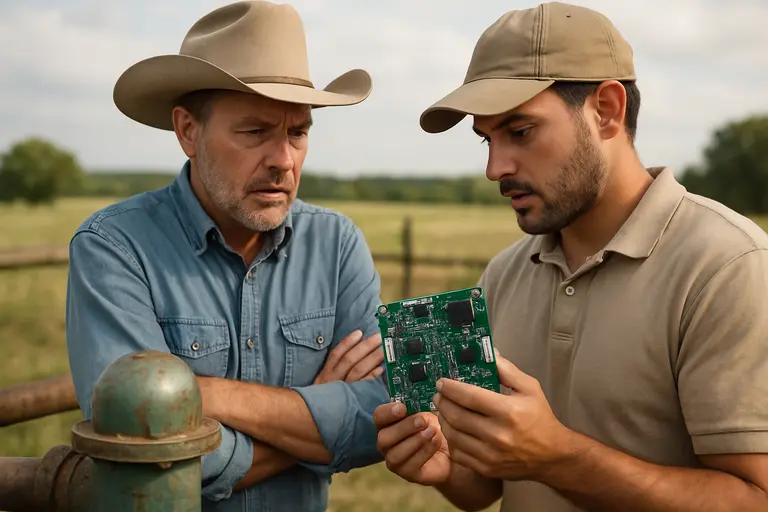
Adoption Remains Modest
The adoption story is more cautious than the technology headlines. A Choices Magazine article from Q2 2025-2026 on precision livestock farming in beef cattle production reported adoption rates of about 11.8% for daily water monitoring and about 11.8% for forage quantity and quality monitoring among the surveyed precision livestock technologies. That suggests many ranchers still see barriers, even where the use case is clear.
Those barriers may include purchase cost, subscription fees, maintenance, signal coverage, battery or solar performance, staff training and uncertainty about whether the system will pay for itself. The strongest candidates are likely operations where water points are widely dispersed, labor is tight, drought risk is high or travel costs are substantial. Smaller or more compact ranches may still benefit, but the cost calculation can be different.
- Check whether cellular, satellite or LoRaWAN coverage fits the ranch’s terrain.
- Compare sensor costs with current labor, fuel and vehicle wear from water checks.
- Plan how alerts will be handled during weekends, storms and crew shortages.
- Confirm who maintains batteries, solar panels, mounts and calibration.
- Keep manual inspection routines for animal welfare and infrastructure verification.
Data Should Support, Not Replace, Ranch Judgment
Water sensors can improve awareness, but they do not replace stockmanship. Ranchers still need to judge pasture condition, animal distribution, body condition, heat stress and equipment reliability. The best use of monitoring data is often as an early warning system that helps people act faster and avoid wasted trips.
There is also a sustainability angle, though it should not be overstated. Better water visibility may reduce unnecessary driving, help detect leaks and support more planned grazing decisions. Those outcomes depend on how the system is installed and used. A poorly matched system can create false confidence or extra work.
Remote Water Monitoring In Beef Ranching
As of August 24, 2026, remote water monitoring was best understood as a practical precision ranching tool with growing evidence, larger deployments and still-limited adoption. The technology has shown value in tracking water levels, supporting drought response and linking water availability with animal movement. The scale of recent deployments and the rise of satellite-connected systems show that the category is maturing.
The most realistic view is neither hype nor dismissal. For beef ranchers managing large, dry or labor-constrained operations, water sensors can reduce uncertainty and help direct fieldwork. For other operations, the economics may need closer review before purchase. The next test is not whether the devices can collect data; that is already clear. The test is whether ranchers can turn that data into timely, reliable decisions that protect cattle, conserve water and make daily work more efficient.