U.S. farmers are entering the 2026 harvest season with diesel costs adding another layer of pressure to already strained production budgets. The national average retail price for on-highway diesel reached $5.652 per gallon for the week of August 24, according to the U.S. Energy Information Administration, up from $5.134 on July 20. In the Midwest, where much of the country’s corn and soybean production is concentrated, the average reached $5.636 per gallon on August 24.
The timing matters. Harvest is among the most fuel-intensive periods of the agricultural year because combines, tractors, grain carts, trucks and other equipment operate for extended hours. Farmers who paid more for fuel during spring planting are now facing another period of heavy consumption just as fertilizer and other input costs remain elevated.
Recent analysis from the University of Illinois’ farmdoc program found that both diesel and fertilizer prices heading into fall 2026 were higher than in the previous two years. The combination creates a difficult margin environment for producers who must harvest the crop before they can fully benefit from any improvement in commodity prices.
For U.S. agriculture, the issue is no longer simply the price displayed at a diesel pump. Fuel costs are becoming a broader question of harvest economics, transportation expenses, crop profitability and farm cash flow.
Diesel Prices Reach A Critical Harvest Point
The latest EIA figures show how quickly diesel costs have moved higher.
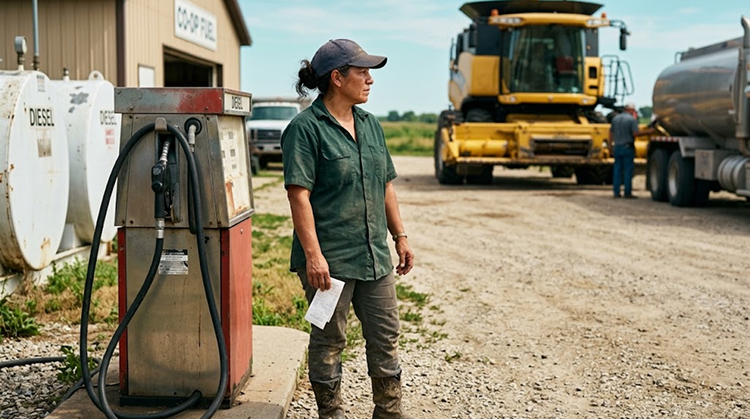
On July 20, the national average stood at $5.134 per gallon. By August 24, it had reached $5.652, an increase of about 52 cents per gallon in five weeks. The Midwest followed a similar trajectory, rising from $4.988 per gallon on July 20 to $5.636 on August 24.
| Location | July 20, 2026 | August 24, 2026 | Change |
|---|---|---|---|
| U.S. average | $5.134/gal. | $5.652/gal. | +$0.518 |
| Midwest | $4.988/gal. | $5.636/gal. | +$0.648 |
| East Coast | $5.194/gal. | $5.498/gal. | +$0.304 |
These averages include taxes and represent retail on-highway diesel prices. Farm operations can face different effective costs depending on whether producers purchase fuel in bulk, use off-road diesel or have existing contracts with suppliers.
Even so, the direction of the market is clear.
The increase comes immediately before the period when farmers need to move large quantities of fuel from storage facilities into combines, tractors and trucks. That makes the August price level particularly consequential.
A producer who purchased fuel earlier in the year may be partially insulated. Another farmer who needs to replenish a bulk tank repeatedly during harvest could face substantially higher operating expenses.
Recent reporting from the farm sector illustrates the difference. Jed Bower, an Ohio corn and soybean farmer who serves as president of the National Corn Growers Association, said his operation could spend an additional $20,000 to $25,000 on diesel this year compared with prices at the beginning of 2026.
That kind of increase cannot easily be absorbed when grain margins are already under pressure.
The Midwest Faces A Particularly Sharp Increase
The Midwest is one of the most important regions to watch because it combines enormous agricultural fuel demand with some of the country’s largest corn and soybean production areas.
EIA data show Midwest on-highway diesel at $5.636 per gallon on August 24, approximately 39 cents higher than the national average. More importantly, the Midwest price had risen by nearly 65 cents per gallon since July 20.
For farmers purchasing hundreds or thousands of gallons, relatively small changes in the per-gallon price can become significant operating expenses.
A hypothetical 10,000-gallon harvest requirement illustrates the sensitivity. At $4.99 per gallon, that volume would cost approximately $49,900. At $5.64, it would cost about $56,400 — a difference of roughly $6,500.
Actual farm consumption varies substantially by crop, equipment, acreage, soil conditions, field size and transportation distance, so this is not a universal farm cost estimate. It does demonstrate why fuel-price movements matter when applied to large volumes.
Illinois is particularly exposed because of its enormous row-crop footprint. An August analysis reported that Midwest on-highway diesel averaged $5.26 per gallon during the week of August 3, compared with $3.79 during the same week a year earlier. The same analysis estimated that U.S. farmers spent about $1.4 billion more on diesel during the 2026 planting season than during the previous year’s planting period.
The fact that fuel prices remain elevated after planting means the financial pressure has not disappeared with the completion of spring fieldwork.
Global Supply Disruptions Are Driving The Fuel Problem
The current diesel market is being influenced by factors well beyond U.S. farm country.
Reuters reported that the U.S. diesel crack spread — the difference between the value of refined diesel and crude oil — exceeded $100 per barrel for the first time, reaching $102.20. The publication attributed the extraordinary refining margin to global supply disruptions involving the Middle East and Russia, while U.S. distillate inventories were at their lowest August level since 1996.
The significance for farmers is straightforward: agricultural demand is arriving at a time when the broader diesel market is already tight.
The situation also illustrates why domestic crude production does not automatically guarantee low diesel prices. Crude oil must be transported and refined, and diesel supply depends on refinery capacity, international trade flows, inventories and demand.
Recent disruptions involving refineries and shipping routes have therefore affected the cost of refined products even as the U.S. continues producing crude oil.
Reuters reported on August 10 that U.S. ultra-low sulfur diesel futures jumped 7.4% in one day, while global refining margins also increased sharply.
For agriculture, this creates an exposure that is difficult to control at the farm level.
A producer can improve equipment efficiency, reduce unnecessary trips or purchase fuel strategically. A farmer cannot control international refinery outages or geopolitical disruptions that affect global diesel availability.
Fuel And Fertilizer Costs Are Hitting Farm Budgets Together
Diesel is not the only input putting pressure on producers.
The University of Illinois farmdoc analysis published August 11 found that fertilizer and fuel prices were both higher heading into fall 2026 than in the previous two years. The researchers included Nick Paulson, Gary Schnitkey, Ryan Batts, Bradley Zwilling and Carl Zulauf in the analysis.
That combination matters because the two costs affect different stages of production.
Fertilizer expenses are concentrated heavily around planting and nutrient applications, while diesel consumption rises again during harvest. Farmers therefore have exposure to elevated input prices at multiple points during the crop cycle.
The result is a compounding effect on working capital.
| Farm Cost | Primary 2026 Pressure | Timing Of Exposure |
|---|---|---|
| Diesel | Higher fuel prices and tight inventories | Planting, spraying, harvest and transportation |
| Fertilizer | Elevated global input costs | Preplant and growing season |
| Machinery | Higher operating costs | Throughout production cycle |
| Grain transportation | Higher fuel component | Harvest and post-harvest |
| Grain drying | Energy-dependent operation | Especially after high-moisture harvests |
A farm operation that was already operating on a narrow expected margin may have less flexibility when both fuel and fertilizer costs rise.
That is why current diesel prices are becoming an agricultural-market story rather than simply an energy-market story.
Harvest Is The Most Fuel-Intensive Farm Operation
Fuel demand is particularly important during harvest because the machinery involved is both large and highly productive.
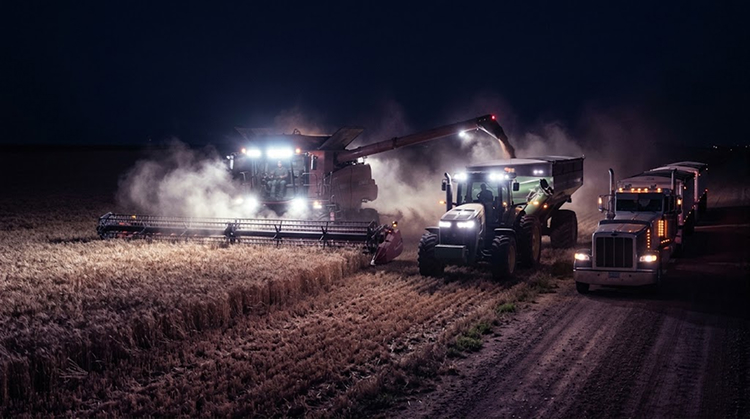
A typical grain operation can require diesel for combines, tractors pulling grain carts, semis or farm trucks transporting harvested crops, grain dryers and other equipment. When harvest conditions are favorable, producers may operate machinery for long stretches to take advantage of limited weather windows.
The University of Missouri has noted that harvest is generally the most fuel-intensive farm operation, with activity extending through November in many areas of the country.
That creates an unusual economic situation.
Farmers cannot simply reduce fuel consumption in proportion to higher prices without potentially reducing their ability to harvest the crop efficiently. A combine sitting idle because diesel is expensive does not necessarily save money if a subsequent rain event damages crop quality or delays fieldwork.
Fuel is therefore a necessary variable cost, not an optional expense.
This is particularly important for corn and soybean producers. Corn harvest often involves substantial grain movement from field to farm storage or elevators, while soybeans can require similarly intensive combine and transportation operations. Wheat, cotton, rice and other crops also have their own machinery and transportation requirements.
For producers planning around agricultural markets, the important calculation is not simply whether diesel is expensive. It is how the additional cost compares with expected crop revenue.
Higher Fuel Costs Can Reach Grain Transportation
The farm’s diesel bill is only the first layer.
Once grain leaves the field, it may be transported by farm trucks, commercial carriers, rail or barge. Every additional movement can create fuel-related costs.
A corn producer harvesting into on-farm storage may have relatively limited immediate transportation exposure. Another producer hauling grain directly to an elevator 30 or 50 miles away faces more fuel consumption per bushel.
The same principle applies to livestock and feed markets.
Higher transportation costs can influence the cost of moving feed ingredients, fertilizer, agricultural chemicals, machinery parts and finished products. In areas where trucking plays a major role in moving crops, diesel prices can therefore spread beyond individual farm operations.
Axios reported that diesel’s importance extends well beyond agriculture because it is a major input for trucking and food distribution as well. The publication noted that rising diesel prices are increasing operating expenses across the transportation economy.
This creates a potential feedback loop: higher farm fuel costs raise production expenses, while higher freight costs raise the expense of moving agricultural commodities.
Farmers Are Using Different Strategies To Manage Fuel Risk
Farmers do have tools available to reduce exposure, although none completely eliminates the risk.
Some producers buy fuel in advance when prices appear favorable. Others use bulk storage to reduce reliance on retail purchases during periods of peak demand. Larger operations may negotiate contracts with suppliers, while smaller farms may have less purchasing power.
Recent agricultural reporting highlighted farmers who purchased supplies earlier in the year to avoid the latest price increases. That strategy can work when producers have adequate storage and cash flow, but it also introduces another risk: buying too much fuel before prices fall.
The decision is therefore similar to other farm commodity-management choices.
Buying fuel early provides price certainty but sacrifices potential savings if the market declines. Waiting provides flexibility but exposes the farm to further increases.
The correct approach depends on expected fuel consumption, storage capacity, cash position, supplier relationships and the producer’s tolerance for price volatility.
Higher Diesel Costs Could Change Harvest Decisions
The effect of expensive diesel may become more visible as farmers make harvest-management decisions.
For some operations, fuel prices could encourage more careful planning of field routes, equipment utilization and transportation schedules. Combining field operations where practical can reduce unnecessary machinery hours.
However, efficiency has limits.
Harvest timing is controlled partly by crop maturity, moisture, weather and available labor. A farmer cannot indefinitely delay harvest simply because fuel is expensive. Corn that remains in the field too long can face risks from lodging, storms, wildlife and quality deterioration. Soybeans can also suffer losses when harvest is delayed under unfavorable conditions.
This creates an important distinction between reducing fuel waste and reducing fuel use at the expense of crop value.
The first can improve profitability. The second may create a larger loss elsewhere.
That is why high diesel prices are especially challenging during harvest: the fuel is being used precisely when farmers have the greatest incentive to complete fieldwork efficiently.
Crop Prices Will Determine How Much Farmers Can Absorb
Fuel prices do not operate in isolation from commodity prices.
If corn, soybeans or wheat prices rise enough to offset higher production expenses, farmers may absorb additional diesel costs without a major deterioration in profitability.
If crop prices remain weak while fuel and fertilizer rise, the impact becomes much more severe.
This is where current agricultural markets become important. Producers are not simply comparing today’s diesel price with last year’s diesel price. They are comparing total expected production costs against expected revenue per acre.
The difference can determine whether an operation generates a positive margin, breaks even or loses money.
Recent reporting has described the current U.S. grain-farming environment as particularly difficult because high input costs are occurring alongside weak crop margins and trade uncertainty. The Financial Times reported that Corn Belt producers are facing severe financial pressure as diesel and fertilizer costs rise.
That makes harvest fuel efficiency an increasingly important component of farm management.
The Harvest Fuel Market Could Remain Volatile
The immediate question is whether diesel prices will remain elevated through the peak harvest period.
Recent market indicators suggest that uncertainty remains high. Reuters reported that U.S. distillate inventories were roughly 13% below the five-year average in recent reporting, while global refinery disruptions were restricting available supply.
That does not guarantee that diesel prices will continue rising.
Markets can change quickly if refinery operations recover, international supply routes stabilize or demand weakens. Conversely, additional disruptions could push prices higher.
For farmers, that uncertainty is itself a cost-management challenge.
A producer planning a harvest that extends from September into November cannot know exactly what diesel will cost every week. The best available strategy is therefore a combination of budgeting, purchasing discipline, equipment efficiency and careful monitoring of local fuel markets.
Fuel Costs Are Becoming A Bigger Part Of The 2026 Farm Equation
The 2026 harvest is approaching under a different energy environment from the one farmers faced a year ago.
The national diesel average reached $5.652 per gallon on August 24, while the Midwest reached $5.636. At the same time, agricultural economists have identified higher fertilizer and fuel prices as important pressures heading into the fall harvest.
The numbers matter because farmers cannot postpone harvest indefinitely, and diesel is deeply embedded in the process of turning a standing crop into a marketable commodity.
The most exposed operations will likely be those with large fuel requirements, long transportation distances, high grain-drying needs or limited ability to lock in fuel purchases ahead of time. Producers who already secured supplies earlier in the year may have more protection from the latest price increases.
But the broader market remains connected.
Diesel affects machinery. Machinery affects harvest costs. Harvest costs affect farm margins. Transportation costs affect elevators, processors and exporters. And all of those costs ultimately interact with commodity prices.
For U.S. agriculture, the approaching harvest will therefore provide a real-world test of how much higher energy costs can be absorbed before they begin changing planting decisions, marketing strategies and farm profitability.
The critical issue is not simply whether diesel remains above $5 per gallon. It is whether the combination of fuel, fertilizer, machinery, transportation and crop prices leaves producers enough margin to justify the next production cycle.
That calculation will become clearer as combines enter fields across the Midwest and other major agricultural regions this fall.