A reporting error in a U.S. Department of Agriculture beef export report has placed new attention on the accuracy of federal agricultural statistics at a time when farmers, commodity traders, exporters, lenders and policymakers are relying heavily on official data to make decisions. In July 2026, USDA initially reported a nearly 500% increase in beef export sales before revising the figure downward by about 90%. The agency characterized the mistake as an isolated processing issue, but the episode has prompted questions in Congress about data quality, staffing and the reliability of USDA’s reporting infrastructure.
On August 20, 2026, six Democratic senators led by Sen. Amy Klobuchar of Minnesota asked USDA for additional information about the reporting error and the department’s staffing changes. Their questions extend beyond one incorrect number: agricultural statistics influence commodity markets, trade policy, farm financing, insurance decisions and federal programs, making accuracy a core part of the country’s agricultural infrastructure.
The controversy arrives as USDA continues publishing large volumes of crop, livestock and trade information. Its National Agricultural Statistics Service, Foreign Agricultural Service and Economic Research Service collectively provide data that markets use to estimate supply, demand, exports, production and prices. The incident therefore raises a broader issue for U.S. agriculture: how much confidence should producers and markets place in individual government data releases when a single reporting mistake can alter the interpretation of market conditions?
Why One Reporting Error Matters To Agricultural Markets
Agricultural markets react quickly to information because commodities are traded on expectations about future supply and demand. A sharp change in reported export sales can alter assumptions about foreign demand, domestic inventories and the pace at which U.S. supplies are moving into international markets.

That is particularly important for livestock.
USDA’s Economic Research Service maintains monthly and annual international trade data covering live cattle, beef and veal, hogs, pork, poultry and other animal products. Its current livestock trade database was updated on August 17, 2026, and incorporates official U.S. Census trade statistics.
The distinction between an initial estimate and a corrected figure is therefore more than an administrative detail. Export data can influence decisions by feedlots, meat processors, exporters, traders and livestock producers.
For example, an apparent surge in foreign beef demand could encourage market participants to anticipate stronger processor demand or tighter domestic availability. If that increase later proves to be a processing error, those expectations can reverse.
The issue becomes even more significant when agricultural markets are already dealing with tight supplies, elevated prices and uncertainty over trade relationships.
USDA’s current cattle outlook illustrates that environment. The agency’s August 19 market outlook projects 2026 U.S. beef production at 24.967 billion pounds, down from the previous month’s forecast because of expectations for a slower cattle slaughter pace during the second half of the year. USDA also raised projected beef imports for 2026 and 2027 while moderately increasing its 2026 export projection.
When supply conditions are this closely watched, reliable data becomes a market asset.
The Beef Export Error Came At A Sensitive Time
The USDA reporting problem emerged as American cattle markets were already navigating historically constrained supplies.
According to Reuters, USDA initially reported an almost 500% increase in beef export sales in July before correcting the figure downward by approximately 90%. USDA attributed the discrepancy to an isolated processing issue.
The correction does not mean that all USDA agricultural statistics are unreliable. The agency operates multiple statistical systems with different collection procedures, validation methods and review processes.
But the incident demonstrates how an error can become significant before it is corrected.
Weekly export reports are designed to provide timely information. USDA’s Foreign Agricultural Service publishes weekly export sales data covering commodities including corn, soybeans, wheat, cotton, beef and pork. The latest report available on August 20 was scheduled for another release on August 27.
The speed of that reporting cycle creates a trade-off.
Markets want information quickly, but rapid processing leaves less time to identify every potential discrepancy before publication. The challenge for USDA is therefore not simply producing more data. It is maintaining a system capable of processing information rapidly while applying enough quality controls to identify unusual results.
That balance becomes especially important during periods of major market volatility.
USDA Statistics Influence More Than Commodity Prices
The importance of agricultural statistics extends far beyond futures exchanges.
USDA’s National Agricultural Statistics Service explains that crop acreage, production and stocks information is used by producers, financial institutions, insurance companies, farm organizations, agribusinesses, government agencies and commodity buyers. The data also supports federal programs involving acreage, production potential, prices and farm income.
That means an inaccurate number can potentially affect decisions at several levels.
A farmer might use USDA production estimates when evaluating whether to sell grain immediately or store it. A lender could use agricultural market information when assessing farm repayment capacity. An insurance company may depend on official production statistics when evaluating regional conditions. Exporters use supply and demand information to plan international sales.
The result is a statistical chain that connects Washington, D.C., with farms across the country.
Agheiro’s coverage of agricultural markets can therefore treat USDA data as infrastructure rather than simply another source of news. The reliability of those numbers helps determine how participants understand the market itself.
USDA Uses Multiple Layers Of Agricultural Data
USDA’s crop statistics are not produced from a single spreadsheet or one source.
NASS uses probability surveys, administrative information, objective yield measurements and other data sources to construct estimates. Its crop methodology explains that agricultural estimates are reviewed for consistency with historical information, weather patterns and crop progress before publication. Regional field offices provide state-level estimates and analysis, while the Agricultural Statistics Board conducts national review and reconciliation.
For the 2025 crop year, for example, USDA’s December Agricultural Survey sampled approximately 73,100 farm operators. Responses were collected through mail, internet, telephone and personal interviews and used alongside objective yield information and administrative data.
This multilayered system is designed precisely because agricultural production cannot be measured perfectly from one source.
The methodology also acknowledges that surveys can contain both sampling and non-sampling errors. Non-sampling problems can include omission, duplication, imputation for missing information and mistakes in reporting, recording or processing. USDA says quality controls and reviews are used to minimize those risks.
The recent beef export incident fits into that broader reality.
The important question is not whether agricultural statistics can contain errors. USDA itself acknowledges that possibility. The more important question is whether errors are identified quickly, corrected transparently and prevented from recurring.
The Corn Acreage Revision Adds Another Layer Of Concern
The beef export mistake is also being viewed alongside other recent USDA data controversies.
Reuters reported that senators questioning USDA cited previous problems involving agricultural reports, including a major revision to corn acreage data. The lawmakers also asked about staffing changes and whether reductions in personnel could affect the department’s ability to produce accurate statistics.
Corn acreage is particularly sensitive because acreage estimates feed directly into production forecasts.
A relatively small change in planted or harvested acreage can alter expectations for total crop production when multiplied across millions of acres. That can subsequently affect estimates of ending stocks, exports, feed demand and prices.
This is where agricultural data becomes interconnected.
| USDA Data Area | Market Participants Watching It | Potential Impact |
|---|---|---|
| Crop acreage | Farmers, grain traders, lenders | Production and supply expectations |
| Yield estimates | Farmers, processors, commodity markets | Harvest forecasts and prices |
| Export sales | Exporters, traders, producers | Foreign demand expectations |
| Cattle inventories | Ranchers, feedlots, processors | Beef supply and livestock prices |
| Beef exports | Meat companies, traders, ranchers | International demand and domestic availability |
| Grain stocks | Farmers, elevators, feed users | Supply and storage decisions |
The more widely a statistic is used, the greater the potential consequence when it changes.
Staffing Questions Add A Human Resource Dimension
The Senate inquiry also focuses attention on USDA staffing.
The six senators asked the department to explain staffing changes and whether reductions could have contributed to recent data problems. Reuters reported that the questions were linked to concerns about the reliability of USDA statistics and the potential effect of workforce reductions on agricultural reporting.
Determining whether staffing changes caused the beef export mistake would require additional information from USDA. The department has described the incident as an isolated processing issue, and that explanation should not automatically be expanded into a broader conclusion about the entire statistical system.
Still, staffing matters because agricultural statistics require specialized knowledge.
Data collection is only one part of the process. Staff must also validate unusual results, reconcile information from different sources, investigate inconsistencies and communicate revisions.
That becomes increasingly difficult as agricultural data systems become more complex.
Modern USDA reporting involves enormous quantities of information from producers, field offices, customs records, surveys, administrative databases and international trade channels. The sophistication of the system creates opportunities for more detailed analysis, but it also increases the number of points where processing errors can occur.
Digital Agriculture Makes Data Accuracy Even More Important
The evolution of precision agriculture is making reliable public data increasingly valuable.
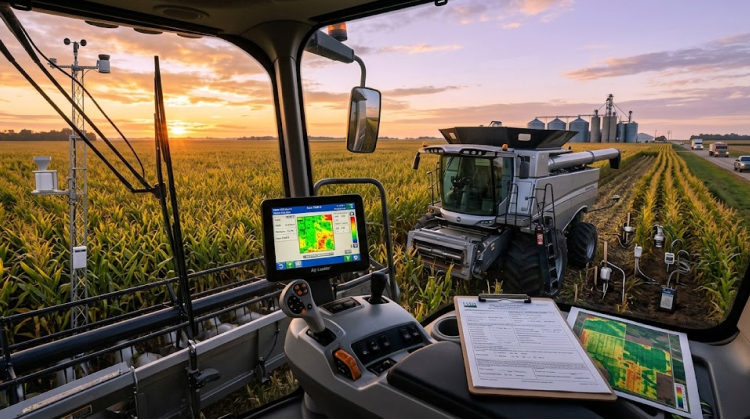
Farmers now have access to field-level information from yield monitors, satellite imagery, soil sensors, weather stations, machinery telemetry and farm-management platforms. That information can help producers make decisions at a much smaller geographic scale than traditional government statistics.
However, local farm data and national agricultural statistics serve different purposes.
A farmer can use a precision agriculture system to understand conditions in a specific field. USDA statistics provide a broader benchmark for understanding regional, state and national production.
The two layers can complement each other.
When USDA reports indicate declining yields in a particular region, producers can compare those estimates with their own field observations. When government data indicates unusually strong production, farmers and agronomists can evaluate whether their own measurements support that broader picture.
This makes data quality increasingly important as agriculture becomes more data-driven.
The agricultural sector is moving toward a system in which decisions are increasingly based on measurements rather than assumptions. Government statistics remain one of the major reference points within that ecosystem.
Trade Data Requires Particular Attention
International trade is another area where reporting accuracy can have immediate consequences.
USDA’s Foreign Agricultural Service maintains the Foreign Agricultural Trade of the United States database, which provides agricultural export and import values and volumes by commodity and country. The database is updated regularly and includes long historical series extending back decades for many categories.
USDA also operates the Global Agricultural Trade System and weekly export-sales reporting tools, giving market participants several ways to monitor international demand.
That breadth is useful, but it also creates an important distinction between different datasets.
A weekly export-sales report, monthly trade database and longer-term agricultural forecast are not interchangeable. Each has a different purpose, timing and methodology.
Market participants therefore need to understand what a USDA number represents before interpreting what it means.
An apparent jump in weekly sales does not necessarily mean that monthly exports will rise by the same amount. A revision to one dataset does not automatically invalidate another. And a forecast should not be treated as a confirmed measurement of actual production.
This distinction becomes particularly important when headlines turn preliminary numbers into market narratives.
Transparency Will Matter More Than A Single Revision
The immediate USDA error will eventually become a historical footnote if the agency explains what happened and demonstrates that corrective measures are working.
The larger issue is transparency.
When a published number changes substantially, users need to know why it changed. Was the problem caused by data entry? A processing system? Late reporting? A methodological adjustment? A communication problem between offices?
Those distinctions matter because each requires a different solution.
USDA’s existing methodology already recognizes that revisions can occur when additional information becomes available. Its crop-production documentation states that estimates may be revised when new information justifies a change.
A normal revision and a processing error are not the same thing.
A revision can represent better information becoming available. A processing error means the original published figure did not accurately reflect the information USDA intended to report.
Maintaining that distinction is essential for market participants.
Farmers Need Data They Can Use, Not Just More Data
The debate over USDA accuracy ultimately returns to the producer.
A farmer does not need an endless stream of statistics. The more valuable resource is reliable information that can support a decision.
A corn producer deciding when to market grain needs a reasonable assessment of national production, stocks, exports and demand. A cattle producer deciding whether to retain heifers needs dependable information about herd inventories, slaughter and beef demand. A lender evaluating a farm operation needs confidence that market benchmarks are not being distorted by avoidable reporting mistakes.
That makes data quality an economic issue.
USDA’s own methodology describes agricultural statistics as inputs into marketing decisions, farm loans, insurance, government programs and international trade.
The recent controversy therefore deserves attention without turning one mistake into a judgment about every USDA report.
The strongest response would be a transparent examination of how the beef export error occurred, what quality-control steps failed, how quickly the problem was identified and whether staffing or processing changes require additional safeguards.
As U.S. agriculture becomes more dependent on real-time information, trust in the numbers becomes part of the farm economy itself.
The USDA data system remains one of the most important information networks in American agriculture. Its value depends on the same principle that applies to precision farming, crop monitoring and financial analysis: better decisions begin with better measurements.
For producers, traders and agribusinesses, the lesson from the August 2026 controversy is not to ignore USDA statistics. It is to understand their methodology, watch revisions, compare multiple sources and recognize the difference between an estimate, a forecast and a confirmed result.
That approach makes federal agricultural data more useful while keeping its limitations visible.
USDA National Agricultural Statistics Service remains the primary reference point for understanding how many of the country’s major agricultural estimates are collected, reviewed and published.