The Trump administration has announced an $8 billion federal assistance program aimed at helping American farmers manage rising fuel expenses and other production costs during the 2026 harvest season. President Donald Trump and U.S. Agriculture Secretary Brooke L. Rollins announced the Harvest Fuel Relief (HFR) program on October 19, 2026, with the U.S. Department of Agriculture (USDA) planning to distribute one-time payments through its Farm Service Agency (FSA).
The announcement arrives at a difficult point in the agricultural calendar. Farmers are operating combines, grain dryers, tractors, irrigation systems, and trucks while managing expenses for fertilizer, machinery, labor, and crop transportation. When fuel prices rise while commodity prices remain under pressure, even a productive harvest may deliver weaker financial results than expected.
However, the $8 billion announcement is not the same as a payment guarantee for every farm. USDA has described a formula-based program intended to cover a portion of modeled losses during the 2026 crop year. As of October 26, commodity-specific rates for major covered crops have not yet been published, and USDA has not announced the application period. Farmers should therefore treat the program as a significant federal aid commitment while waiting for the eligibility rules, payment calculations, and enrollment instructions that determine what they can actually receive.
What Is the $8 Billion Harvest Fuel Relief Program?
USDA announced the Harvest Fuel Relief program on October 19 as a one-time payment initiative intended to provide support during temporary market disruptions and increased agricultural input costs. The department says the program will use a uniform formula to distribute assistance proportionally, rather than reimburse each producer dollar for dollar for every gallon of diesel purchased.
The program is authorized under the Commodity Credit Corporation (CCC) Charter Act and will be administered by USDA’s Farm Service Agency. This gives the department an established administrative structure for handling farm support, although producers will still need to follow the program’s specific application and documentation requirements once they are released.
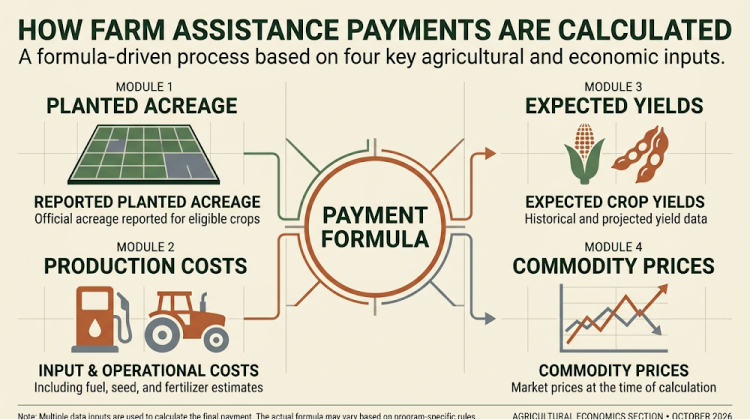
According to the official USDA announcement, the formula will draw on three central sources of agricultural data:
- Planted acreage reported to FSA, which provides the acreage information used in calculating support.
- USDA Economic Research Service cost-of-production estimates, which help establish modeled production expenses.
- USDA World Agricultural Supply and Demand Estimates (WASDE) yields and prices, which provide crop-market assumptions for the loss calculations.
These inputs suggest that the program is intended to estimate losses across agricultural production rather than simply refund fuel receipts. That distinction matters: two farms that face similar diesel prices may not receive identical payments because acreage, crop mix, modeled costs, and expected crop revenue can differ.
USDA has said the program will cover a portion of modeled losses for the 2026 crop year. It has not yet published enough information to calculate a reliable individual payment estimate. Farmers should be cautious about unofficial payment calculators or claims that a particular dollar amount per acre has already been confirmed.
Why Fuel Costs Have Become a Major Farm Budget Concern
Diesel is a core operating expense for many U.S. farms. It powers tractors, combines, sprayers, grain trucks, and other equipment used throughout planting, crop maintenance, harvest, and delivery. Natural-gas and petroleum markets also influence the broader cost of producing and transporting agricultural inputs, although fuel is only one part of the farm’s overall expense structure.

A sharp increase in diesel prices can affect a farm several times within one crop cycle. A grower may pay more to harvest a field, move grain to a storage site, dry crops after harvest, and transport the crop to a processor or export terminal. Livestock operations may also face higher costs for feed delivery, manure handling, machinery, and transportation.
CBS News reported on October 20 that the U.S. average diesel price had reached $6.53 per gallon on September 22 before easing to approximately $6.32 per gallon. The report compared that later figure with $3.62 per gallon a year earlier, illustrating the scale of the cost pressure facing fuel-dependent businesses. These are reported national averages, not the price every farmer pays at the local pump or through a bulk fuel contract. Regional prices, delivery charges, and purchasing arrangements can produce different results.
Source: CBS News — Trump pledges $8 billion in relief for farmers struggling with soaring diesel prices.
For a farm operating several large machines during a compressed harvest window, the financial effect can be substantial. Harvesting cannot always be postponed until fuel becomes cheaper: weather, crop maturity, soil conditions, labor availability, and equipment scheduling all influence when fields need to be completed. In some cases, waiting may expose crops to additional weather risk or reduce quality.
The key issue is the relationship between higher operating costs and crop revenue. If corn, soybeans, wheat, or other commodities sell at prices that do not fully compensate for increased expenses, farmers can experience weaker margins even when yields are reasonable. Federal assistance may soften part of that pressure, but it cannot eliminate all the risks associated with fuel prices, market volatility, weather, and borrowing costs.
How Will USDA Calculate Harvest Fuel Relief Payments?
USDA says the program will follow a proportional formula similar in broad design to the Farmer Bridge Assistance program. It will use reported planted acres, estimated production costs, and WASDE yields and prices to model losses for the 2026 crop year.
This framework makes crop-specific payment rates particularly important. Acreage is only one part of the calculation. The formula’s assumptions about production expenses, expected yields, and commodity prices will help determine how the $8 billion pool is allocated across eligible production.
As of October 26, USDA had stated that payment rates for Title I commodities would be released in November. Title I crops include major agricultural commodities covered by federal farm-program legislation, such as corn, soybeans, wheat, cotton, sorghum, and other eligible crops. Farmers should check the final USDA list rather than assume every crop or agricultural activity will receive the same treatment.
The payment methodology for other eligible commodities is expected to be announced later. USDA has specifically encouraged producers outside the Title I commodity group, including specialty crop growers and fishermen, to submit information about increased fuel expenses for consideration as payment rates are developed.
There are several practical implications for farm planning.
First, producers should not assume the $8 billion will be divided equally among all farms. The announced formula is proportional, and final rates will depend on USDA’s calculations and eligibility rules.
Second, the headline amount does not indicate what any one producer will receive. A farm’s acreage, crop type, and the applicable payment rate will matter, but the complete formula and limits must be confirmed in USDA’s detailed guidance.
Third, farmers should avoid building an expected payment into cash-flow projections before the amount and timing are known. It may be reasonable to monitor the program as a possible source of assistance, but loan repayment, input purchases, and grain-marketing decisions should account for the possibility that payments arrive later than expected or cover less than the farm’s additional costs.
The industry publication S&P Global’s October 20 report also noted that the Title I payment rates were expected in November and that details for other eligible commodities would follow at a later date.
Who May Qualify for the Program?
The USDA announcement describes one-time support for eligible American farmers, but producers should not interpret that broad description as a final determination of eligibility. The department has not yet released all application instructions, payment rates, or commodity-specific methodologies.
Farmers producing eligible Title I commodities should monitor the forthcoming USDA announcements for the official rate schedule and enrollment process. Specialty crop producers and other non-Title I operations should pay close attention to later guidance, since their payment methodology has not yet been fully specified.
USDA has also clarified that participation in crop insurance will not be required for Harvest Fuel Relief. This is an important distinction for producers who do not hold a qualifying crop insurance policy, but it does not mean every farm will automatically qualify. Other program requirements may apply once the FSA publishes the complete rules.
The department is encouraging eligible producers to create a Login.gov account and link it to their USDA records before applications open. USDA says producers with linked accounts will be able to access pre-filled applications online. Preparing an account in advance may reduce administrative delays when the application period is announced.
Farmers should also make sure their farm and acreage information is current with FSA. Because reported planted acreage is one of the inputs USDA identified for the formula, discrepancies in records could create unnecessary problems when a producer tries to access a federal program. Producers with questions about their records can contact their local FSA service center for guidance.
At this stage, farmers should rely on USDA’s official program updates rather than social media posts, unofficial payment estimates, or third-party services promising guaranteed enrollment. No final individual payment amount can be established from the $8 billion announcement alone.
What Specialty Crop Growers and Other Producers Should Do
USDA has explicitly invited producers of non-Title I commodities, including specialty crop growers and fishermen, to provide information about increased fuel costs. The department has listed HarvestFuel@usda.gov as the email address for submitting that information for consideration during the development of payment rates.
This request is especially relevant to producers whose operating expenses do not fit neatly into the cost patterns of major row crops. Specialty crop operations may rely on irrigation pumps, refrigerated storage, greenhouse heating, packing facilities, repeated field passes, and time-sensitive transportation. Those expenses can vary widely by crop, region, and production system.
Producers who submit information should provide a clear and accurate description of their operation and the fuel-cost pressures they have experienced. Relevant records may include fuel invoices, delivery receipts, farm expense summaries, and comparisons with earlier periods, where available. These records can also help with general budgeting and discussions with lenders, regardless of whether a particular expense is ultimately considered under the program.
Submitting information does not guarantee eligibility or a specific payment. USDA has said that the data will be considered when determining payment rates, while the final methodology for other eligible commodities remains forthcoming. Growers should therefore continue following the official announcements and retain their underlying business records.
How Harvest Fuel Relief Fits Into Other Federal Farm Assistance
The $8 billion program follows other substantial federal support announced or delivered during 2026. According to USDA, the Farmer Bridge Assistance program delivered $12 billion in one-time bridge payments to more than 560,000 farmers earlier in the year. The department also reported nearly $14 billion in gross payments through the Agriculture Risk Coverage (ARC) and Price Loss Coverage (PLC) programs in early October.
USDA said those ARC and PLC payments represented an increase of approximately $8 billion over what producers would have received without the Working Families Tax Cuts Act. These figures describe different programs and should not be treated as a single payment available to every farm. Eligibility, timing, and calculation methods vary across the initiatives.
The Harvest Fuel Relief program adds another layer of support, this time with a stated emphasis on temporary market disruptions and increased input costs during the 2026 crop year. Taken together, the measures show the scale of federal attention to farm finances, but they also underline the importance of distinguishing between announced funding, allocated funds, and assistance actually received by a specific producer.
The long-term question is whether one-time payments can help farms bridge a difficult season without addressing the underlying causes of financial pressure. Fuel prices can change quickly, while fertilizer, equipment, labor, interest, and land costs influence production budgets over longer periods. Commodity prices may also shift between the time a farmer makes planting decisions and the time the crop is sold.
For producers developing a longer-term business plan, modern agricultural planning and farm design can complement financial monitoring by helping organize equipment use, field operations, storage decisions, and resource allocation. Such planning does not replace financial aid, but it can help farms evaluate how operational choices affect costs and resilience.
What Farmers Should Do Before Applications Open
With commodity-specific payment rates expected in November and the application period not yet announced as of October 26, farmers can take several practical steps without assuming that funding is already available.
Prepare USDA account access. Create a Login.gov account and link it to USDA records as the department recommends. Confirm that the person responsible for program applications can access the account.
Review acreage and farm records. Check that planted acreage and other farm information reported to FSA are accurate. Resolve discrepancies early rather than waiting until an enrollment deadline is announced.
Organize fuel-cost documentation. Keep diesel invoices, bulk-fuel receipts, and operating expense records accessible. These documents may support farm budgeting and can be useful if the final program guidance requests additional information.
Monitor official payment rates. USDA has said Title I commodity rates will be released in November. Wait for the published schedule and methodology before estimating a payment or committing the funds to a particular expense.
Keep cash-flow forecasts conservative. Plan for fuel, labor, repairs, drying, storage, and transportation costs using realistic assumptions. Treat possible HFR funds as uncertain until eligibility, payment amounts, and timing are confirmed.
Specialty crop producers should consider submitting cost information. USDA has invited non-Title I producers to send increased fuel-cost data to HarvestFuel@usda.gov for consideration as payment methodologies are developed.
The official source for program announcements is the USDA Harvest Fuel Relief announcement. Farmers can also contact their local FSA office for help reviewing their records and following application updates.
What the $8 Billion Program Could Mean for the 2026 Harvest
The Harvest Fuel Relief program could provide meaningful assistance to eligible producers facing unusually high fuel and other input costs, but its actual impact will depend on the final payment rates, distribution formula, eligibility rules, and timing. The $8 billion headline is significant; it is not a promise that every farm will recover its additional fuel expenses.
For farms operating on tight margins, a one-time payment may help cover part of a fuel bill, repair expense, or other harvest cost. It may also give some producers additional flexibility while they market grain or prepare financial plans for the next crop year. Yet payments cannot guarantee profitability when commodity prices are weak, yields fall short, or operating expenses remain elevated.
The next important milestone is USDA’s release of Title I commodity-specific payment rates in November, followed by further guidance for other eligible commodities and the application period. Until those details are published, the most useful approach is to keep records accurate, prepare account access, document costs, and avoid relying on unconfirmed payment estimates.
The program offers a potential bridge through a demanding harvest season. Its real value to American agriculture will become clearer when farmers can see how the formula applies to their crops and when the payments can actually reach their operations.